ARTS / CULTURE & LEISURE
China’s social media fuels a surreal Nordic-inspired frozen lake experience
Ice floating drifts into winter sports
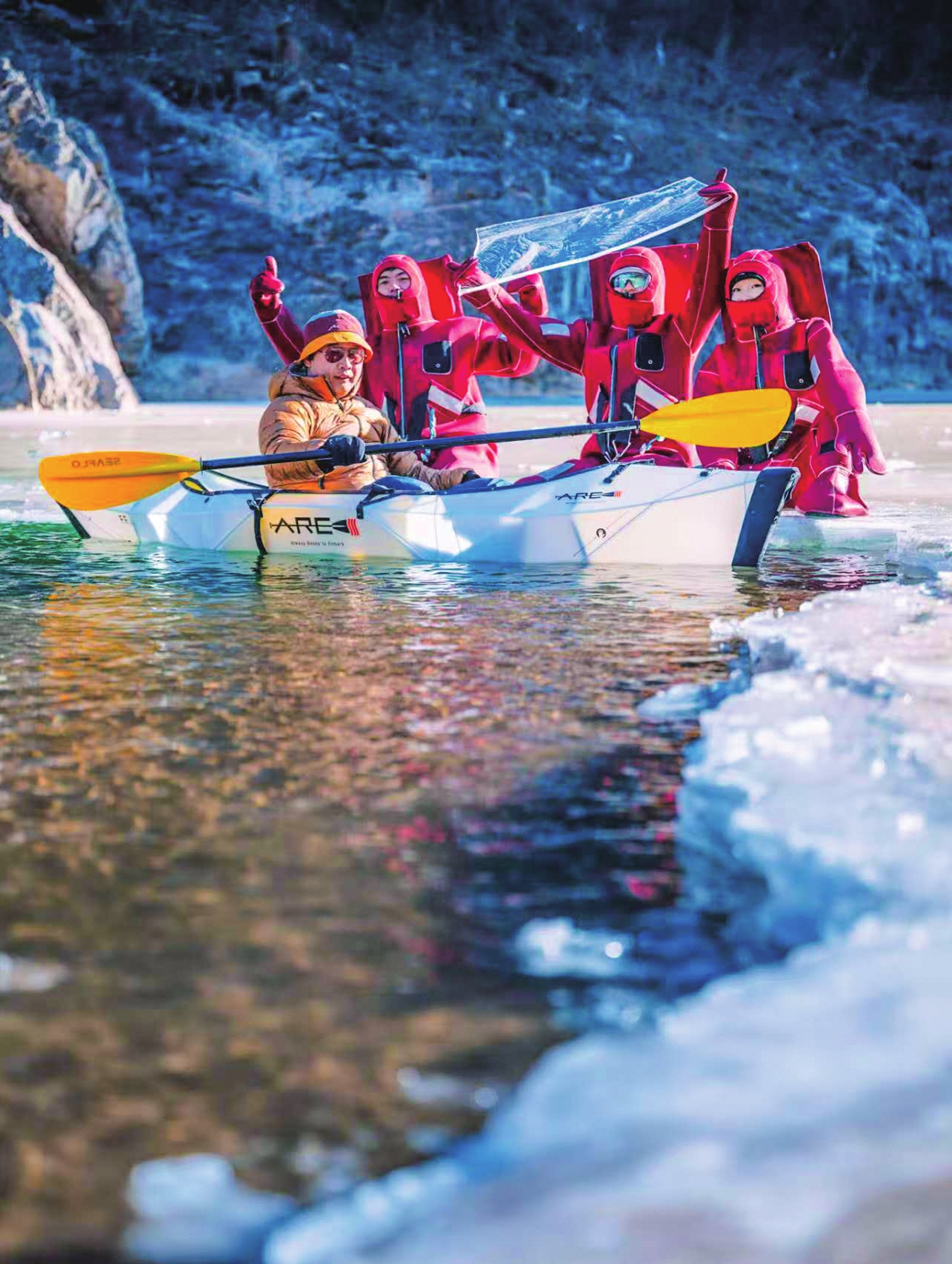
Ice floating participants pose for a group photo on January 11, 2026 in Miyun district, Beijing. Photos on this page: Courtesy of Da Yu
Lying on her back between jagged slabs of ice, Wang Yanze felt an unexpected warmth envelop her body. Beneath her, icy water pressed against the surface of her suit. Above her, the winter sky stretched, endlessly blue.From the air, the scene was eye-catching: several red figures scattered across a frozen lake, floating silently like tiny crimson crayfish trapped in ice.
This is ice floating, a once niche winter activity that has quietly surged into China's social media spotlight, becoming one of the country's hottest cold-weather experiences this winter.
For Wang, a 30-year-old based in Hangzhou, East China's Zhejiang Province, the appeal was immediate.
"I saw it becoming popular on Xiaohongshu, or RedNote, and decided to go alone to Altay City in Xinjiang," she said.
"The whole experience lasts about 10 to 15 minutes. During that time, all you see is the blue sky. The air is incredibly clear. It feels like the whole world goes quiet." "That moment," she added, "was both relaxing and deeply relieving."
On Xiaohongshu, China's lifestyle-sharing platform, searches for "ice floating" yield numerous posts. Users pose in bulky, bright-red suits, affectionately dubbed "lobster suits," drifting across frozen rivers and lakes from Beijing's Liangma River to the snowbound landscapes of Xinjiang and Inner Mongolia autonomous regions.
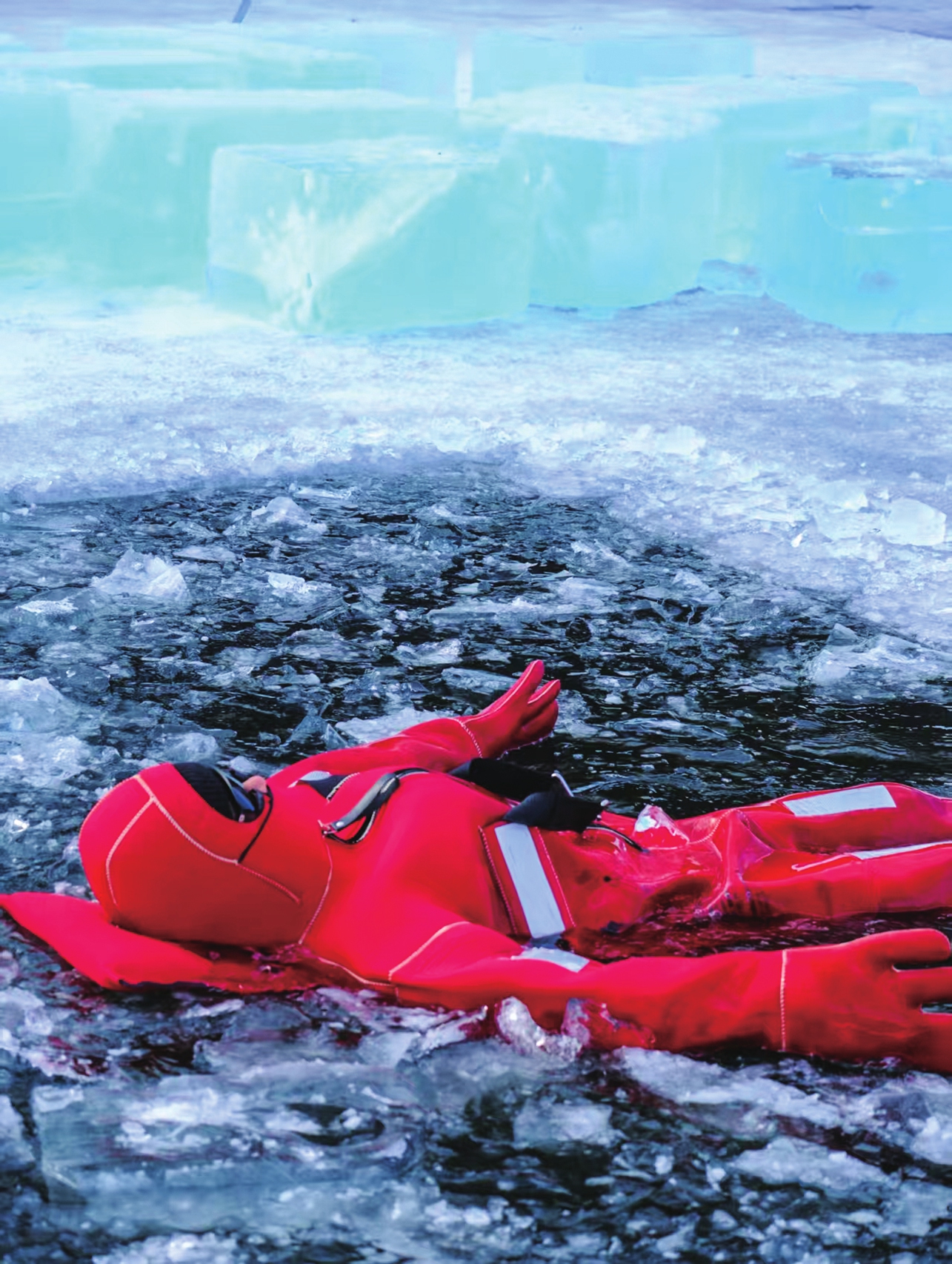
An individual tries ice floating on Monday in Yanqing district, Beijing.
Nordic import finds Chinese iceIce floating is not a new concept. The activity originated in high-latitude countries such as Norway, Finland and Russia, where participants don insulated suits and float calmly in icy waters, often amid snow-covered forests and frozen lakes. In recent years, the experience has been introduced to China, gradually transitioning from novelty to a niche tourism offering.
Unlike traditional winter sports such as skiing or ice skating, ice floating requires no athletic skills. Participants are guided by staff, dressed in full-body waterproof suits capable of retaining heat for up to eight hours, and gently lowered into an opening carved into thick ice.
Staff first give basic instructions on shore, explaining what is safe to do and what should be avoided. Then they gently guide participants from the ice into a carved-out pool, where bodies naturally begin to float. We can move slowly, mimicking paddling motions to navigate the water, Wang recalled.
"For me, ice floating isn't particularly thrilling. It's more of a unique life experience," Wang told the Global Times. Overall, it's a very safe and enjoyable activity.
Da Yu, an operator of an ice floating club in Beijing, believes the activity's popularity comes from a mix of factors.
"You don't need extra skills, and it photographs incredibly well," he said. "The contrast between the red suits and the ice and snow is very strong."
He also noted a seasonal gap. "Water sports are huge in summer, but in winter everything stops. Ice floating fills that void."
His club began offering ice floating services in December 2025 after noticing the activity's sudden surge in popularity, providing venues, equipment, training, safety supervision and professional photography - a full-package experience designed for social media-savvy customers.
Altay emerges as hub
In November 2025, China's first dedicated ice floating club officially opened in Altay.
Cheng Hou, the club's founder, told the Global Times that Altay was a natural choice.
"Altay is recognized as the birthplace of human skiing," Cheng said.
"It meets all the requirements for ice floating - the climate, the duration of freezing and the thickness of the ice."
According to Cheng, the club now receives more than 100 visitors per day. While most are domestic tourists, there is a growing number of international visitors, particularly from Southeast Asia.
A standard ticket costs about 300 yuan ($43.1), including group photos. Additional photography services are available for an extra fee, an option many visitors choose.
To prevent hypothermia or frostbite, the club employs trained instructors, safety personnel and on-site rescue teams. Participants receive instructions on land before entering the water, including which movements are allowed and which should be avoided.
Staff members then carefully guide participants from the ice edge into the water, where buoyancy takes over and bodies begin to float effortlessly.
Niche with momentum
Despite its viral popularity, ice floating remains a small segment of China's winter sports market. Cheng acknowledges that the industry is still in its early stages. But he is optimistic about the future.
He sees ice floating as a potential "off-season breakthrough" for winter tourism, aligning with China's broader push to develop ice-and-snow industries.
Local governments in Northwest China's Xinjiang Uygur Autonomous Region are actively promoting "ice and snow plus culture and tourism" initiatives, aiming to extend the winter travel season and diversify offerings beyond skiing.
Still, Cheng emphasized the need for clearer regulations and industry standards as the activity grows.
"For it to develop healthily," he said, "we need more regulation and standardization."
Luo Le, a sports scholar at the Beijing University of Chemical Technology, told the Global Times that ice floating's rise reflects broader shifts in China's leisure culture.
As incomes grow and lifestyles diversify, consumers are increasingly drawn to novel, photogenic activities that emphasize experience over competition.
"In recent years, we've seen trends move from frisbee to flag football, then to pickleball," added Luo.
"Ice floating fits this pattern. It's highly social, visually distinctive and easy to participate in."
In addition, the public's growing interest in ice and snow sports is creating space for newer activities like ice floating to flourish, remarked Luo.
RELATED ARTICLES