From extreme cold tests to growth engine: Heihe anchors China’s ice-and-snow economy expansion through NEV testing
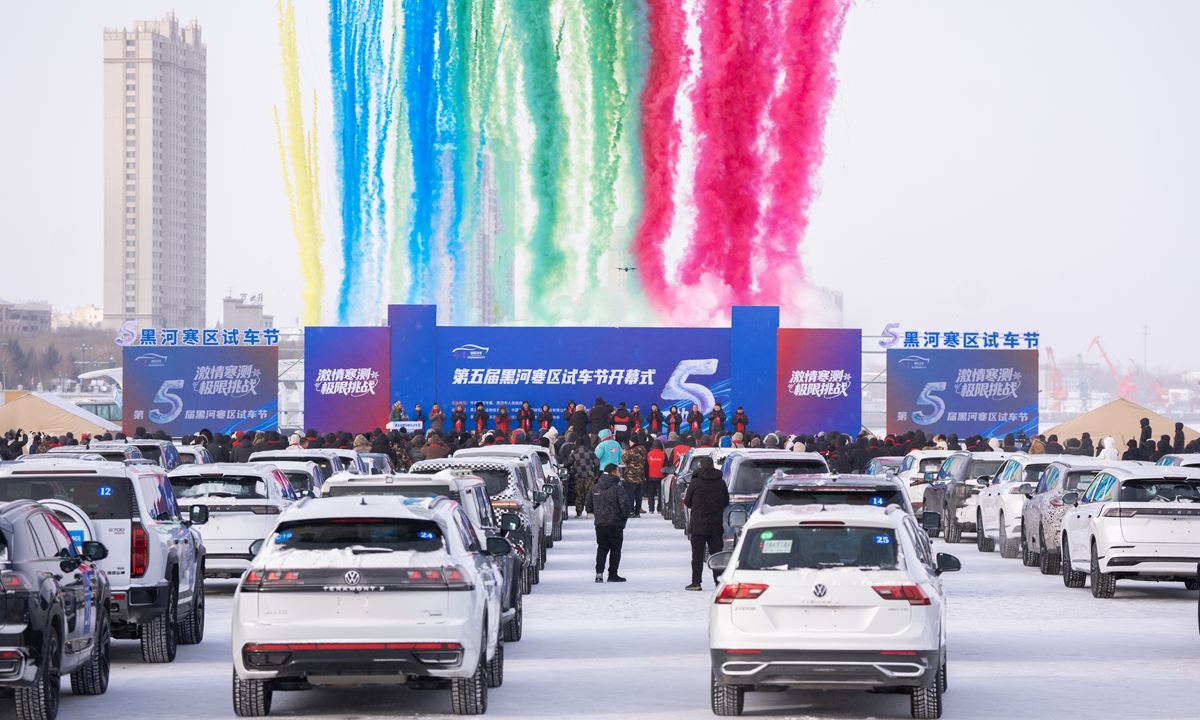
Colorful fireworks light up the sky during the opening ceremony of the Heihe cold-weather vehicle testing festival on January 17, 2026, marking the start of the event. Photo: Courtesy of Heihe Municipal Government
Woods covered with snow, river capped by thick ice at a temperature of - 30 C, Heihe in Northeast China's Heilongjiang, has just witnessed a contest of vehicles, technology and local economic vitality, which showcases how EV boom has written a new connotation in the country's prospering ice-and-snow economy at this border city.From Wednesday to Sunday, the small city on the China-Russia border mobilized its resources to host a five-day vehicle testing festival under extreme cold weather as Heihe leverages its harsh climate to ensure that China-made vehicles can operate reliably in extreme cold.
The event also marked the city's latest effort to tap the potential of its ice-and-snow economy as the testing festival also featured investment promotion activities aimed at attracting new projects and partners.
A Festival of vehicle testing
"Turning vehicle testing into a festival — this is something unique to Heihe," a participating technician told the Global Times at the event venue, with excitement evident on his frost-reddened face.
According to the Heihe municipal government website, the city's average winter temperature stands at - 20.5 C, with extreme lows reaching - 48 C. It experiences more than 100 days of severe cold and 143 days with snow cover annually. Conditions considered inhospitable are ideal to test the performance of vehicles in extreme environments.
The fifth Heihe Cold-Weather Vehicle Testing Festival also incorporated racing events, professional skills competitions, as well as cultural, tourism and sports elements, accelerating the conversion of ice-and-snow resources into industrial advantages and economic momentum.
At Saturday's opening ceremony, rows of vehicles undergoing winter testing stretched as far as the eye could see. Models from Chinese automakers such as Geely, Xiaomi and Aito stood alongside international brands including Audi, Lotus and Volkswagen. Light snow blanketed each vehicle under swirling flurries, giving the scene the look of an inspection lineup rather than a conventional festival launch.
On the same day, Heihe organized NEV parades and test drives on the frozen Heilongjiang River, turning the ice-sealed waterway into a dramatic testing stage and drawing gasps from onlookers.
The vehicle testing festival is made possible with the city's established cold-weather testing facilities. According to the Xinhua News Agency, Heihe has fostered 14 cold-weather testing enterprises, built 34 specialized testing bases, and developed more than 120 test roads—including ABS tracks, cobblestone roads and ice-handling courses—gradually forming a comprehensive, standardized cold-weather testing network.
At the opening ceremony, Heihe Mayor Qin Bo said the city's cold-weather testing industry has undergone more than three decades of sustained development, with expanding scale and steadily rising influence. The sector has evolved from seasonal to year-round operations, from vehicle testing to equipment testing, and from serving domestic models to accommodating international-brand vehicles.
Heihe has become the country's primary cold-weather testing base, undertaking more than 80 percent of the nation's such tests and establishing stable partnerships with over 170 automakers and research institutions. Between 2022 and 2025, the cold-weather testing industry drove cumulative related income growth exceeding 1.7 billion yuan ($244 million), making it the core engine of the local ice-and-snow economy, Qin said.
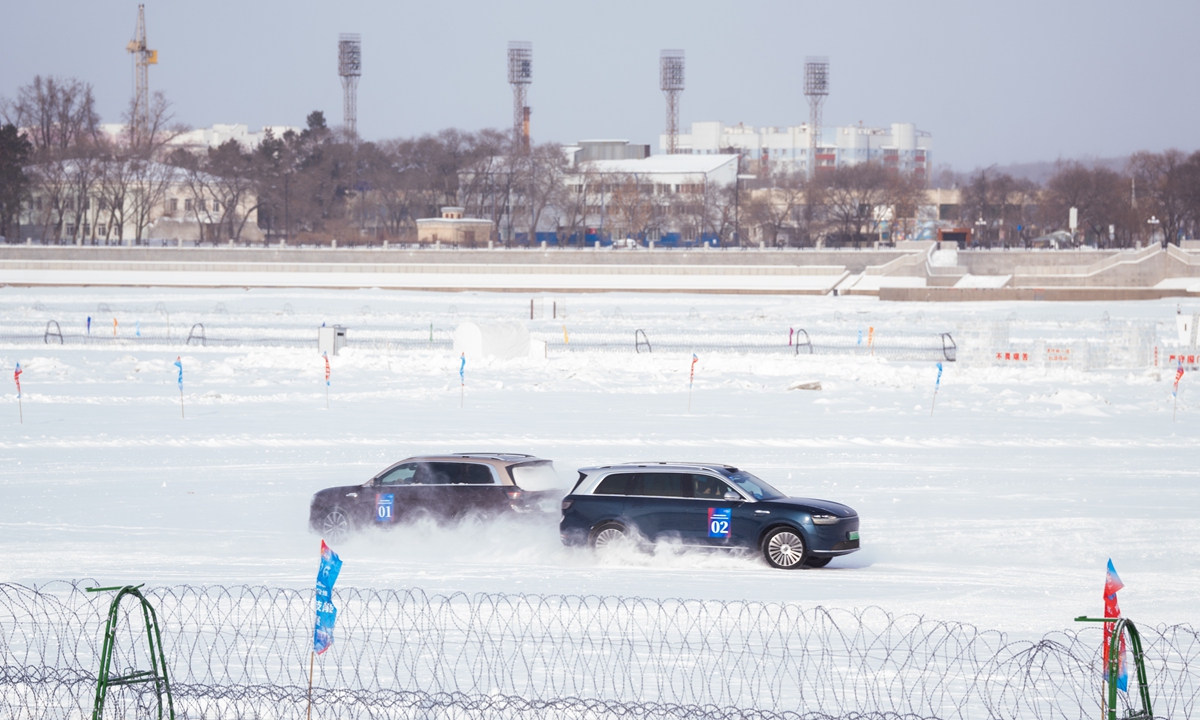
China-made new energy vehicles put on a performance on the ice-covered surface of the Heilongjiang River during the opening ceremony of the Heihe cold-weather vehicle testing festival on January 17, 2026. Photo: Courtesy of Heihe Municipal Government
Snow developed opportunitiesTaking the vehicle testing industry as a starting point, Heihe and its affiliated districts explored new development opportunities under the theme of ice and snow.
Heihe now has achieved full-scenario cold-weather testing coverage. Asia's largest mobile ice-wind tunnel has established in the city's Wudalianchi district. The C919 passenger jet, China's first domestically developed large passenger jet, has completied its northernmost test flight in the region, Mayor Qin said, adding that testing has also extended to emerging fields such as drones and flying cars.
Meanwhile, the integrated model of "testing plus tourism plus competitions" is gaining momentum, providing broad space for industrial synergy, Qin noted.
Such efforts were also reflected following this year's vehicle testing festival in Heihe. Beyond activities directly related to the auto testing industry, the city on Sunday hosted an ice running race on the frozen Heilongjiang River, the boundary river between China and Russia. A total of 320 participants from the two countries took part in the cross-border event. Benefiting from the implementation of the China-Russia mutual visa-free policy, the unique ice run on the boundary river has emerged as a new highlight of border cultural and tourism exchanges.
China's ice-and-snow economy is now benefiting from both policy support and market demand. A guideline issued by the General Office of the State Council targets an overall ice-and-snow economy scale of 1.5 trillion yuan by 2030, while a recently released report by China Tourism Academy said that the scale of the country's ice and snow economy exceeded 1 trillion yuan in 2025.
Against this backdrop, more cities like Heihe are grasping this trend, transforming unique conditions to momentum of growth. From the snow-themed park Ice and Snow World in Harbin, Northeast China's Heilongjiang to the newly built ski resort in Hemu, Northwest China's Xinjiang Uygur Autonomous Region, China is witnessing a heated momentum of ice-and-snow economy.
"Looking ahead, we will promote deeper integration between vehicle testing and tourism, culture and sports," Wang Yulong, head of Heihe's Bureau of Industry and Information Technology, told the Global Times. "By fostering diversified models that combine cold-weather testing with ice-and-snow tourism, the testing industry will become a new engine for Heihe's ice-and-snow economy."
RELATED ARTICLES