2025 sees China's grain output at new high; country to leverage tech for higher rural incomes
Hard-won achievement reflects surge in corn crop, tech benefits
By Published: Jan 22, 2026 10:03 PM

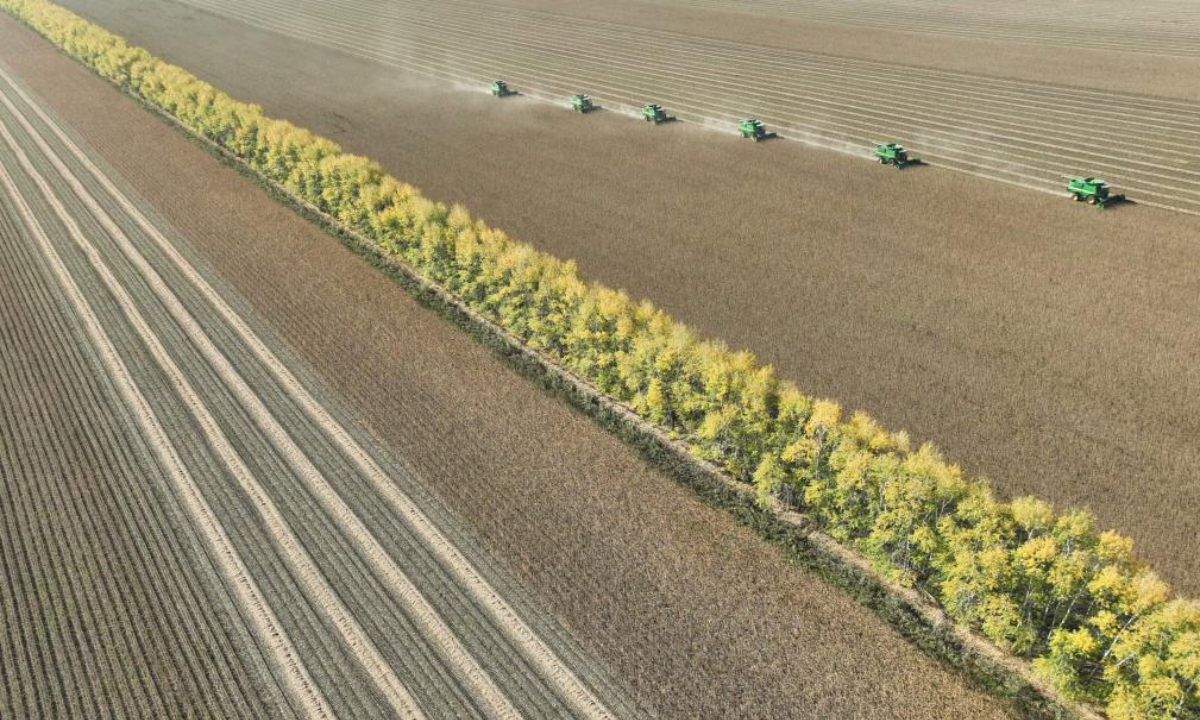
An aerial drone photo shows harvesters working at a soybean field of a farming company under Beidahuang Group in northeast China's Heilongjiang Province, Sept. 30, 2025. Heilongjiang Province, a major grain producer in northeast China, saw its 22nd bumper harvest with a record-breaking grain output reaching 82 million tonnes this year, data from the National Bureau of Statistics (NBS) showed on Friday. After surpassing 80 million tonnes in total grain production in 2024, Heilongjiang has once again topped the record this year, marking its 16th straight year as the top grain-producing region in China, according to the provincial agriculture and rural affairs department. (Photo by Lin Jinchun/Xinhua)
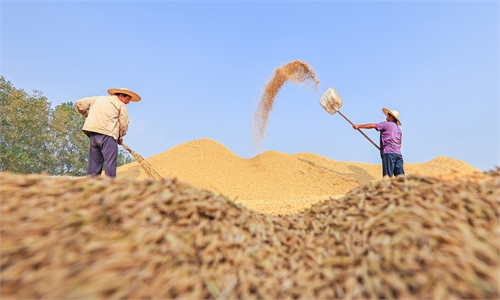
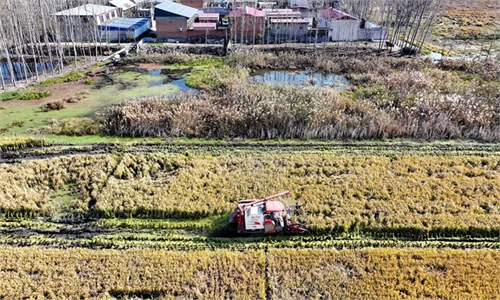
China recorded another bumper grain harvest last year, with grain production reaching about 714.9 million tons and pushing output to a new high despite bouts of drought, flooding and prolonged rainfall in parts of the country, official data showed on Thursday.
The figures were announced by officials of the Ministry of Agriculture and Rural Affairs at a State Council Information Office press conference, who declared that China's agricultural and rural development maintained a momentum of steady progress with a good outlook in the past year. Both the 2025 annual targets and all tasks for the 14th Five-Year Plan (2021-25) period were successfully accomplished.
In 2025, grain production reached 714.9 million tons, a rise of 8.4 million tons from a year earlier, according to the ministry. The output has remained above 700 million tons for two consecutive years.
In 2026, efforts will focus on accelerating agricultural and rural modernization, and solidly advancing the comprehensive revitalization of rural areas, Vice Minister of Agriculture and Rural Affairs Zhang Xingwang told the press conference.
The goal is to modernize agriculture into a robust industry, ensure that rural areas are basically equipped with modern living conditions, and make farmers' lives more prosperous and fulfilling. In all, the efforts aim to provide strong support for a good start and a solid first step in the 15th Five-Year Plan (2026-30) period, Zhang said.
Li Guoxiang, a research fellow at the Rural Development Institute of the Chinese Academy of Social Sciences, told the Global Times on Thursday that the achievement is hard-won, marking a new stage reached by China's agriculture industry as it played a vital supporting role in promoting the country's overall high-quality development.
According to officials from the ministry, last year's increase in grain output primarily stemmed from the following factors. In terms of crop varieties, the main contribution came from corn, with its output rising by 63.2 million tons, accounting for 75 percent of the annual total grain increment.
Overall, the steady growth in grain production in recent years came from the promotion of large-scale per-unit yield increases in grain, Zhang said.
According to expert assessments, the increase in per-unit yields contributed to more than 90 percent of the national grain output growth in 2025. This means that on a largely stable cultivation area, the production increase was primarily achieved through large-scale enhancements in per-unit yields.
Soybean production reached 20.91 million tons, remaining stable at more than 20 million tons for four consecutive years.
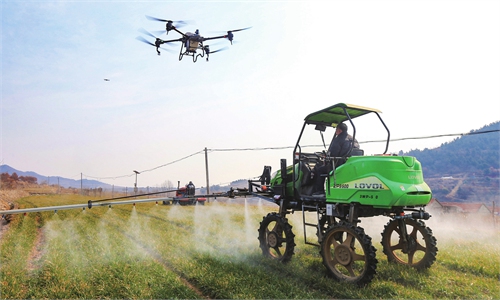
The increase also came from sizeable support from the adaptation of advanced technologies, including the accelerated layout of the "AI + agriculture" program, and the application of large models for smart agriculture that were continuously iterated and applied.
In 2025, China's agricultural modernization gained pace with strengthened technological support, with the contribution rate of agricultural scientific and technological progress exceeding 64 percent, Zhang said.
In 2025, the expansion of soybean and oilseed cultivation was consistently solidified, with soybean output reaching 20.91 million tons, maintaining a level above 20 million tons for the fourth consecutive year.
"We will continue to promote the application of artificial intelligence and other technologies in the agricultural sector, expanding the use of drones, the Internet of Things, robots, and other scenarios to make production more precise and efficient," Zhang said.
The fundamental advancement of agriculture in China relies on technological breakthroughs to overcome constraints imposed by the country's resources and environmental conditions, Li said.
"Today, consumers demand not only good, nutritious, and healthy food but also delicious food with excellent flavor. Ensuring good quality depends on technology. On the efficiency front, technology also helps ensure producers can make a profit, which is essential for maintaining their motivation."
The development of smart technology, smart agriculture, and digitalization are essential. This process will help replace labor to address the issue of the shrinking rural population, Li said.
In addition to the continuous level of the harvest, progress in agricultural technology, agricultural and rural work also saw an overall improvement in 2025, paving the way for its steady growth in the new year.
According to data released by the National Bureau of Statistics, the per capita disposable income of rural residents reached 24,456 yuan ($3,500), showing real growth of 6 percent year-on-year.
The year 2025 marked the final year of the five-year transition period for effectively consolidating and expanding the achievements in poverty alleviation and linking them with rural revitalization.
As of the end of 2025, more than 7 million monitored individuals or households had received targeted assistance, with the risks of falling back into poverty or becoming impoverished steadily eliminated. Nationwide, the scale of employed migrant workers from households where poverty had been alleviated exceeded 32 million.
Analysts said that the development of the Chinese agricultural sector was closely associated with the steady attention given by the government.
The Central Economic Work Conference (CEWC), held in December, stipulated that coordination in development should be promoted to facilitate integrated urban-rural development and regional synergy.
The CEWC noted that coordinated steps should be taken to advance urbanization with a focus on counties and all-around rural revitalization, promoting the high-quality development of county economies.
Li Chang'an, a professor at the Academy of China Open Economy Studies at the University of International Business and Economics, told the Global Times on Thursday that ensuring food security is set to remain the top priority of the government's work agenda.
Meanwhile, policy is set to pivot to increasing the incomes of rural residents in a timely manner, as rural areas still represent a significant weak link in the overall government goal of expanding domestic demand and consumption, the professor said.
"More efforts to enhance the overall competitiveness, knowledge, and skills of rural residents, including the training for migrant workers, are also expected to be further strengthened as the country pursues high-quality development," he added.
RELATED ARTICLES