ARTS / CULTURE & LEISURE
China’s new parents bring tradition into modern naming conventions
Life’s first gift
Editor's Note:
In contemporary China, an increasing number of names draw inspiration from Chinese history and classical texts. From high-tech products to newborns, names offer a window into the nation's rich cultural heritage and ongoing development.
To unpack the allure behind these names, the Global Times has launched the Chinese Calling Card trilogy. The third installment will inquire how names for ordinary Chinese people have changed over the generations and how shifts in naming preferences reflect a "microcosm" of societal change.
The name "Chirou," (lit: harness/and soft/gentle) draws from a line from Chapter 43 of the classic that speaks to the quiet power of softness: "The way of the gentlest of things can master the hardest." "I want my daughter to carry this quiet strength within her," Cheng told the Global Times.
She added that the name is the "first life gift" to her daughter, and a name that "carries cultural tradition is a gift beyond value."
Like Cheng, a growing number of parents, especially from the post-1990 generation, are now naming their children with cultural allusions to tradition. And this trend can be seen in lists of "2025 newborn names" recently released by public authorities across multiple provinces, such as Yunnan and Sichuan.
Self-expression
Looking at the 2025 newborn names in Yibin, Sichuan Province, given names like "Jincheng" and "Yanzhou" are trending on the list. The name "Jincheng" is rooted in the four-character Chinese idiom "Qiancheng Sijin," which means "the future is like brocade" and symbolizes "splendid prospects."
Another name, "Yanzhou" (lit: inkstone and boat), has an even more unique origin. It has roots in a line from a poem by Zeng Gong, a Northern Song Dynasty (960-1127) poet. In this poem, Zeng metaphorically compares an inkstone to a boat that carries thought, conveyed through brush and ink.
These poetic names, reminiscent of characters from Chinese costume dramas, have gained cross-regional popularity. "Yanzhou," for example, was also a popular name for newborns in Shaoxing's Yuecheng, Zhejiang Province.
One of the first-graders at the school had the name "Fusu." This name not only appears in China's oldest poem anthology the Book of Songs, but was also the name of the oldest son of Emperor Qinshihuang.
Cultural sociologist Xu Shumin told the Global Times that these names, be it the historically inspired "Fusu" or the poetic "Yanzhou," are not just a pursuit of "uniqueness," but rather a sign that "young parents are reclaiming traditional Chinese culture as a living aesthetic in everyday life."
"Parents of the post-1990 generation live in an era marked by parallel advances in technology and the revival of traditional culture. Just as they might wear Hanfu (a type of traditional Chinese clothing) to express themselves, naming their children is another form of expressing their cultural identity," Xu remarked.
He also noted that the shift in naming preferences is also a "microcosm" of societal change.
Beyond titles
Born in 1991, the 34-year-old Cheng Mengyue's name means "dreaming about the moon." It is representative of the names given to her generation.
Influenced by different cultures, particularly from TV dramas and literary works of China's Hong Kong Special Administrative Region and the island of Taiwan, parents of that era began to favor romanticized names and so characters such as "meng" (dream), "yu" (rain) and "han" (cultivation) frequently appeared in their children's names.
Going back a decade prior, names of the post-1980 generation frequently include characters like "wei" (great), "qiang" (powerful) and "jie" (excellence). These names, often consisting of just a single character, reflect the pioneering and resilient spirit prevalent during the early years of China's reform and opening-up.
For even older generations, particularly for those older parents who are deeply patriotic, their children's names are touchingly meaningful.
Feng "Aimin" (love the people), a 64-year-old foreign trade merchant, told the Global Times that she was the youngest of her three siblings. She has a brother whose name is Feng "Jianguo" (build the country) and a sister called Feng "Yongjun" (support the army).
"Living and working in the UK, everyone calls me 'Amy' now. But I always explain the meaning of my Chinese name to my British friends. It's my parents' way of reminding me never to forget where I came from and what I am," said Feng.
Just as Feng sees her name as a tether to her cultural roots, for her and most Chinese people, a name is far from a simple label. It is a significant act that blends family heritage and cultural aspirations. Sometimes, a name tells not only "who you are" but also "who you should be."
Located in Jinhua, Zhejiang Province, a village possesses a family genealogy that documents its history as the home of the descendants of Zhuge Liang, an ancient Chinese military strategist.
Zhuge Kunheng, the lead of the village, told the Global Times that every villager's name is derived from an 80-character poem.
Taking one poetry line, "An Yuan Fu Gui Chang" (peace, origin,happiness, wealth and prosperity) as an example, each character in it is used in rotation every five years. All individuals born within a certain five-year period share that specific character in their given names.
"I am fully aware that my name is unique, but it is not a token for showing off. Rather, it serves as a reminder of my responsibility as a descendant: to protect and preserve my family's heritage," said Zhuge Kunheng.
In contemporary China, an increasing number of names draw inspiration from Chinese history and classical texts. From high-tech products to newborns, names offer a window into the nation's rich cultural heritage and ongoing development.
To unpack the allure behind these names, the Global Times has launched the Chinese Calling Card trilogy. The third installment will inquire how names for ordinary Chinese people have changed over the generations and how shifts in naming preferences reflect a "microcosm" of societal change.
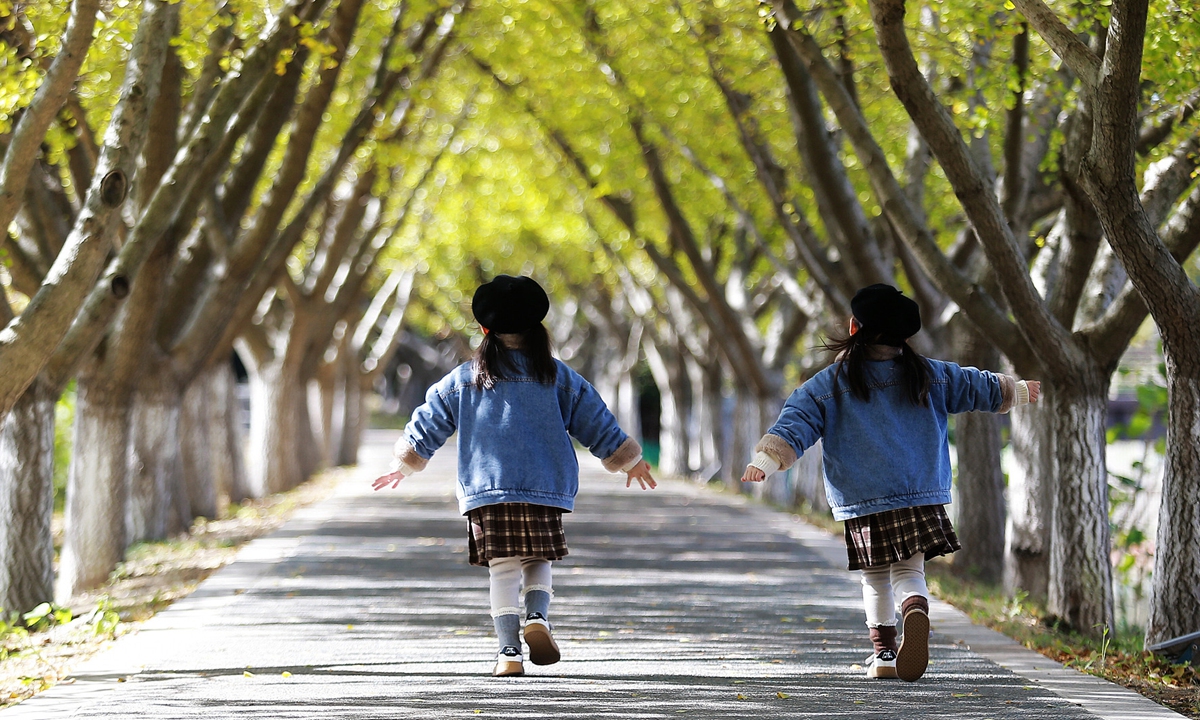
Two kids have fun on a street in Yangzhou, East China's Jiangsu Province. Photo: VCG
Inspired by the Chinese classic Tao Te Ching, a 34-year-old mother in Chengdu named Cheng Mengyue chose a name for her 3-and-a-half-year-old daughter that carries a philosophical touch: "Liao Chirou."The name "Chirou," (lit: harness/and soft/gentle) draws from a line from Chapter 43 of the classic that speaks to the quiet power of softness: "The way of the gentlest of things can master the hardest." "I want my daughter to carry this quiet strength within her," Cheng told the Global Times.
She added that the name is the "first life gift" to her daughter, and a name that "carries cultural tradition is a gift beyond value."
Like Cheng, a growing number of parents, especially from the post-1990 generation, are now naming their children with cultural allusions to tradition. And this trend can be seen in lists of "2025 newborn names" recently released by public authorities across multiple provinces, such as Yunnan and Sichuan.
Self-expression
Looking at the 2025 newborn names in Yibin, Sichuan Province, given names like "Jincheng" and "Yanzhou" are trending on the list. The name "Jincheng" is rooted in the four-character Chinese idiom "Qiancheng Sijin," which means "the future is like brocade" and symbolizes "splendid prospects."
Another name, "Yanzhou" (lit: inkstone and boat), has an even more unique origin. It has roots in a line from a poem by Zeng Gong, a Northern Song Dynasty (960-1127) poet. In this poem, Zeng metaphorically compares an inkstone to a boat that carries thought, conveyed through brush and ink.
These poetic names, reminiscent of characters from Chinese costume dramas, have gained cross-regional popularity. "Yanzhou," for example, was also a popular name for newborns in Shaoxing's Yuecheng, Zhejiang Province.
One of the first-graders at the school had the name "Fusu." This name not only appears in China's oldest poem anthology the Book of Songs, but was also the name of the oldest son of Emperor Qinshihuang.
Cultural sociologist Xu Shumin told the Global Times that these names, be it the historically inspired "Fusu" or the poetic "Yanzhou," are not just a pursuit of "uniqueness," but rather a sign that "young parents are reclaiming traditional Chinese culture as a living aesthetic in everyday life."
"Parents of the post-1990 generation live in an era marked by parallel advances in technology and the revival of traditional culture. Just as they might wear Hanfu (a type of traditional Chinese clothing) to express themselves, naming their children is another form of expressing their cultural identity," Xu remarked.
He also noted that the shift in naming preferences is also a "microcosm" of societal change.
Beyond titles
Born in 1991, the 34-year-old Cheng Mengyue's name means "dreaming about the moon." It is representative of the names given to her generation.
Influenced by different cultures, particularly from TV dramas and literary works of China's Hong Kong Special Administrative Region and the island of Taiwan, parents of that era began to favor romanticized names and so characters such as "meng" (dream), "yu" (rain) and "han" (cultivation) frequently appeared in their children's names.
Going back a decade prior, names of the post-1980 generation frequently include characters like "wei" (great), "qiang" (powerful) and "jie" (excellence). These names, often consisting of just a single character, reflect the pioneering and resilient spirit prevalent during the early years of China's reform and opening-up.
For even older generations, particularly for those older parents who are deeply patriotic, their children's names are touchingly meaningful.
Feng "Aimin" (love the people), a 64-year-old foreign trade merchant, told the Global Times that she was the youngest of her three siblings. She has a brother whose name is Feng "Jianguo" (build the country) and a sister called Feng "Yongjun" (support the army).
"Living and working in the UK, everyone calls me 'Amy' now. But I always explain the meaning of my Chinese name to my British friends. It's my parents' way of reminding me never to forget where I came from and what I am," said Feng.
Just as Feng sees her name as a tether to her cultural roots, for her and most Chinese people, a name is far from a simple label. It is a significant act that blends family heritage and cultural aspirations. Sometimes, a name tells not only "who you are" but also "who you should be."
Located in Jinhua, Zhejiang Province, a village possesses a family genealogy that documents its history as the home of the descendants of Zhuge Liang, an ancient Chinese military strategist.
Zhuge Kunheng, the lead of the village, told the Global Times that every villager's name is derived from an 80-character poem.
Taking one poetry line, "An Yuan Fu Gui Chang" (peace, origin,happiness, wealth and prosperity) as an example, each character in it is used in rotation every five years. All individuals born within a certain five-year period share that specific character in their given names.
"I am fully aware that my name is unique, but it is not a token for showing off. Rather, it serves as a reminder of my responsibility as a descendant: to protect and preserve my family's heritage," said Zhuge Kunheng.
RELATED ARTICLES