China’s voices receive significant attention in Davos as nation has many key assets in global economy: WEF official
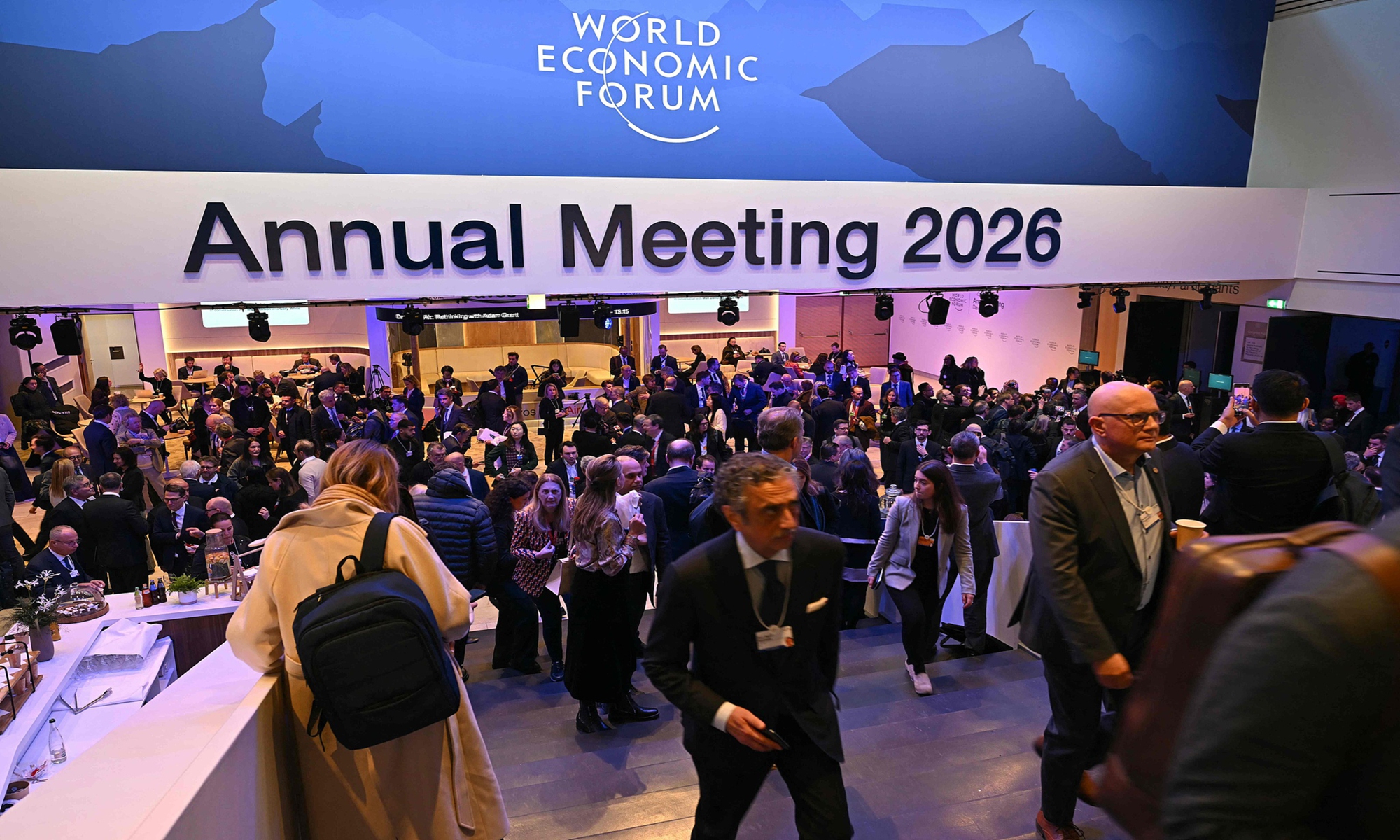
Visitors attend the World Economic Forum (WEF) annual meeting in Davos on January 20, 2026. The World Economic Forum takes place in Davos from January 19 to January 23, 2026. Photo: AFP
China's voices are receiving significant attention at the ongoing World Economic Forum (WEF) Annual Meeting 2026 in Davos, Switzerland, because China has many key assets in the global economy, including trade and investment connectivity, industrial transformation and supply chain resilience, responsible technology deployment, and the scaling of clean energy solutions, Kimberley Botwright, deputy head of the Centre for Regions, Trade and Geopolitics at the WEF, told the Global Times on Thursday in a written interview.
The voices from China that tend to resonate most widely are those that are practical and solutions-oriented, and those that connect domestic priorities with global cooperation. This includes policy perspectives on stabilizing and facilitating trade, strengthening investment confidence, and advancing high-quality development through innovation and industrial upgrading. It also includes business and innovation perspectives focused on scaling real-economy applications, moving from pilots to measurable outcomes, and strengthening resilience in production networks, Botwright said.
In terms of examples from the event, China-related discussions that attracted broad interest include dialogues on China's economic trajectory and global linkages, the next phase of manufacturing transformation, and how China will manage its relationship with the US, according to the official.
Under the theme "A Spirit of Dialogue," the five-day event has drawn nearly 3,000 leaders and experts worldwide to discuss five pressing global challenges, including enhancing cooperation, unlocking new sources of growth, and deploying innovation at scale and responsibly, according to the WEF website.
At the forum, participants consistently recognize China's systemic relevance, including its role in global value chains, trade linkages with emerging markets, industrial competitiveness, and the scaling of innovation and clean technologies, Botwright said. At the same time, discussions reflect the broader uncertainty in the global outlook, and the reality that different sectors and regions will experience global shifts in different ways, she said.
Despite abrupt changes in the external environment and mounting domestic difficulties and challenges in 2025, China's economy posted 5 percent growth to reach a record 140.1879 trillion yuan ($20.01 trillion) last year, showing a trajectory of resilient and stable growth and remaining a powerhouse of the world economy.
What is distinctive at the WEF is the focus on the drivers of China's growth, not only the headline number. Many conversations center on productivity and innovation-led upgrading, the integration of technology into industrial transformation, and the policy and market conditions that support confidence and domestic demand. Another recurring theme is how China's external economic links, including trade and investment relationships across emerging markets, impact the global economy, she said.
The overall atmosphere of this year's WEF has been constructive and oriented toward practical cooperation. In a more fragmented global environment, participants have been candid about differences, but there has also been a clear recognition that shared challenges, from trade and supply chain resilience to technology governance and the energy transition, require continued dialogue, according to Botwright.
She affirmed China's important role in upholding multilateralism. "From a cooperation perspective, the key point is that engagement with China remains essential for progress on shared priorities. Dialogue that improves predictability, reduces friction, and creates practical pathways for collaboration is a net benefit for global stability and growth," she said.
RELATED ARTICLES