US commerce secretary's remarks on Canada's trade relations with China reflect US hegemony mindset: analyst
By Published: Jan 23, 2026 12:05 PM

China and Canada Photo: VCG
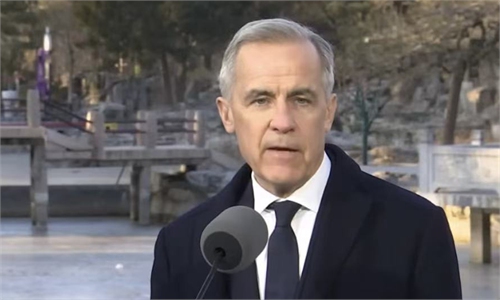
US Commerce Secretary Howard Lutnick on Thursday reportedly labeled the recent moves of Canada's Prime Minister Mark Carney to strengthen trade relations with China as "political noise," and floated the idea that Canada's move could affect talks on a revamped North American trade accord later this year, the Bloomberg reported. A Chinese analyst said the remarks by Lutnick reflect the US' hegemony mindset and won't block the normal trade relations between Canada and China.
In an interview with Bloomberg TV on Thursday while attending the World Economic Forum at Davos, Switzerland, Lutnick claimed that the thought that "China is going to open their economy to accept exports from Canada" is "the silliest thing" he's ever seen.
His remarks came after a visit by the Canadian PM to China, the first such visit in eight years, yielded a number of agreements that are set to enhance China-Canada trade cooperation.
At Davos, Carney on Tuesday delivered a closely watched speech, warning that the world is "in the midst of a rupture" of the international order and urging middle powers to be both principled and pragmatic, while citing newly concluded strategic partnerships with China and Qatar as part of Canada's efforts to diversify its external relations.
In the interview, Lutnick went further to label Carney's recent messaging as "political noise coming out of a prime minister," emphasizing the importance of Canada's trade ties with the US.
Zhou Mi, a senior researcher at the Chinese Academy of International Trade and Economic Cooperation, told the Global Times on Friday that countries should be able to determine their own economic and trade policies by themselves.
"Canada has its own judgment on its future development, and its decisions are based on its own pragmatic needs, as well as lessons learned from the past," Zhou said, noting that countries are rethinking the impacts of the US hegemonic approach on their economy.
The Chinese expert said diversification in international trade is crucial for a country to maintain stability. "It should be said that China has consistently signaled to all of its trade partners about its willingness to open its markets. This is not just a slogan, and China has matched up its commitment with concrete actions," Zhou said.
The US commerce chief also implied that Canada's "tilt toward China" could become an issue in talks over revamping the US-Mexico-Canada trade agreement known as USMCA, the Bloomberg reported on Thursday.
"Facts speak louder than words. Cooperation between Chinese and Canadian companies, if they can operate in a more predicable environment, can significantly help Canada reduce the risks of relying entirely on a single market," Zhou said.
It is also highly impolite and contrary to basic international etiquette for officials of one country to publicly judge the remarks of another countries' prime minister, Zhou added, noting that Lutnick's remarks reflected the arrogance held by some in the US government.
Canada's Finance Minister Francois-Philippe Champagne told reporters in Quebec City that every Group of Seven nation is charting its own strategic path forward with China, and Canada is no different, Bloomberg reported.
"We'll continue to work hand in hand with our US partner," he said. "At the same time, I think Canadians have understood by now that diversification is key. We need to be more resilient," the foreign minister said, according to Bloomberg.
In response to questions regarding the consensus reached between China and Canada on electric vehicles and canola seeds, He Yongqian, China's Ministry of Commerce spokesperson, said on Thursday that China believes that this is a positive step taken by Canada in the right direction and good news for makers of Chinese EVs aiming to explore the Canadian market.
Regarding canola seeds, China has always advocated resolving trade disputes through dialogue and consultation, said He.
"China will fully consider Canada's reasonable demands within the framework of rules and make a final ruling based on facts and evidence. It is believed that these measures will play a positive role in deepening relevant trade and industrial cooperation between China and Canada and enhancing the well-being of the people of both countries," the spokesperson said.
RELATED ARTICLES