iPhone Air price is cut by 2,500 yuan in Chinese mainland, as company pins hope on deep discount to drive sales amid fierce competition
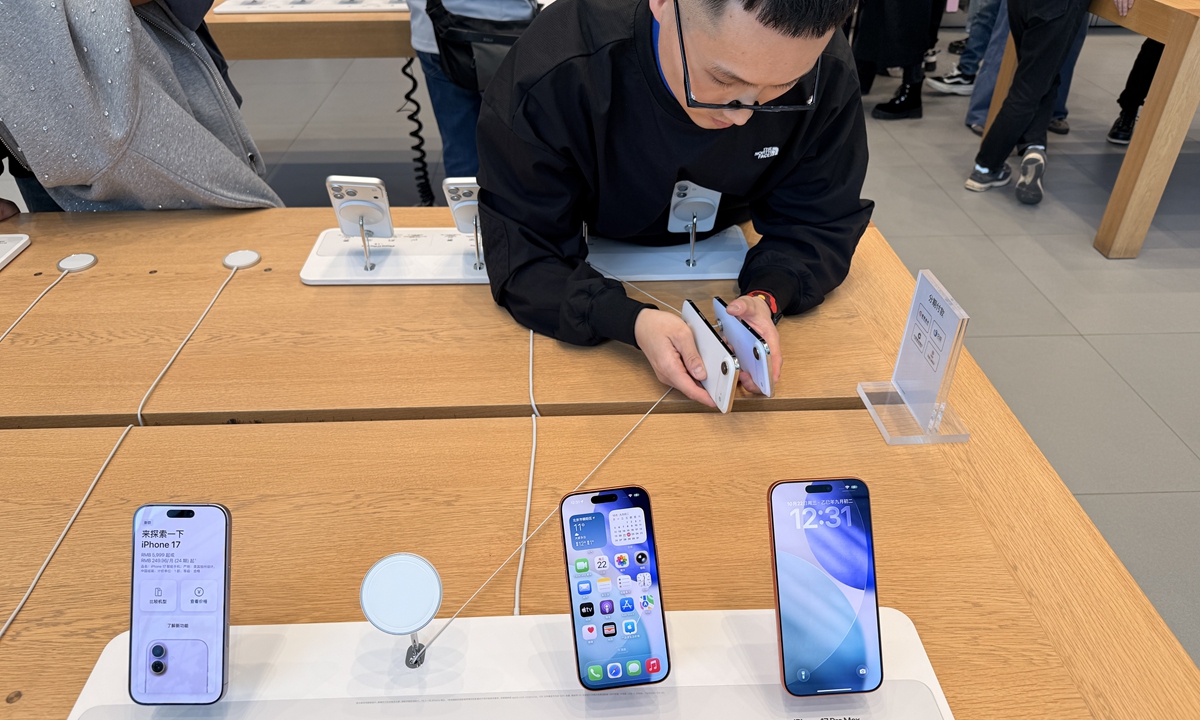
A consumer checks newly launched iPhone Air at an Apple store in Beijing CBD on October 22, 2025. Photo: Tao Mingyang/GT
Apple will sharply cut the price of its iPhone Air in its Chinese New Year promotion, with the 256GB model dropping by 2,000 yuan ($285) to as low as 5,499 yuan, according to the company's flagship store on Tmall.com.
According to Apple's flagship store on Tmall.com, the company will launch 2026 Tmall New Year Shopping Festival from Sunday 8:00 pm to 11:59:59 pm on February 11.
An expert told the Global Times that the price reduction reflect the iPhone Air's lack of core competitiveness, citing the limited adoption of e-SIMs in China, relatively small battery capacity, and intense competition in the mid-range segment from domestic brands including Huawei, Oppo and Vivo, which offer consumers a wide range of alternatives.
Apple's other products are included in the promotion, with discounts ranging from 300 yuan to 1,200 yuan.
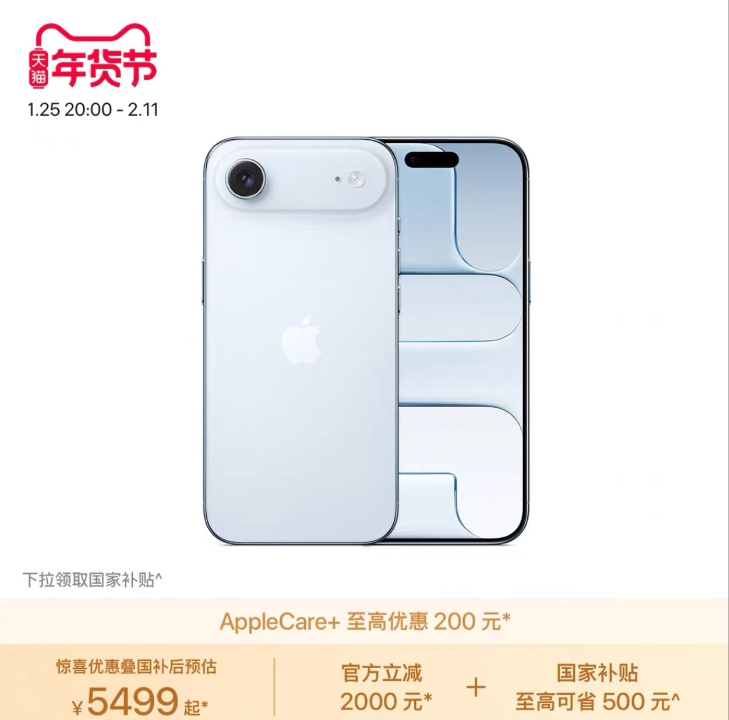
Photo: screenshot from Apple's flagship store on Tmall
The still best-selling iPhone 17 Pro and 17 Pro Max are eligible for price cuts of up to 300 yuan, while the MacBook Air and iPad Air can see discounts of up to 1,200 yuan and 1,000 yuan, respectively. Additional promotional items include the Apple Pencil and AirPods, with price reductions of between 100 yuan and 300 yuan. Although Apple has rolled out limited promotions shortly after new model launches in recent years, the upcoming Chinese New Year campaign marks the steepest price cut for the iPhone Air.
This represents Apple's third large-scale promotional push within just over a month. Public information shows that the iPhone Air was launched in the Chinese mainland market on October 22, 2025, with a starting price of 7,999 yuan. Just three months later, prices on third-party e-commerce platforms have fallen to around 5,099 yuan after trade-in subsidies—meaning the brand-new model has seen a decline of about 2,900 yuan within three months, according to China Business Journal.
Liu Dingding, a Beijing-based internet analyst, told the Global Times that the iPhone Air was initially priced lower to drive volume while the iPhone 17 Pro Max targeted the high end, but the Pro Max later became the best seller, showing Chinese consumers are less price-sensitive.
Liu emphasized that sales of the iPhone 17 Pro Max have surpassed domestic phone brands, highlighting the strong appeal of Apple's premium devices. By contrast, models such as the iPhone Air have fallen short of market expectations, reflecting a mismatch with consumer demand, as competition in the mid-range segment is intense in China, particularly in areas such as camera performance and battery life, where domestic brands often outperform the Air.
Liu said that although the iPhone Air has seen price cuts, the adjustment has not addressed the core issue, as lower prices may signal reduced value to consumers, accelerate depreciation in the second-hand market, and limit any meaningful rebound in sales.
Liu noted that the user experience of e-SIM iPhones in China remains weak, as customers are often required to visit physical stores for activation, while purchasing and using a physical SIM card is far more convenient. If Apple fails to address this issue and improve battery performance and SIM-related functions, future e-SIM models could face headwinds in the Chinese market. That said, Liu added that Apple is likely to continue adjusting its pricing strategy as it clearly views China's vast market as critical, and is seeking to further engage Chinese consumers to drive growth. In the fourth quarter of 2025, Apple's shipments in China surged 28 percent year-on-year, leading the domestic smartphone market, driven by strong demand for the iPhone 17 series.
Counterpoint's senior analyst Ivan Lam said that the iPhone Air's later market entry, along with trade-offs between its ultra-thin design and feature configuration, resulted in a slow start. "Still, it is a meaningful product—not only for exploring ultra-slim form factors, but also for its potential long-term structural impact on China's eSIM smartphone market," Lam said, according to a statement sent to the Global Times by data research firm Counterpoint.
Liu Dingding, a Beijing-based internet analyst, told the Global Times that the iPhone Air was initially priced lower to drive volume while the iPhone 17 Pro Max targeted the high end, but the Pro Max later became the best seller, showing Chinese consumers are less price-sensitive.
Liu emphasized that sales of the iPhone 17 Pro Max have surpassed domestic phone brands, highlighting the strong appeal of Apple's premium devices. By contrast, models such as the iPhone Air have fallen short of market expectations, reflecting a mismatch with consumer demand, as competition in the mid-range segment is intense in China, particularly in areas such as camera performance and battery life, where domestic brands often outperform the Air.
Liu said that although the iPhone Air has seen price cuts, the adjustment has not addressed the core issue, as lower prices may signal reduced value to consumers, accelerate depreciation in the second-hand market, and limit any meaningful rebound in sales.
Liu noted that the user experience of e-SIM iPhones in China remains weak, as customers are often required to visit physical stores for activation, while purchasing and using a physical SIM card is far more convenient. If Apple fails to address this issue and improve battery performance and SIM-related functions, future e-SIM models could face headwinds in the Chinese market. That said, Liu added that Apple is likely to continue adjusting its pricing strategy as it clearly views China's vast market as critical, and is seeking to further engage Chinese consumers to drive growth. In the fourth quarter of 2025, Apple's shipments in China surged 28 percent year-on-year, leading the domestic smartphone market, driven by strong demand for the iPhone 17 series.
Counterpoint's senior analyst Ivan Lam said that the iPhone Air's later market entry, along with trade-offs between its ultra-thin design and feature configuration, resulted in a slow start. "Still, it is a meaningful product—not only for exploring ultra-slim form factors, but also for its potential long-term structural impact on China's eSIM smartphone market," Lam said, according to a statement sent to the Global Times by data research firm Counterpoint.
RELATED ARTICLES