In-depth applications contribute to China’s construction of a modern industrial system: expert
AI empowering industries
Editor's Note:
Currently, a new round of scientific and technological revolution and industrial transformation is developing rapidly, with artificial intelligence (AI) emerging as a strategic technology which shapes the future. The Recommendations of the Central Committee of the Communist Party of China (CPC) for Formulating the 15th Five-Year Plan for National Economic and Social Development stated that the "AI Plus Initiative" should be advanced comprehensively. How is AI being translated into real industrial capacity and long-term economic upgrading in China? The Global Times launches a new column called "AI in Action" to focus on the industrial transformation.
As a strategic technology driving a new round of scientific and technological revolution and industrial transformation, artificial intelligence (AI) has strong spillover effects and driving power.
Currently, China's "AI+" campaign is accelerating industrial reshaping, achieving systematic optimization and holistic upgrading of the industrial structure, and better empowering the development of modern industrial system.
A total of 113 teams, comprising over 350 contestants, showcased their latest achievements in AI during the Third China Innovation Challenge on Artificial Intelligence Application Scene, held in Suzhou, East China's Jiangsu Province from Friday to Sunday.
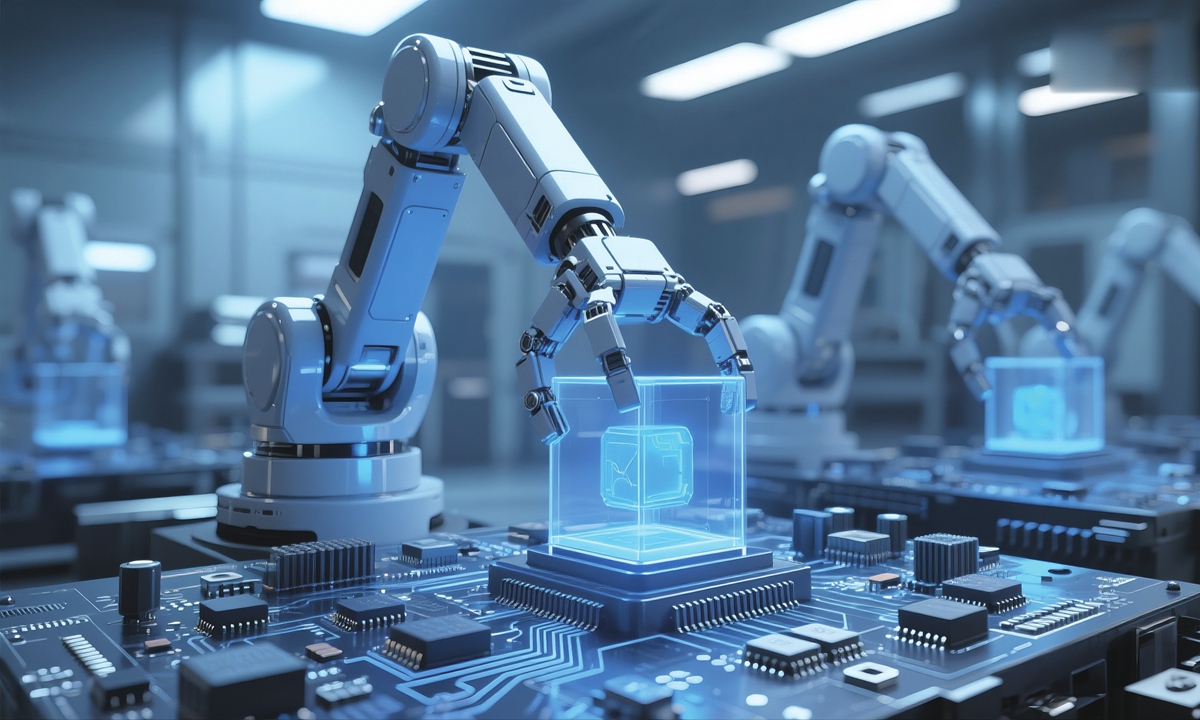
An AI-powered system showing the real-time operational landscape of Kunming Changshui International Airport, an industrial robot lifting printed circuit boards for testing, and AI technology-based computing power center management systems were among the applications on display.
Industrial empowerment
On a computer screen at the event, an AI dispatcher named "Mingyue" answers questions fluently, drafts dispatch instructions, handles alarm signals, and issues intelligent voice notifications, ensuring the normal operation of power grids.
"This is the first multi-agent collaboration-based provincial power grid AI dispatcher in China, jointly developed by research teams from the Power Dispatching and Control Center of Guangdong Power Grid Co, the Chinese University of Hong Kong (Shenzhen), the Shenzhen Institute of Artificial Intelligence and Robotics for Society, and Nanjing NARI Information and Communication Technology Co," a project staff worker surnamed Meng told the Global Times on Saturday.
Empowered by AI technology, the rollout of the agent achieves the in-depth integration of AI with power grid dispatching operations, promoting the accelerated transformation of power grid dispatching from an experience-driven model to an intelligence-based decision-making model, Meng said.
Since Chinese AI startup DeepSeek released its open-source model DeepSeek-R1 in January 2025, China's AI industry has seen a vibrant and dynamic phase.
China had more than 6,000 AI enterprises last year, while the scale of the country's core AI industry was expected to exceed 1.2 trillion yuan ($171.39 billion) in 2025. Meanwhile, AI applications have expanded to cover key industries including steel, non-ferrous metals, power and telecommunications. They are increasingly being applied in product research and development, quality inspection and customer services, according to the latest data from the Ministry of Industry and Information Technology (MIIT).
Autonomous mining trucks are also a good example of the practical applications of AI technology. In May 2025, a fleet of 100 Huaneng Ruichi autonomous electric mining trucks, the first of its kind in the world, officially entered operation at the Yimin open-pit mine in North China's Inner Mongolia Autonomous Region. Powered by a 5G-Advanced (5G-A) network, these autonomous electric mining trucks have greatly improved the production safety and set a new benchmark for intelligent mining.
AI technology is also transforming healthcare at Ruijin Hospital, an affiliate of Shanghai Jiao Tong University School of Medicine. In 2025, the hospital released a large pathology model that is expected to significantly improve diagnostic efficiency and accuracy, accelerating medical intelligence in pathology diagnosis scenarios. Last year, the hospital open-sourced its artificial intelligence pathology model to give smaller hospitals access, thereby improving diagnostic speed and accuracy across China.
"Overall, the AI industry chain is shifting from being algorithm-driven to the collaborative optimization of computing power, models, and application terminals," He You, deputy secretary-general of the Chinese Association for Artificial Intelligence, said in a speech delivered at the opening ceremony of the above-mentioned event on Saturday.
On the technology side, foundational models in the base layer are continuously evolving, while world models are about to emerge. AI is evolving from general intelligence toward embodied intelligence with task-oriented training, and accelerating collaborative development within an open intelligent computing ecosystem, He You said.
Policy support
The Recommendations of the Central Committee of the Communist Party of China (CPC) for Formulating the 15th Five-Year Plan (2026-30) for National Economic and Social Development stated that the "AI Plus Initiative" should be advanced across the board, charting the blueprint for the country's AI development over the next five years.
"We should steer the transformation of scientific research paradigms with AI, apply AI tools in industrial development, cultural advancement, public well-being initiatives, and social governance, and strive to gain the edge in AI industrial application. All these efforts will facilitate AI empowerment in all sectors on all fronts," the document states.
On January 9, eight government agencies including the MIIT, the Cyberspace Administration of China, and the National Development and Reform Commission unveiled an action plan on "AI + Manufacturing."
By 2027, the plan targets the deep applications of three to five general-purpose large AI models in manufacturing, the development of specialized, full-coverage industry-specific large models, the creation of 100 high-quality industrial datasets, and the promotion of 500 typical application scenarios, says the document.
With the in-depth applications of AI in key areas, China is emerging as a global leader in the autonomous driving industry, creating new modes of production in the industrial manufacturing sector, and driving major transformations in scientific and educational fields, Liu Gang, chief economist of the Chinese Institute of New Generation Artificial Intelligence Development Strategies, told the Global Times.
"These breakthroughs will ultimately contribute to the construction of a modern industrial system with international competitiveness, thereby injecting strong momentum into China's pursuit of high-quality development," Liu said.
Currently, a new round of scientific and technological revolution and industrial transformation is developing rapidly, with artificial intelligence (AI) emerging as a strategic technology which shapes the future. The Recommendations of the Central Committee of the Communist Party of China (CPC) for Formulating the 15th Five-Year Plan for National Economic and Social Development stated that the "AI Plus Initiative" should be advanced comprehensively. How is AI being translated into real industrial capacity and long-term economic upgrading in China? The Global Times launches a new column called "AI in Action" to focus on the industrial transformation.
Illustration: VCG
As a strategic technology driving a new round of scientific and technological revolution and industrial transformation, artificial intelligence (AI) has strong spillover effects and driving power.
Currently, China's "AI+" campaign is accelerating industrial reshaping, achieving systematic optimization and holistic upgrading of the industrial structure, and better empowering the development of modern industrial system.
A total of 113 teams, comprising over 350 contestants, showcased their latest achievements in AI during the Third China Innovation Challenge on Artificial Intelligence Application Scene, held in Suzhou, East China's Jiangsu Province from Friday to Sunday.
An AI-powered system showing the real-time operational landscape of Kunming Changshui International Airport, an industrial robot lifting printed circuit boards for testing, and AI technology-based computing power center management systems were among the applications on display.
Industrial empowerment
On a computer screen at the event, an AI dispatcher named "Mingyue" answers questions fluently, drafts dispatch instructions, handles alarm signals, and issues intelligent voice notifications, ensuring the normal operation of power grids.
"This is the first multi-agent collaboration-based provincial power grid AI dispatcher in China, jointly developed by research teams from the Power Dispatching and Control Center of Guangdong Power Grid Co, the Chinese University of Hong Kong (Shenzhen), the Shenzhen Institute of Artificial Intelligence and Robotics for Society, and Nanjing NARI Information and Communication Technology Co," a project staff worker surnamed Meng told the Global Times on Saturday.
Empowered by AI technology, the rollout of the agent achieves the in-depth integration of AI with power grid dispatching operations, promoting the accelerated transformation of power grid dispatching from an experience-driven model to an intelligence-based decision-making model, Meng said.
Since Chinese AI startup DeepSeek released its open-source model DeepSeek-R1 in January 2025, China's AI industry has seen a vibrant and dynamic phase.
China had more than 6,000 AI enterprises last year, while the scale of the country's core AI industry was expected to exceed 1.2 trillion yuan ($171.39 billion) in 2025. Meanwhile, AI applications have expanded to cover key industries including steel, non-ferrous metals, power and telecommunications. They are increasingly being applied in product research and development, quality inspection and customer services, according to the latest data from the Ministry of Industry and Information Technology (MIIT).
Autonomous mining trucks are also a good example of the practical applications of AI technology. In May 2025, a fleet of 100 Huaneng Ruichi autonomous electric mining trucks, the first of its kind in the world, officially entered operation at the Yimin open-pit mine in North China's Inner Mongolia Autonomous Region. Powered by a 5G-Advanced (5G-A) network, these autonomous electric mining trucks have greatly improved the production safety and set a new benchmark for intelligent mining.
AI technology is also transforming healthcare at Ruijin Hospital, an affiliate of Shanghai Jiao Tong University School of Medicine. In 2025, the hospital released a large pathology model that is expected to significantly improve diagnostic efficiency and accuracy, accelerating medical intelligence in pathology diagnosis scenarios. Last year, the hospital open-sourced its artificial intelligence pathology model to give smaller hospitals access, thereby improving diagnostic speed and accuracy across China.
"Overall, the AI industry chain is shifting from being algorithm-driven to the collaborative optimization of computing power, models, and application terminals," He You, deputy secretary-general of the Chinese Association for Artificial Intelligence, said in a speech delivered at the opening ceremony of the above-mentioned event on Saturday.
On the technology side, foundational models in the base layer are continuously evolving, while world models are about to emerge. AI is evolving from general intelligence toward embodied intelligence with task-oriented training, and accelerating collaborative development within an open intelligent computing ecosystem, He You said.
Policy support
The Recommendations of the Central Committee of the Communist Party of China (CPC) for Formulating the 15th Five-Year Plan (2026-30) for National Economic and Social Development stated that the "AI Plus Initiative" should be advanced across the board, charting the blueprint for the country's AI development over the next five years.
"We should steer the transformation of scientific research paradigms with AI, apply AI tools in industrial development, cultural advancement, public well-being initiatives, and social governance, and strive to gain the edge in AI industrial application. All these efforts will facilitate AI empowerment in all sectors on all fronts," the document states.
On January 9, eight government agencies including the MIIT, the Cyberspace Administration of China, and the National Development and Reform Commission unveiled an action plan on "AI + Manufacturing."
By 2027, the plan targets the deep applications of three to five general-purpose large AI models in manufacturing, the development of specialized, full-coverage industry-specific large models, the creation of 100 high-quality industrial datasets, and the promotion of 500 typical application scenarios, says the document.
With the in-depth applications of AI in key areas, China is emerging as a global leader in the autonomous driving industry, creating new modes of production in the industrial manufacturing sector, and driving major transformations in scientific and educational fields, Liu Gang, chief economist of the Chinese Institute of New Generation Artificial Intelligence Development Strategies, told the Global Times.
"These breakthroughs will ultimately contribute to the construction of a modern industrial system with international competitiveness, thereby injecting strong momentum into China's pursuit of high-quality development," Liu said.
RELATED ARTICLES