China will ‘far exceed the rest of the world in AI compute,’ Musk reportedly says; experts cite infrastructure factors
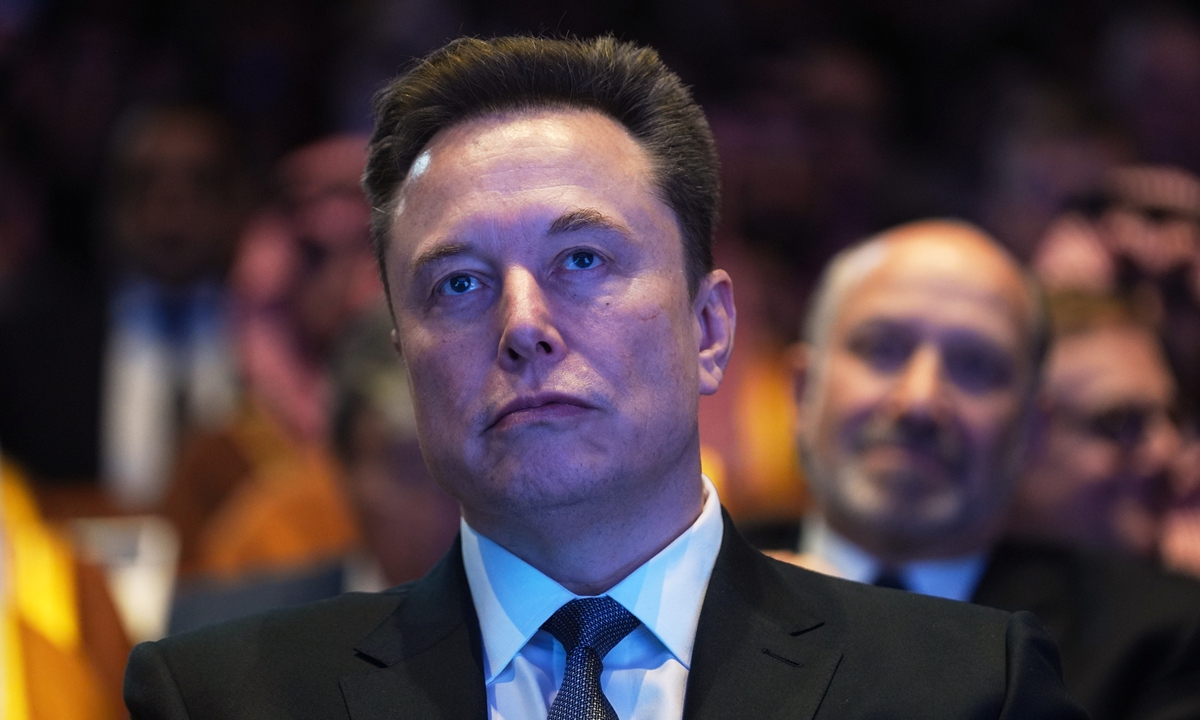
Elon Musk Photo: VCG
Elon Musk has said that China is on track to outpace every other country in the computing power needed to run artificial intelligence (AI), US tech and business outlet Business Insider reported on Wednesday. Chinese experts said Musk's comments reflect his personal assessment based on current industry dynamics. In the global white-hot AI competition, China has a clear advantage in power infrastructure, while its domestic chip capabilities are accelerating their catch-up.
"China's going to have more power than anyone else and probably will have more chips," Must, CEO of Tesla and SpaceX, said in an episode of the "Moonshots with Peter Diamandis" podcast, according to Business Insider. "Based on current trends, China will far exceed the rest of the world in AI compute," he added.
Musk further noted that China's decisive advantage in the AI race lies in its ability to scale electricity generation. He estimated that China could reach about three times the electricity output of the US by 2026, giving it the capacity to support energy-hungry AI data centers. Electricity generation is the limiting factor to scaling AI systems, he said, Business Insider reported.
Zhou Mi, a senior researcher at the Chinese Academy of International Trade and Economic Cooperation, told the Global Times that Musk's comments represent his personal analysis, shaped by bottlenecks he has encountered while advancing AI projects in the US, rather than a straightforward China-US comparison.
Power supply constraints in many parts of the US, combined with the concentration of major tech companies and the enormous electricity demands of AI data centers, have likely limited the further expansion of some projects, Zhou said.
Musk's comments come as energy supply and data infrastructure emerge as key constraints in scaling AI, rather than chips or algorithms, according to Business Insider.
By contrast, Zhou said China's power supply and infrastructure conditions are often cited as factors that could support sustained growth in computing capacity, with electricity remaining a fundamental prerequisite for long-term AI development.
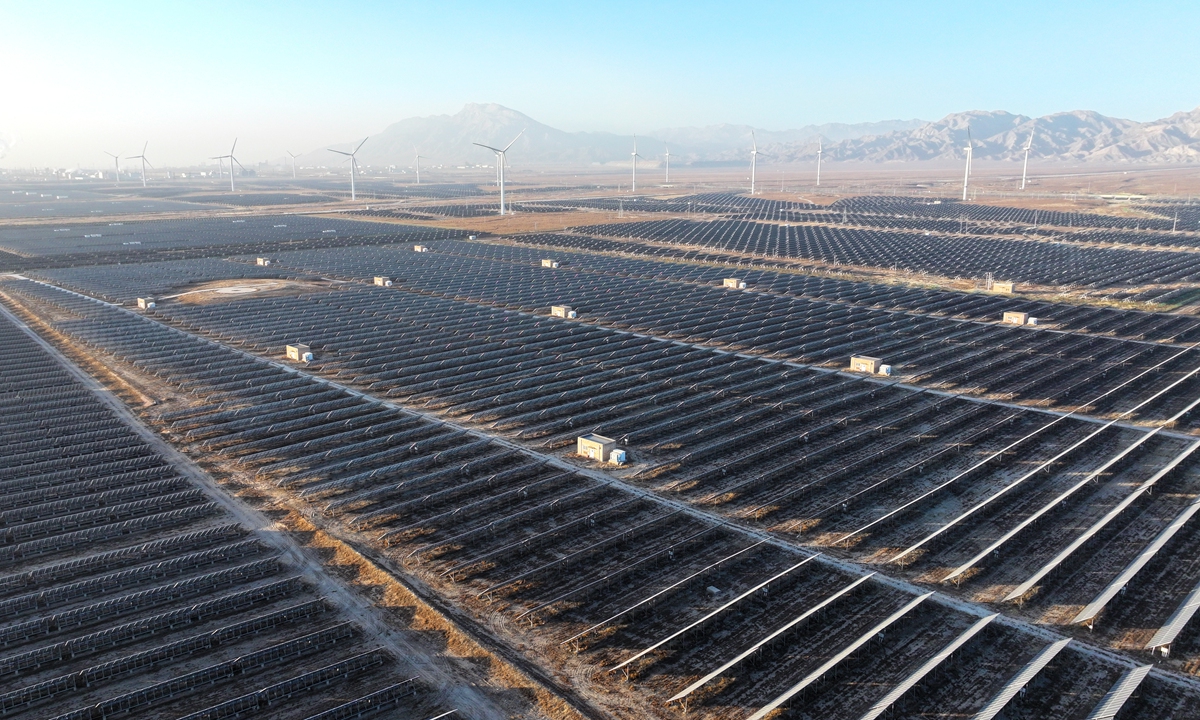
Wind turbines and rows of photovoltaic panels generate a steady flow of green electricity at a "sand-gravel-desert" clean energy base in Shizuishan, Northwest China's Ningxia Hui Autonomous Region, December 23, 2025. Photo: VCG
As many have highlighted China's advantages in AI and other high-tech, Washington has also moved to restrict high-tech trade, including chips, in an apparent attempt to contain China's tech development.While the US has focused on restricting China's access to advanced semiconductors, Musk suggested those constraints may matter less over time. China will "figure out the chips," he said, according to the Business Insider.
In an exclusive interview with the Global Times, Wei Shaojun, vice chairman of China Semiconductor Industry Association, stressed that China must continue to strengthen its independent chip development.
Wei noted that high-level competition has pushed Chinese companies to accelerate breakthroughs in areas such as chip architecture, advanced packaging and integration, and toolchain development. Domestic GPUs and AI accelerators, he added, are already being deployed at scale across training and inference workloads as well as edge computing scenarios.
"Imports are about narrowing the gap," Wei said, "but catching up is only a stage — the goal is to compete head-on and eventually take the lead."
According to a Morgan Stanley research report released in 2025, China's self-sufficiency rate in AI GPUs has risen from below 10 percent in 2020 to about 34 percent in 2024, and is expected to reach roughly 82 percent by 2027.
Against this backdrop, development of the computing power sector is shifting from a narrow focus on hardware performance catch-up toward more pragmatic and efficient system-level innovation, the People's Daily reported in December.
China aims to achieve secure and reliable supply of key core AI technologies by 2027, with its industrial scale and empowerment level remaining among the world's forefront, according to a recent government action plan, according to the Xinhua News Agency.
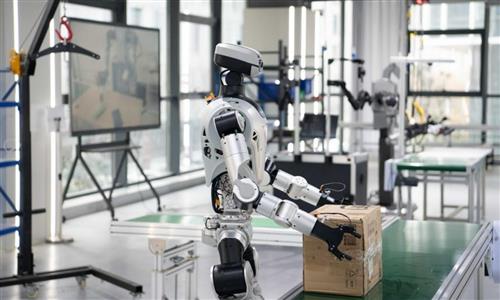
The plan, issued by eight government agencies including the Ministry of Industry and Information Technology, aims to integrate AI more deeply into manufacturing and drive new industrial growth.
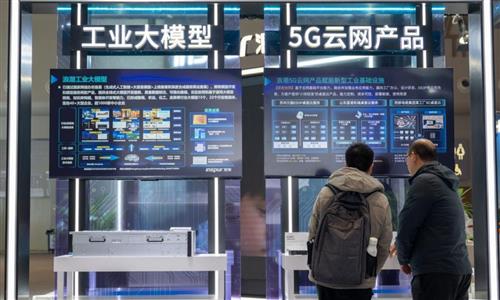
By 2027, the plan targets the deep application of three to five general-purpose large AI models in manufacturing, the development of specialized, full-coverage industry-specific large models, the creation of 100 high-quality industrial datasets, and the promotion of 500 typical application scenarios, Xinhua reported.
RELATED ARTICLES