Illustration: Xia Qing/GT
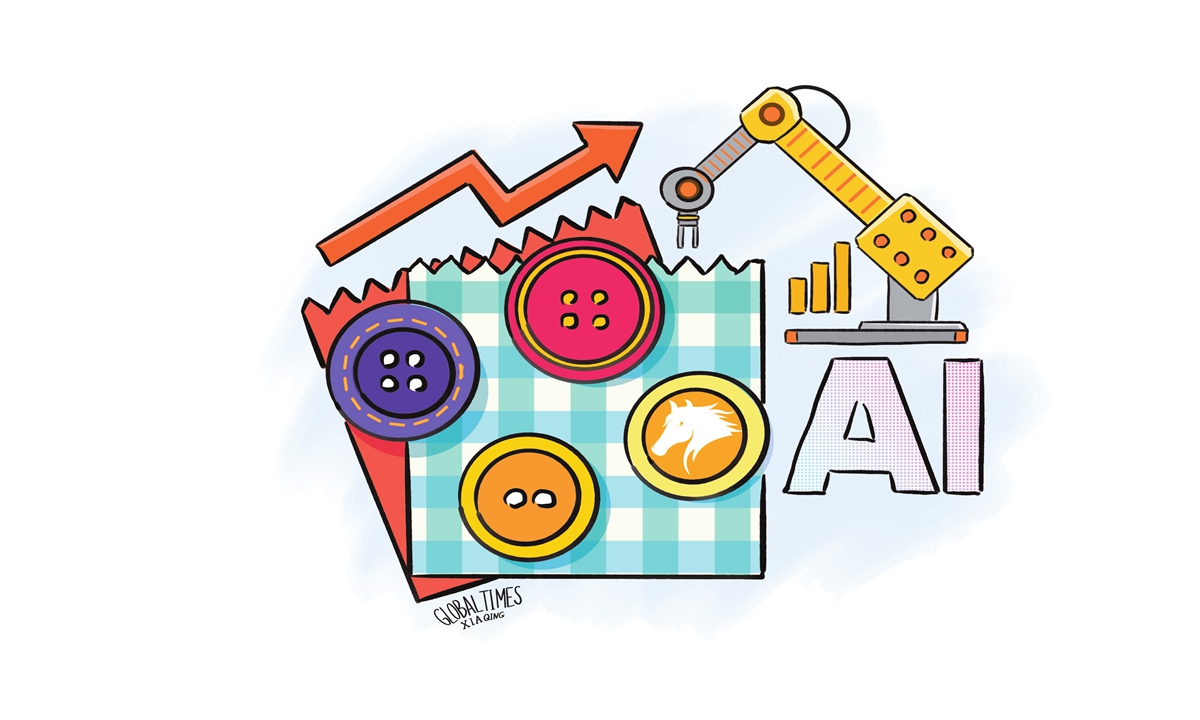
In China, the Spring Festival is traditionally associated with the custom of wearing new clothes. As the holiday approaches, some consumers again start to refresh their wardrobes, with attention this year drawn to a detail often overlooked: buttons.According to CCTV News, buttons shaped like the zodiac animal of this year - the horse - have gained popularity. While this may appear to be a minor trend, it offers a subtle reflection of broader development in Chinese economy, where opportunities are arising as the focus gradually moves toward greater refinement and precision in both production processes and consumer preferences.
Behind this seemingly simple item lies a complex supply chain. In Qiaotou, a town in East China's Zhejiang Province, button production has reached impressive scale. According to CCTV News, the town makes about 100 billion buttons annually, with an estimated half of those buttons sold worldwide originating from Qiaotou.
The popularity of one small button reflects broader trends within the economy. Supply-side upgrades and demand-side diversification are evolving simultaneously, gradually influencing each other. This parallel development reflects China's ongoing transition toward high-quality and more refined economic upgrading.
On the demand side, buttons offer a revealing glimpse into the growing segmentation and refinement of consumer preferences. Across China, a vast variety of buttons can be found, differing in color, shape, and material - from resin to metal, shell to horn, and even fruit shells.
This diversity highlights the extent to which the button market has become highly specialized, catering to an increasing desire for distinctive and customized products. The range of options available for such a seemingly small item suggests a broader shift toward more individualized consumer choices, where attention to detail and personal expression are increasingly noticeable.
In recent years, the growing appeal of new Chinese-style fashion has driven a heightened demand for custom accessories, including buttons. To meet the demand, manufacturers have delved into a wide array of designs, experimenting with bead patterns, color palettes, and intricate motifs, all crafted to complement the unique aesthetic of these garments. This focus on design and detail reflects the increasing diversification of consumer preferences.
This growing demand for variety has created new opportunities for both domestic and international businesses, extending far beyond the button market to encompass numerous industries.
Customs data reveals an increase in imports of some consumer-oriented goods, including fresh fruits, nuts, personal care and cosmetics. For example, imports of dried and fresh fruits and nuts reached 9.08 million tons in 2025, a 13.4 percent year-on-year rise. This trend underscores strong consumer demand for higher-quality and diverse products, offering attractive prospects for foreign businesses seeking to capitalize on China's evolving market.
The rise of e-commerce has made it easier to meet the growing demand for diverse consumer preferences. In the realm of cross-border e-commerce, imports have expanded across a broad range of categories, including health supplements, food, and fresh produce. These categories reflect a growing consumer preference for specialized and personalized products, extending beyond standardized basic necessities.
Another important area to consider is manufacturing. On the supply side, intelligent design tools and flexible production systems are reshaping even traditional industries, enabling manufacturers to quickly adapt to highly diversified and small-batch orders. This reflects a steady transition from scale-driven manufacturing to precision-focused production, marking an evolution in industrial capabilities.
Take the button industry as an example: intelligent technologies such as AI-driven design software, industrial inspection systems, and automated weighing and packaging machines are raising the technological complexity of even the smallest components.
Widening the lens to the broader industrial sector, the proportion of Chinese industrial enterprises applying AI models and intelligent agents surged from 9.6 percent in 2024 to 47.5 percent in 2025, according to the Economic Information Daily. This increase highlights the expanding role of AI in production processes and supply chains across China's industrial landscape.
One trend in China's economy is the synchronized development of supply and demand, which seems to be steering the economy toward a more refined model of growth. This transition - from increasingly personalized consumer preferences to precision-driven manufacturing - provides insight into the broader transformation now unfolding in the country.
The popularity of horse-shaped buttons serves as a small yet telling example of these evolving opportunities. As intelligent manufacturing and personalized consumption continue to evolve, new business prospects are likely to emerge.
The author is a reporter with the Global Times. bizopinion@globaltimes.com.cn
RELATED ARTICLES