Trump’s Afghanistan comments spark European backlash; Chinese expert says they unsettle transatlantic foundation
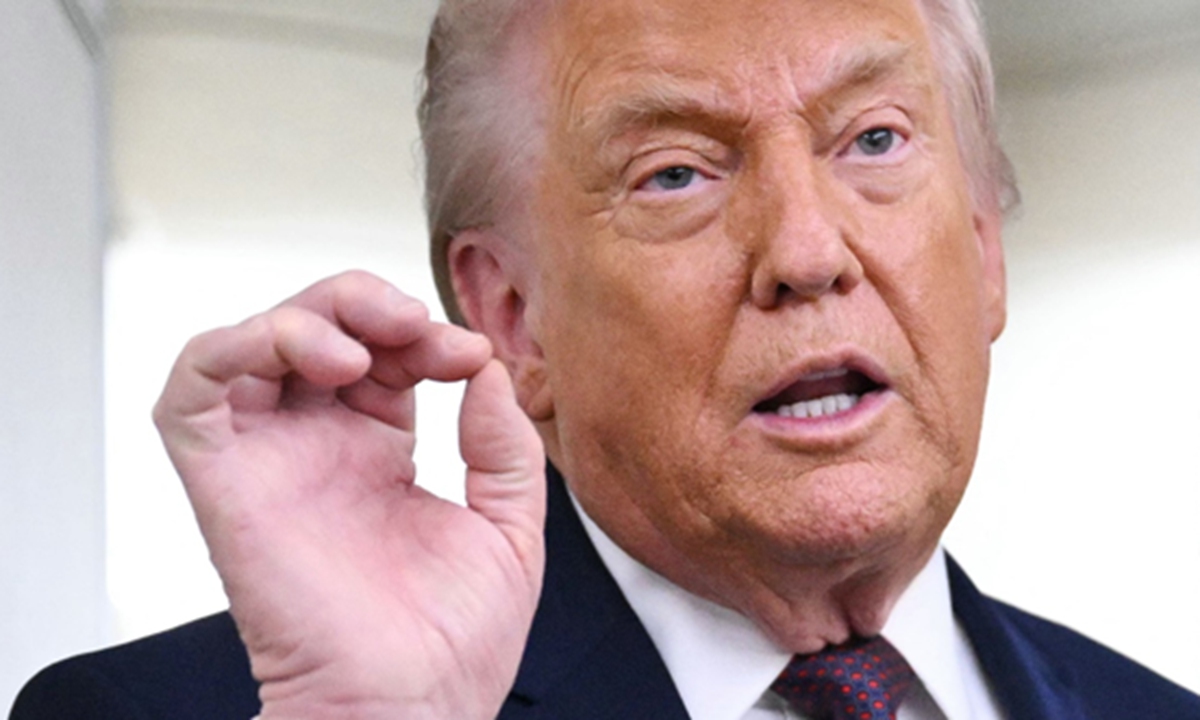
US President Donald Trump speaks to reporters while in flight on Air Force One, traveling from Shannon, Ireland en route Joint Base Andrews in Maryland on January 22, 2026. Trump is returning from Davos, Switzerland after attending the World Economic Forum. Photo: VCG
Leaders from several NATO countries, including France and Italy, have pushed back against US President Donald Trump's claim that NATO allies fell short in supporting the US during operations in Afghanistan, media reports said.
A Chinese expert noted that reactions from some European leaders indicate that certain recent moves by the current US administration seem to have touched on Europe's sovereignty and security sensitivities, somewhat unsettling the long-standing transatlantic relationship built around "US-led peace" since World War II.
The current US administration's tough stance toward Europe and NATO is not a momentary reaction but a continuation of long-held views, Lü Xiang, a research fellow at the Chinese Academy of Social Sciences, told the Global Times on Sunday.
According to CNN, Trump said Thursday in an interview with Fox News in Davos, Switzerland that "I've always said, 'Will they be there, if we ever needed them?' And that's really the ultimate test. And I'm not sure of that. I know that we would have been there, or we would be there, but will they be there?"
The Italian, French and Danish governments expressed their disapproval Saturday at Trump's comments, with all of them describing them as "unacceptable."
According to the AFP News, the office of French President Emmanuel Macron said Saturday: "These unacceptable comments are not worthy of response." Italy's Prime Minister Giorgia Meloni also expressed her government's astonishment at Trump's comments.
In a statement posted on X, Meloni said, "The Italian Government has learned with astonishment of President Trump's statements according to which NATO allies would have 'fallen behind' during operations in Afghanistan." She stressed that such claims overlook the unprecedented solidarity shown by the alliance following the September 11, 2001 terrorist attacks.
Danish Prime Minister Mette said Saturday on Facebook: "I fully understand that Danish veterans have said no words can describe how much this hurts. It is unacceptable that the American president questions the commitment of allied soldiers in Afghanistan."
British Prime Minister Keir Starmer responded on Friday with describing those words as "insulting and frankly appalling," the Associated Press reported Saturday.
Poland's Prime Minister Donald Tusk recalled attending a farewell ceremony in 2011 for five Polish soldiers killed in Afghanistan to underscore his disagreement with such remarks. "The American officers who accompanied me then told me that America would never forget the Polish heroes," he wrote in a post on X. "Perhaps they will remind President Trump of that fact."
BBC described Trump's claims "drew condemnation from international allies." CNN also reported that "the president's comments have rankled US allies in NATO," noting that these coming at the end of a week in which he has severely strained the alliance through his repeated threats to seize control of Greenland, an autonomous part of Denmark, another NATO member.
"Washington has consistently believed Europe benefits unfairly in trade while 'free-riding' on US security efforts, with NATO allies relying on American resources to sustain the defense system — at the US' expense. This perspective underpins its foreign policy logic and has been reiterated in forums like Davos, reinforcing dissatisfaction over Europe's failure to align with key US interests," Lü said.
From Europe's perspective, these approaches appear to have touched on core sensitivities regarding sovereignty and security, somewhat unsettling the post-World War II transatlantic framework built around US-led peace—effectively challenging a key supporting pillar of the system, Lü noted.
Unlike past quick concessions on trade and tariff issues to ease US pressure, Europe is showing rare unity this time on matters involving sovereignty and security, where major countries and the EU have not yielded, he noted.
Looking ahead, Lü said the situation remains highly uncertain. The transatlantic partnership is now influenced by multiple regional hotspots, with competing pulls over security, sovereignty, and interests signaling that transatlantic ties — and the broader global power structure — are entering a complex, volatile and unpredictable phase of competition.
RELATED ARTICLES