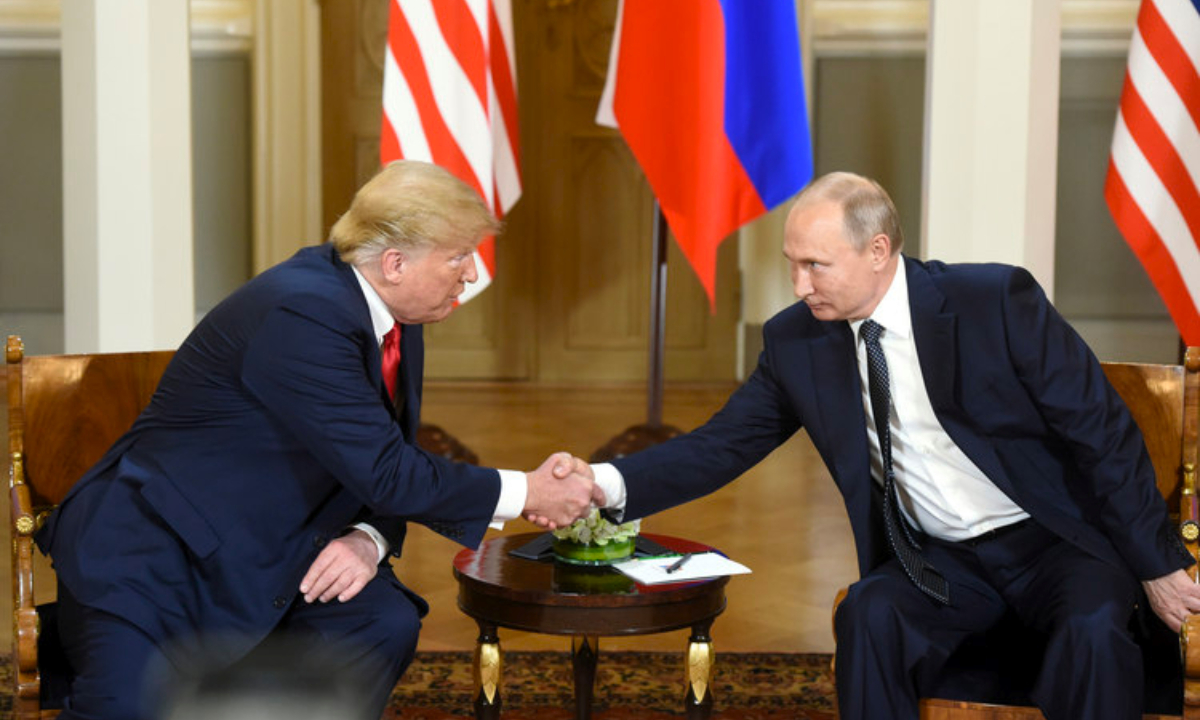
File Photo: Donald Trump (L) shakes hands with Vladimir Putin. (Xinhua/Lehtikuva/Heikki Saukkomaa)
European countries scrambled to meet on Saturday and presented a joint statement urging that Ukraine, as well as Europe, shouldn't be left out of the discussion table about the future of the Russia-Ukraine conflict, after it was announced that US President Donald Trump would meet his Russian counterpart Vladimir Putin on August 15 in Alaska.
US Vice-President JD Vance and UK Foreign Secretary David Lammy hosted a meeting of security officials at Chevening House, a country mansion southeast of London, on Saturday to discuss the Ukraine issue, joined by Ukrainian officials and European national security advisers. The talks are said to have been called at US' request, media reported.
During the meeting, major European countries and Ukraine responded to Putin's ceasefire plan with a counterproposal that they say must "serve as a framework so that coming talks between President Trump and the Russian leader can gain traction," according to European officials familiar with the talks, per the Wall Street Journal.
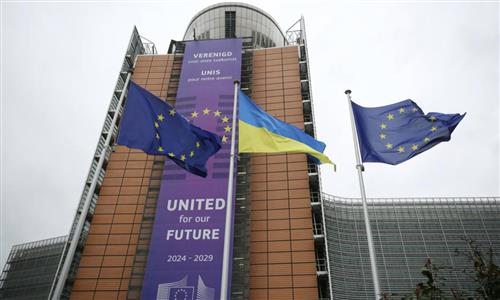
Leaders of the UK, France, Italy, Germany, Poland, Finland and the European Commission also issued a joint statement late on Saturday, BBC reported on Sunday, which said "the path to peace in Ukraine cannot be decided without Ukraine."
"We share the conviction that a diplomatic solution must protect Ukraine's and Europe's vital security interests," the joint statement said, per Reuters.
Ukrainian President Volodymyr Zelensky on Sunday said Kiev "values and fully supports" the joint statement by European leaders. "The end of the war must be fair, and I am grateful to everyone who stands with Ukraine and our people today for the sake of peace in Ukraine, which is defending the vital security interests of our European nations," he wrote on X.
"The Trump administration has been trying to secure a ceasefire deal through negotiations with Russia, but direct talks with Russia could provoke opposition from Ukraine and Europe, as well as criticism within the US, Zhao Junjie, senior research fellow at the Institute of European Studies at the Chinese Academy of Social Sciences, told the Global Times on Sunday, noting that the US sent the US Vice President to gather European allies in the discussions, to demonstrate the unity of Western allies under US leadership and provide moral support to Ukraine, at the same time, this move aims to shift the responsibility for supporting Ukraine to Europe.
Europe trying to stay relevant
NBC News reported on Sunday that the White House is considering inviting Zelensky to Alaska, citing a senior US official and three people briefed on the internal discussions.
"The president remains open to a trilateral summit with both leaders," said a senior White House official, but added that "right now, the White House is focusing on planning the bilateral meeting," per the report.
It's not just Ukraine that is struggling to be part of the Alaska meeting, European allies are also worried about their lack of influence over the potential outcome.
In a post on X on Saturday, French President Emmanuel Macron raised concerns about Russia and the US excluding European involvement. "Europeans will also necessarily be part of the solution, as their own security is at stake," he wrote on Saturday.
Europe's desire to get involved reflects its deep strategic anxiety, which primarily stems from the advent of Trump's second term, and which has further marginalized Europe, Zhao said.
Peace deal cannot happen overnight
The European plan presented on Saturday reportedly rejected a Russian proposal to trade Ukrainian-held parts of the Donetsk region for a ceasefire. It also includes demands that a ceasefire take place before any other steps are taken, and that territory can be exchanged only in a reciprocal manner, according to the report. Moreover, the European plan stipulates that any territorial concession by Kiev must be safeguarded by ironclad security guarantees - including potential NATO membership for Ukraine, reported the Wall Street Journal.
The European peace proposal was in response to last week's encounter between Putin and US special envoy Steve Witkoff at the Kremlin. According to officials briefed on the proposal brought by Witkoff from Moscow, Putin said he would agree to a ceasefire in exchange for Ukraine handing over roughly one-third of the eastern Donetsk region that Kiev still controls. The front line would be frozen elsewhere, including in the Zaporizhzhia and Kherson regions, the report said.
Russia has consistently insisted on Ukraine recognizing Russian sovereignty over several Ukrainian regions, agreeing to demilitarization and abandoning its NATO aspirations, according to BBC.
Following the announcement of the August 15 meeting with Putin, Trump said on Friday that there "will be some swapping of territories, to the betterment of both."
Zelensky has made it clear that he will not accept sacrificing land for peace.
Early on Saturday, he said in a Telegram post "Ukrainians will not give their land to the occupier," and reiterated that Ukraine must be involved in any solution for peace, the BBC reported.
Zelenskyy's chief of staff, Andriy Yermak, who took part in the talks with European leaders and US officials, said on X that "A ceasefire is necessary - but the front line is not a border," reiterating Kiev's position that it will reject any territorial concessions to Russia, per Reuters.
Cui Heng, a scholar from the Shanghai-based China National Institute for SCO International Exchange and Judicial Cooperation, told the Global Times on Sunday that it remains uncertain how much effect the US-Russia bilateral talks in Alaska could take on ending the three-year-long conflict. "Even if an agreement is reached between Trump and Putin, it could face rejection from Europe and Ukraine due to the deep-seated contradictions accumulated over the past three years," Cui said. "And resolving such complex issues through a single meeting between two leaders is unlikely."
Negotiations require a long, gradual approach to bridge the significant differences in demands between the parties.
RELATED ARTICLES