China’s provincial governments unveil 2026 GDP growth targets, putting priority on technological innovation
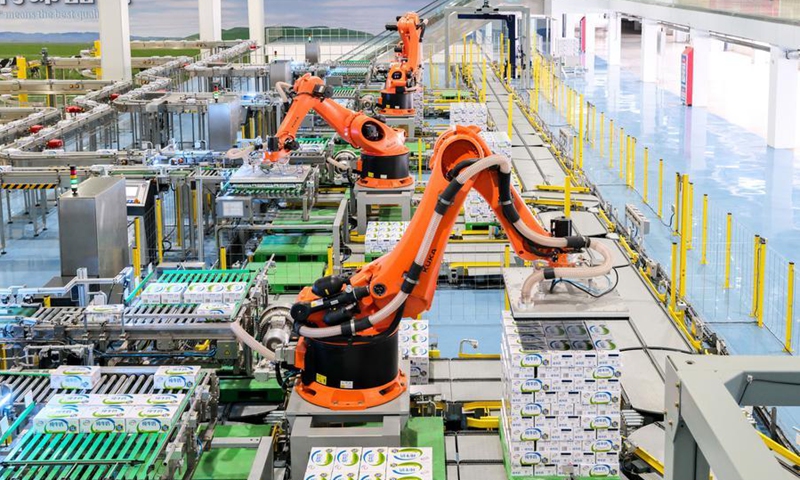
Robotic arms carry out packaging operation at the Global Intelligent Manufacturing Industrial Park of Yili Modern Intelligent Health Valley in Tumd Left Banner in Hohhot, north China's Inner Mongolia Autonomous Region, April 17, 2025. (Photo: Xinhua)
Numerous provincial-level governments in China have announced their economic growth targets for 2026, with a strong focus on expanding research and development (R&D) and increasing investment on innovation to drive growth.
South China's Guangdong Province has set its 2026 GDP growth target at 4.5-5.0 percent, with local fiscal revenue projected to rise by about 3 percent and average household income to grow in lockstep with its GDP growth.
The province will cultivate industries of the future such as 6G, embodied intelligence, gene therapy, brain science and brain-computer interfaces, hydrogen and advanced nuclear energy, deep-sea exploration and quantum technologies.
Central China's Henan Province has announced a target of an average GDP growth rate of about 5 percent during the 15th Five-Year (2026-30) period. The province plans to strengthen agriculture, manufacturing, science and education, digital intelligence, transport, and cultural tourism, according to the website of the Henan provincial government on Monday.
The work report calls for innovation-driven development tailored to local conditions, deeper integration of education, science and talent, and closer alignment of technological and industrial innovation. Targets include annual R&D expenditure growth of more than 10 percent and raising the share of strategic emerging industries to 30 percent of output among major industrial enterprises, while keeping the manufacturing size stable and growing at a reasonable pace.
Beijing has set its annual GDP growth target at 4.5-5 percent starting this year, with ramped-up efforts to strive for even better results, according to the city's draft 15th Five-Year Plan (2026-30) for economic and social development, released on Sunday, the Beijing News reported on Sunday.
As to the development of cutting-edge industries, Beijing will promote the expansion of production capacity and mass production for key integrated circuit projects, build the international pharmaceutical innovation park at a high level and advance the full industry chain development of key projects in advanced green energy, new-energy vehicles, robotics, commercial aerospace, and other fields.
The economic growth targets and action plans outlined at various annual legislative sessions revealed a strategy emphasizing faster R&D growth, the development of new quality productive forces and sizeable investment to support innovation-led economic growth, Wang Peng, an associate research fellow at the Beijing Academy of Social Sciences, told the Global Times on Monday.
The provincial authorities' plans underscore the dual focus on the quantity and quality of growth. The goal is to shift China's regional economy toward higher value-added, innovation-driven sectors, Wang said, adding that the plans signal continued public support for cutting-edge technology — from artificial intelligence and robotics to biotech, quantum and advanced energy — and a heavy emphasis on mobilizing investment to accelerate industrial upgrading.
In 2025, China's GDP grew 5 percent year-on-year to 140.19 trillion yuan ($20.01 trillion), data from the National Bureau of Statistics showed, meeting the annual growth target of about 5 percent and surpassing the threshold of 140 trillion yuan for the first time, the Xinhua News Agency reported.
In the next five years, China is expected to play a greater and more indispensable global role in the face of fragmented global supply chains, an intensifying global technology race and rising geopolitical tensions, said Tian Yun, an economist based in Beijing, adding that "China's economy has continued to demonstrate strong resilience, navigating instability while achieving both quantitative leaps and qualitative improvements."
Innovation capacity, alongside China's massive production base and ultra-large market, has become a key advantage of China's high-quality development and has the potential to further attract foreign investment, Tian told the Global Times on Monday.
RELATED ARTICLES