Domestic residents’ trips rise to 6.522b in 2025, exceeding pre-pandemic level


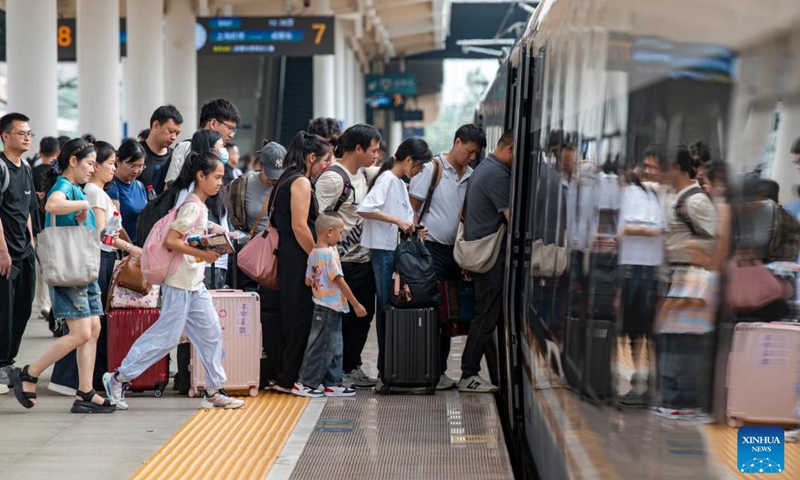
Passengers board a train at Jinhua Railway Station in Jinhua, east China's Zhejiang Province, Sept. 29, 2025. China's National Day holiday travel rush started on Sept. 29 and will last until Oct. 10. Photo: Xinhua
A sample survey of Chinese mainlanders' travel habits found that they made 6.522 billion domestic travel trips in 2025, an increase of 907 million trips or 16.2 percent compared with the previous year, the Ministry of Culture and Tourism said on Monday.
Urban residents made 4.996 billion domestic trips, up 14.3 percent, while rural residents made 1.526 billion domestic trips, up 22.6 percent, the ministry said.
In 2025, Chinese mainland residents spent 6.3 trillion yuan ($903.41 billion) on travel, up 9.5 percent year-on-year, according to the ministry.
Urban residents spent 5.3 trillion yuan on travel, a year-on-year increase of 7.5 percent, while rural residents spent 1.00 trillion yuan, a rise of 21.4 percent, the ministry said.
Last year was the first year that domestic residents' trips exceeded the pre-pandemic level of 6.006 billion in 2019.
Song Ding, a research fellow at the China Development Institute, told the Global Times on Monday that the rebound to a record-setting level underscored a broader recovery of the Chinese tourism sector in wake of the pandemic.
"In a span of six years, it can be said that the Chinese tourism sector had basically recovered by 2025 from the damage of the pandemic, demonstrating the strong resilience and increasing vitality of the sector," Song said.
The tourism sector is one of the growth drivers for China's consumption and overall economy.
In 2024, the added value from tourism and related sectors accounted for about 4.35 percent of GDP. This compared with 3.71 percent in 2022, when the pandemic effect was more apparent, according to the NBS.
The rising data comes as China pursues a comprehensive policy package to boost consumption, further igniting the engine of domestic demand.
Aiming to sustain this momentum and further unleash the potential of domestic demand, the Ministry of Finance on January 20 optimized and extended existing interest rate subsidies for loans to business entities in the services sector and for personal consumption loans to the end of 2026.
Consumption has played a more pronounced "ballast" role as the country shifted toward making domestic demand the main engine and stabilizing anchor of economic growth.
NBS figures showed that retail sales topped 50 trillion yuan in 2025, up 3.7 percent from a year earlier and consolidating China's position as one of the world's largest retail markets. Consumption contributed 52 percent to economic growth, an increase of 5 percentage points.
The Ministry of Commerce said on Monday that retail sales of cultural and sports leisure, tourism consulting and rentals, and transportation services maintained double-digit growth in 2025.
Song noted that the Chinese tourism sector development has been infused with new elements, such as culture and advanced technology.
Although the figure is large in itself, Song said that the country's potential is even greater as the per capita data remains quite low.
"As Chinese people's incomes continue to rise, along with improved living standards, the country's tourism sector boasts great potential for growth, and it will bring more opportunities for consumption, spur related job growth and foster rural development."
Looking beyond the current policy horizon, China's top economic planner on January 20 pledged to formulate a strategic implementation plan for expanding domestic demand for the 2026-2030 period.
The National Development and Reform Commission stated that the plan is designed to align with consumption upgrades and technological transformations, promoting a virtuous cycle in which "new demand steers new supply and new supply creates new demand" through strong innovation support.
RELATED ARTICLES