China's experience lights the path for developing countries' modernization
‘Investing in people’ builds lasting resilience

A view of the Chinese Park at the Mira? ores, Lima, capital of Peru. The park was built in 2022 to commemorate the 50th anniversary of diplomatic relations between China and Peru, and the 172nd anniversary of the arrival of Chinese immigrants in Peru. File photo: VCG
In China, the family is not regarded as an isolated private sphere. It is widely understood as the social foundation upon which national stability, cohesion and long-term development are built.
This perspective reflects the values deeply rooted in Chinese civilization, where social harmony, collective responsibility and intergenerational continuity occupy a central place. Within this context, the family plays a central role not only in private life, but also in sustaining social continuity and shared responsibility.
From this standpoint, economic development is not treated as an end in itself, but as a means to improve the living conditions of households. Growth is expected to translate into concrete gains in education, healthcare, employment, housing and community services. The focus is therefore on whether development outcomes meaningfully improve people's lives, rather than on aggregate expansion alone. The underlying logic is clear: National strength is inseparable from family well-being. This approach reflects a model of governance oriented toward social outcomes and long-term stability, rather than short-term economic performance.
During my time as the Peruvian ambassador to China from 2011 to 2014, I observed how this philosophy is reflected in governance practice. Authorities place strong emphasis on understanding people's needs firsthand and ensuring that policies reach communities effectively. Direct engagement at the grass-roots level is treated as an essential part of policy implementation, not a formality. Political leaders' presence in remote and less-developed areas, engaging directly with families and local residents, sends a consistent message that development is ultimately measured by the improvements in people's daily lives.
This emphasis resonates strongly in Latin America, where the family is likewise a fundamental pillar of social life and cultural identity. In societies where informal family networks often help cushion social and economic risks, policies that stabilize household livelihoods carry particular importance.
People-centered achievements
Over recent decades, China's people-centered approach has delivered deep and sustained social transformation. The country has made notable progress in expanding access to basic public services, strengthening social infrastructure and narrowing long-standing regional disparities. Importantly, social investment, rather than being treated as a secondary objective, has moved forward alongside the economic growth,. These advances reflect a clear political priority to ensure that development reaches broad segments of society.
A key driver behind these achievements has been the institutional capacity of the Chinese state. Medium- and long-term planning, articulated through successive national plans, has provided continuity and strategic direction beyond individual economic or political cycles. By embedding social objectives into national planning frameworks, policy consistency has been maintained even amid changing external conditions. At the same time, coordination across different levels of government has enabled large-scale social programs to be implemented effectively, aligning national priorities with local realities.
For Latin America, this experience offers valuable lessons. It demonstrates that, with strong institutions, strategic planning and a clear social orientation grounded in freedom and democracy, sustained progress in improving people's well-being is possible even amid structural constraints. China's experience highlights the importance of effective state capacity in delivering concrete social outcomes.
This orientation was reaffirmed at the Fourth Plenary Session of the 20th CPC Central Committee, which adopted recommendations for the 15th Five-Year Plan (2026-30).
The plan underscores that meeting the people's aspirations for a better life is the immutable goal of Chinese modernization, with systematic planning across areas such as education, healthcare, employment and social security. These policy areas are addressed in an integrated manner, reflecting their shared impact on household stability and social mobility.
Such progress contributes directly to stronger social cohesion. When households see development translated into tangible improvements in their quality of life, trust between citizens and institutions is reinforced. Reduced uncertainty at the family level helps stabilize social expectations more broadly, lowering the risks of economic or social volatility. This creates a social environment conducive to long-term modernization.
From a strategic perspective, this model also enhances China's resilience in the face of external challenges. A society with higher levels of well-being, stronger safety nets and better preparation is more capable of absorbing shocks, whether economic, health-related or geopolitical. Investment in people thus serves as an important foundation for national resilience.
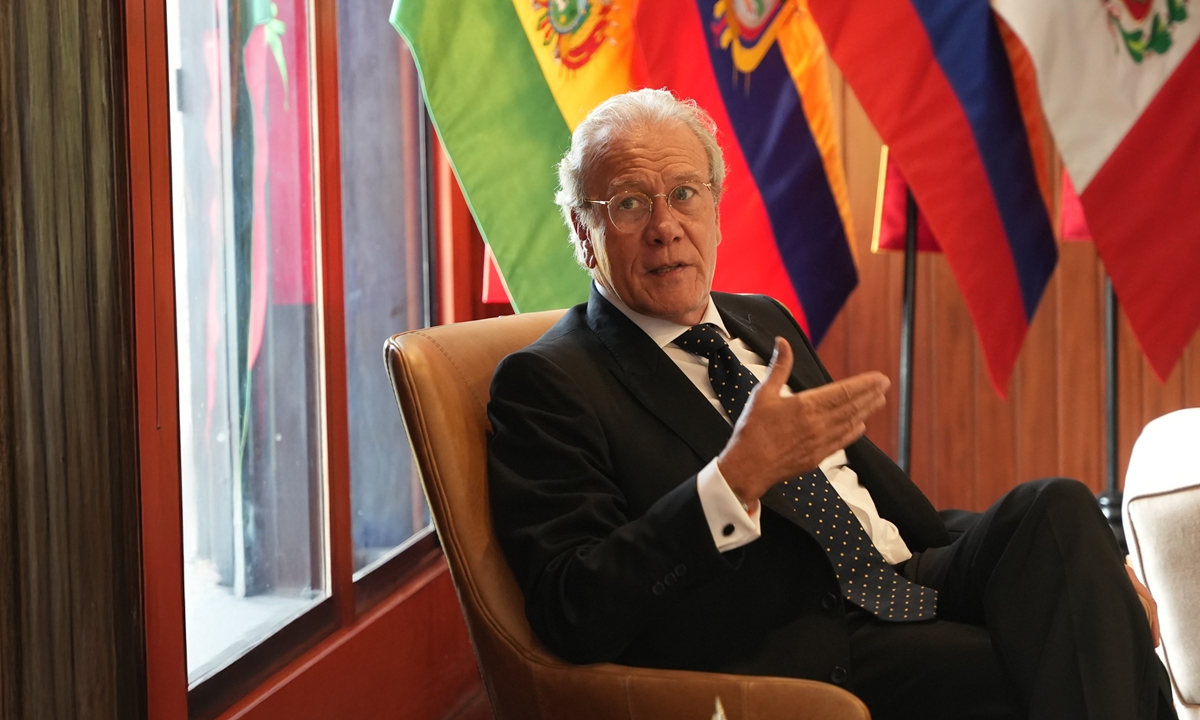
Gonzalo Gutiérrez Photo: Courtesy of Gonzalo Gutiérrez
Shared opportunities
This internal stability, in turn, supports sustained economic ties and more predictable cooperation with international partners, underpinned by respect for international law. Stable domestic foundations reduce policy volatility and enhance credibility in long-term international engagement. It also creates space for deeper exchanges on social policy, allowing cooperation to extend beyond trade into the human and social dimensions of development.
China's 2025 Central Economic Work Conference, held from December 11 to 12, 2025, further highlighted the need to combine investment in physical assets with sustained investment in human capital.
By directing substantial resources toward education, healthcare, employment and environmental protection, China aims to improve livelihoods while expanding domestic demand. This reflects a growing recognition that long-term growth depends on people as much as on capital.
For Latin America, these transformations open opportunities for more diversified and higher-quality cooperation. Partnerships with China in sustainable infrastructure, digital connectivity, clean energy, technological innovation and skills development can contribute not only to economic growth, but also to productive upgrading and institutional strengthening.
For the Andean Community in particular, this agenda is highly relevant. The subregion's strategic resources, human capital and infrastructure needs can be aligned with China's experience and technological capabilities. Ensuring that cooperation promotes local capacity building and value creation will be essential for achieving lasting benefits.
Viewed through the lens of shared development, these opportunities point toward more balanced and resilient international relationships. By investing in human capital and sustainability, China can help strengthen its partners' development capacity, while Latin America can position itself as a reliable participant in more complex and future-oriented value chains.
Chinese leaders have repeatedly stressed that "the essence of modernization lies in the modernization of people," and that modernization of Chinese style seeks common prosperity for all, not just a few.
In recent years, China has made systematic efforts in poverty reduction, expansion of the middle-income group and improvement of the social security system. These policies have helped transform growth dividends into greater social stability.
One of the most instructive aspects of China's experience is the close linkage between economic growth and social well-being. The expansion of a broader middle class has reinforced internal stability and strengthened the domestic market. This has also contributed to reducing long-term structural risks associated with inequality.
Equally significant is China's emphasis on planning, territorial targeting and sustained investment in social infrastructure. The combination of universal policies with focused interventions in lagging regions has helped promote more balanced development. This layered approach offers practical insights for Andean countries still facing pronounced regional and social gaps.
China's experience does not present a single model to be copied wholesale. Rather, it invites countries to draw adaptable principles: prioritizing people's well-being, ensuring coherence between growth and social justice, and strengthening the state's capacity to deliver effective public policies.
Governing, ultimately, means making the continuous improvement of living conditions a top priority, recognizing that political legitimacy is built on concrete and sustained results within democratic institutional frameworks.
The article is compiled based on an interview with Gonzalo Gutiérrez, secretary-general of the Andean Community and the former ambassador of Peru to China from 2011 to 2014.
RELATED ARTICLES