Chinese industrial enterprises achieve positive profit growth in 2025, reversing downward spiral from 2022 to 2024: NBS
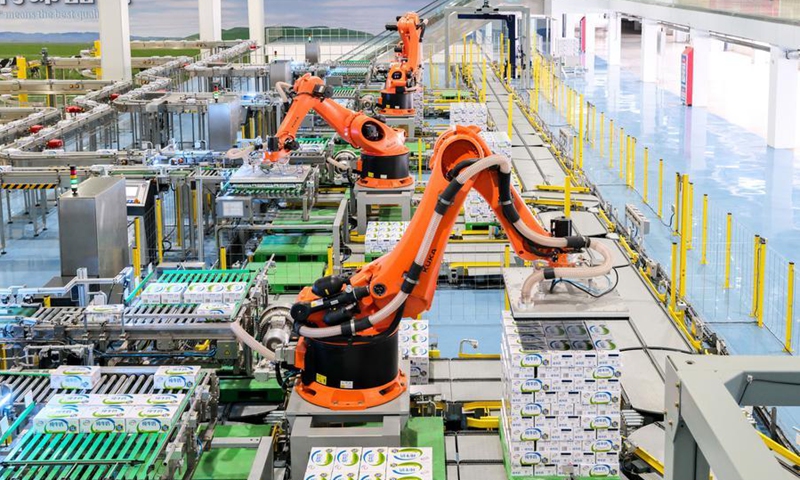
Robotic arms carry out packaging operation at the Global Intelligent Manufacturing Industrial Park of Yili Modern Intelligent Health Valley in Tumd Left Banner in Hohhot, north China's Inner Mongolia Autonomous Region, April 17, 2025. (Photo: Xinhua)
China's major industrial enterprises achieved profit growth last year, reversing the downward spiral that ran from 2022 to 2024, with new growth sectors such as equipment and high-tech manufacturing playing an increasingly prominent role, an official of the National Bureau of Statistics (NBS) said on Tuesday.
According to the NBS, profits of major industrial enterprises rose by 0.6 percent year-on-year in 2025. Manufacturing profits grew by 5.0 percent, a significant rebound of 8.9 percentage points from a year earlier.
In December, the performance of industrial enterprises reversed from a decline of 13.1 percent in November to an expansion of 5.3 percent, a rebound of 18.4 percentage points, NBS data showed.
"China attaches great importance to the deep integration of the digital and real economies, leveraging next-generation information technologies to empower the transformation, upgrading, and development of the real economy, especially in the industrial and manufacturing fields. This has provided a solid foundation and strong impetus for the recovery and high-quality development of the real economy," Li Chang'an, a professor at the Academy of China Open Economy Studies under the University of International Business and Economics, told the Global Times on Tuesday.
NBS statistician Yu Weining said that equipment manufacturing provided solid support for the high-quality upgrading of Chinese enterprises. In 2025, profits of equipment manufacturing enterprises rose by 7.7 percent, contributing 2.8 percentage points to the overall profit growth of industrial enterprises, making it the sector with the strongest pulling effect on profit growth, Yu noted.
The proportion of profits among equipment making enterprises reached 39.8 percent of the total profits of all industrial enterprises last year. Of the eight major sub-sectors of equipment production, profits in seven sub-sectors increased year-on-year. The railway, shipbuilding, aerospace and transportation equipment sectors achieved double-digit growth at 31.2 percent, as well as electronics, which expanded by 19.5 percent, the NBS statistician said.
Li said that as the foundation of industry, the equipment manufacturing sector's profit growth not only reflects the recovery of domestic and international demand for industrial equipment products, but also underscores the strengthened foundation and supply capacity of China's industrial sector.
High-tech manufacturing injected strong momentum into the high-quality growth, Yu said. In 2025, profits of high-tech manufacturing firms rose by 13.3 percent year-on-year, 12.7 percentage points higher than the overall growth rate for all industrial enterprises above the designated size.
Smart electronic products created new consumption trends, driving profit growth in the intelligent equipment manufacturing sector to 48 percent year-on-year. Within this category, profits in intelligent unmanned aerial vehicle manufacturing surged by 102.0 percent and intelligent in-vehicle equipment manufacturing profits rose by 88.8 percent.
According to Yu, profits in the semiconductor sector grew strongly last year, with integrated circuit manufacturing profits growing by 172.6 percent, and those of semiconductor device-specific equipment manufacturing rising by 128 percent.
In the medical care sector, profits in genetic engineering drugs and vaccine manufacturing grew 72.7 percent, and biopharmaceutical manufacturing rose by 37.1 percent.
Yu added that the development of new quality productive forces in traditional industries continued to show results in 2025. For instance, within the chemical industry, profits in the manufacturing of biochemical pesticides and microbial pesticides increased by 20.7 percent, exceeding the average profit growth rate of the chemical industry by 28.0 percentage points.
"New quality productive forces serve as the fundamental driving force behind the optimization of China's industrial structure and the enhancement of quality and efficiency, providing a solid foundation for overcoming structural challenges and achieving the long-term sound development of the industrial economy," Li noted
In addition, the performance of small and medium-sized enterprises and foreign-invested enterprises turned from declines to growth in 2025. Full-year profits increased by 1.4 percent and 4.2 percent, respectively, compared with declines of 1.9 percent and 1.7 percent in 2024, according to Yu.
However, the impact of global uncertainties and changes in the external environment linger, and the process of industrial transformation and upgrading has encountered some pains, and some enterprises still face certain difficulties in production and operations, Yu said.
In the next stage, efforts should be directed to promote the deep integration of scientific and technological innovation with manufacturing, continuously optimize the industrial structure, and accelerate the cultivation of new quality productive forces, in order to drive sustained improvement in the efficiency of Chinese enterprises, Yu noted.
Li said that in 2026, the growth momentum of profits for China's industrial enterprises is expected to continue. Favorable conditions include the intensification of measures such as stabilizing growth, expanding domestic demand, and promoting consumption.
In addition, the integration of advanced technologies including next-generation information technologies, artificial intelligence, and green and low-carbon technologies, with the real economy will deepen further, accelerating the penetration of new quality productive forces into a wider range of industries, Li said.
RELATED ARTICLES