China records 697m cross-border trips in 2025, up 14.2% year-on-year
Surge reflects continued opening-up, improved mobility environment and stronger market confidence, expert says
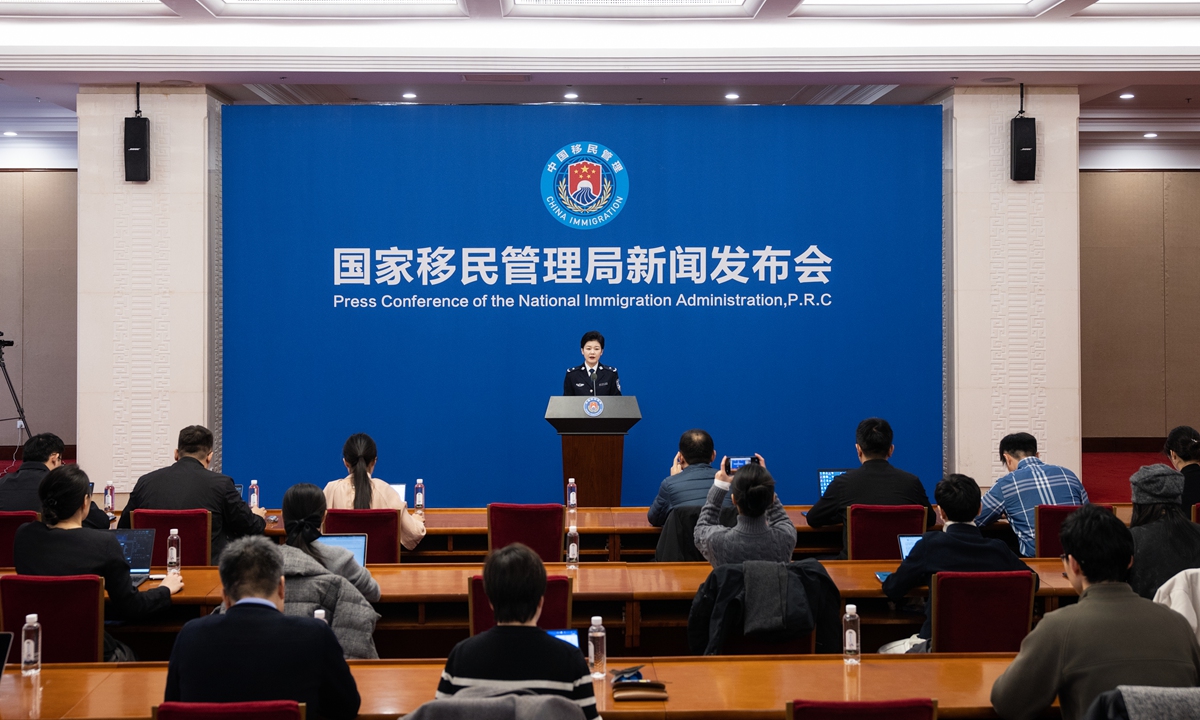
Lü Ning, a spokesperson for the National Immigration Administration (NIA), hosts a press conference on January 28, 2026, to present major statistics and achievements in China's immigration administration work in 2025. Photo: Courtesy of the NIA
China's national immigration authorities processed 697 million cross-border trips in 2025, up 14.2 percent year-on-year, a record high, according to the National Immigration Administration (NIA) on Wednesday.
The surge reflected the country's continued opening-up, an improved mobility environment, and stronger market confidence, a Chinese expert said.
The NIA on Wednesday presented major statistics and achievements in China's immigration administration work in 2025, during which accomplishments made over the past year were outlined.
According to Lü Ning, a spokesperson for the NIA, of the total cross-border trips last year, Chinese mainland residents accounted for 335 million trips, up 15.1 percent, while residents from Hong Kong, Macao, and the Taiwan region made 279 million trips, up 10.1 percent.
One notable development was the accelerating pace of cross-border mobility among foreign nationals. According to Lü, China recorded 82.035 million cross-border trips by foreign nationals, a 26.4 percent increase year-on-year. Of these, 30.08 million entered China visa-free, accounting for 73.1 percent of all foreign arrivals, up 49.5 percent year-on-year.
In 2025, China's national immigration authorities continued to enhance the efficiency of immigration management services. Throughout the year, 20.897 million ordinary Chinese passports were issued. Also, 2.02 million visas for foreign nationals were issued, said the spokesperson.
To promote people-to-people exchanges between China and other countries, China expanded the pilot program allowing mainland residents to apply for renewal and reissuance of exit-entry documents entirely online, increasing the number of participating cities to 50.
Moreover, a visa-free entry policy for ASEAN tour groups visiting Xishuangbanna, Southwest China's Yunnan Province, was implemented.
In coordination with relevant authorities, China expanded the number of countries eligible for unilateral visa-free entry to 48, increased mutual visa-exemption agreements to 29 countries, and advanced efforts to raise the number of countries granted unilateral visa-free entry to China to 28, according to the NIA.
The sharp rise in overseas arrivals highlights China's continued push for opening-up, especially as visa-free arrangements are steadily expanded, Yang Jinsong, an expert with the China Tourism Academy, told the Global Times. He noted that inbound tourism delivers benefits beyond higher visitor volumes, as tourist spending on food, lodging, transport, attractions, retail, and leisure activities helps stimulate a wide range of related industries and translates into tangible economic gains.
The positive figures released by the NIA reflect a sustained increase in the level of cross-border mobility, injecting new momentum into tourism and business activity, Li Changan, a professor at the Academy of China Open Economy Studies under the University of International Business and Economics, told the Global Times on Wednesday.
Li said that in the past two years, China has further rolled out a series of policies to streamline entry and exit procedures and to foster a more favorable business and consumption environment. "These policies have generated strong appeal for both domestic and international travelers and constitute a key driver behind the growth in cross-border movements," he said.
At the same time, relevant authorities have continued to advance more systematic institutional improvements, promote visa facilitation, and optimize immigration administration services, the expert said, noting that "taken together, these efforts have effectively reduced the institutional costs of cross-border mobility."
Moreover, enhanced supporting measures - such as improved language services, more convenient payment options, and smoother transportation - have significantly improved the overall experience for visitors to China, experts said, noting that these factors are particularly important in attracting foreign tourists and business travelers.
As this year marks the first year of China's 15th Five-Year Plan (2026-30), with the country vowing to carry out high-level opening-up, Li said that cross-border activities are expected to maintain the momentum. Greater cross-border mobility also generates spillover effects by boosting foreign investors' confidence in the Chinese market, thereby supporting efforts to attract foreign investment and expand inbound capital flows, said Li.
RELATED ARTICLES