China's central SOEs spend over 1 trln yuan on R&D for fourth consecutive year: SASAC
By Published: Jan 28, 2026 11:16 AM
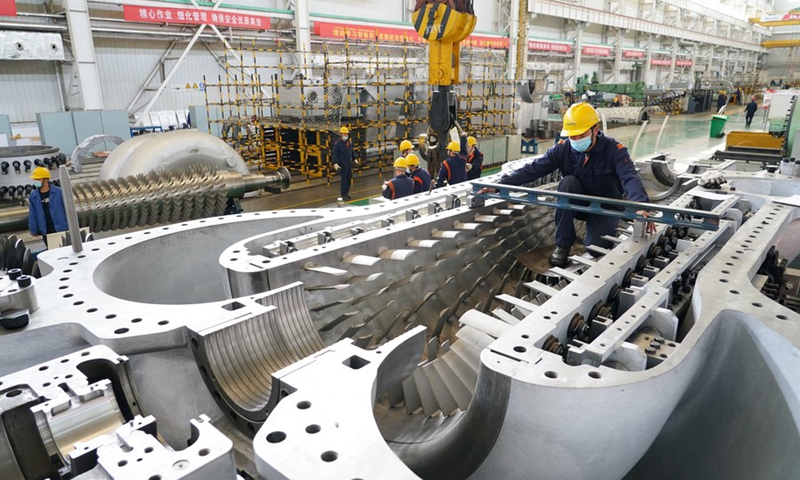
An engineer assembles an axial-flow compressor at a workshop of the Shaanxi Blower (Group) Co., Ltd., a state-owned enterprise, in Xi'an, Northwest China's Shaanxi Province, November 18, 2020. Photo: Xinhua
The total assets of China's centrally administered state-owned enterprises (SOEs) exceeded 95 trillion yuan ($13.66 trillion) in 2025, and their total profits reached 2.5 trillion yuan, data from the State-owned Assets Supervision and Administration Commission (SASAC) of the State Council showed.
During the 14th Five-Year Plan period (2021-25), the total assets of centrally administered SOEs rose from 70 trillion yuan to more than 95 trillion yuan, with an average annual growth rate of 6.9 percent, according to the state asset watchdog.
Looking at the performance of China's central SOEs over the previous year, their role in serving as an important actor in China's drive to promote science-technology innovation became more prominent, Cong Yi, a professor at the Tianjin School of Administration, told the Global Times on Wednesday.
As the country attached greater emphasis to research and development (R&D) and self-reliance in science and technology, central SOEs also played an active role, Pang Xiaogang, deputy head of the SASAC, said at a press conference held by the State Council Information Office on Wednesday.
At the press conference, it was revealed that in 2025, central SOEs invested 1.1 trillion yuan in R&D, marking the fourth consecutive year that R&D spending exceeded 1 trillion yuan. Central SOEs also witnessed a record-high 22 new academicians being elected to the Chinese Academy of Sciences and the Chinese Academy of Engineering.
Additionally, 23 innovation consortiums attracted more than 100 new innovation entities to jointly tackle key challenges, achieving a series of breakthroughs in cutting-edge fields and further highlighting the role of national strategic scientific and technological capabilities, according to Pang.
During the 15th Five-Year Plan period (2026-30), the SASAC will continue to foster sci-tech innovation and enhance the momentum of high-quality development by guiding central SOEs to strengthen efforts in pursuing independent innovation, original innovation and breakthroughs in core technologies in key fields, Pang said.
More efforts will be made to upgrade and enhance innovation consortiums, opening up application scenarios, sharing data, unifying standards and actively promoting the commercialization of scientific and technological achievements to foster new quality productive forces, said the official.
In October, initiated by the SASAC, a fund with an initial capital of 51 billion yuan was launched in Beijing to assist centrally administered SOEs in developing strategic emerging industries such as artificial intelligence, new materials, high-end equipment, and quantum technology.
In accordance with the directives of the SASAC, the fund will prioritize serving national strategic needs, strengthen and complement industrial chains, and facilitate central enterprises in scaling up and improving the quality of their strategic emerging industries. Also, the fund will accelerate the layout and development of these industries by central SOEs.
The central SOEs' role in fostering innovation was highlighted in the previous five years as well as the country's future development plan in driving the advancement of science and technology and promoting high-level self-reliance. The strength stems from China's unique institutional advantage, Cong said.
The country boasts the combined strengths of both "national teams" that press for breakthroughs in basic R&D and those of the vast private sector, which excels in promulgating wide and swift application, Cong said.
In 2025, central SOEs completed investments of 2.5 trillion yuan in strategic emerging industries, accounting for 41.8 percent of their total investment. This marked a sharp increase from 22 percent at the beginning of the 14th Five-Year Plan period (2021-25).
Last year, the central SOEs effectively facilitated the integrated development of enterprises across the industrial chain, providing strong support for the successful accomplishment of the main tasks of China's economic and social development, according to Pang.
Central SOEs completed fixed-asset investments of 5.1 trillion yuan, and paid taxes and fees of 2.5 trillion yuan, according to Pang.
The central SOEs derived more than 70 percent of their revenue from areas related to national security, the lifeline of the national economy, and the people's livelihood, Pang said.
During the year, strategic and specialized restructuring and integration were carried out in an orderly manner, according to SASAC officials. Since 2023, four new central SOEs have been established, leading to continued optimization of resource allocation in the country.
RELATED ARTICLES