Carney denies walking back Davos speech, says ‘almost nothing is normal in the US’; Chinese analyst views remarks as another move to reduce overreliance on US
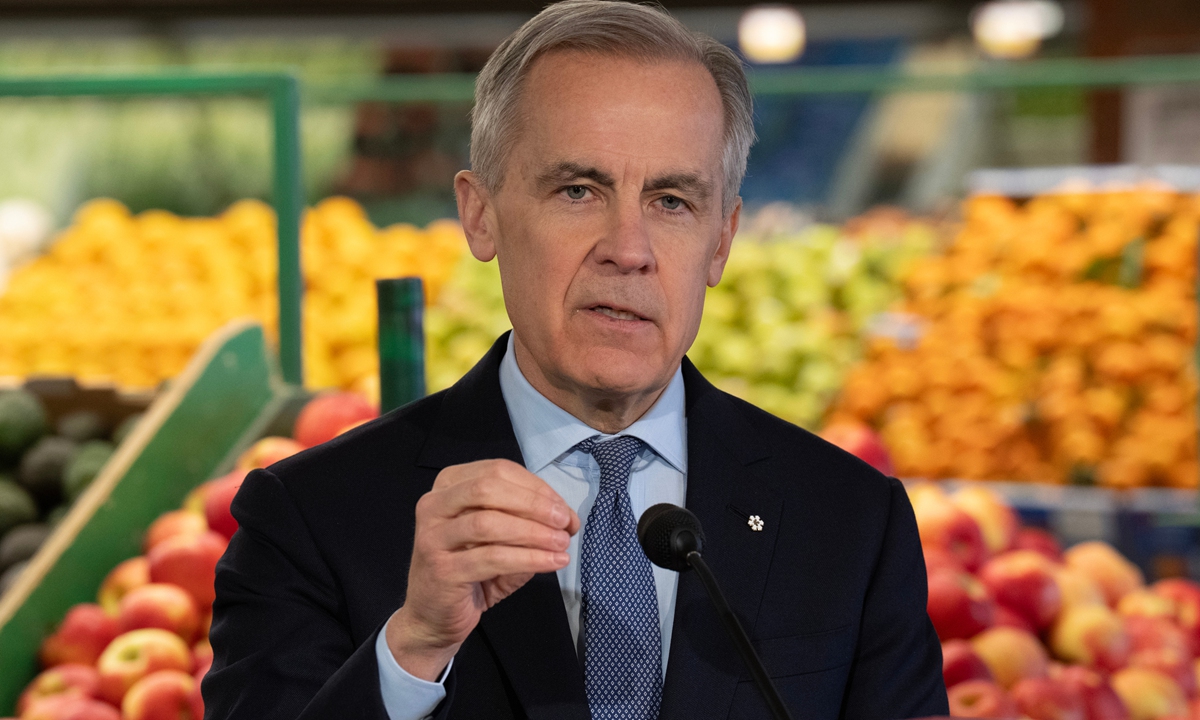
Canadian Prime Minister Mark Carney speaks at an event at a grocery store in Ottawa on January 26, 2026. Photo: VCG
In another move that was viewed by analysts as reducing overreliance on the US and seeking diversification of foreign relations, Prime Minister of Canada Mark Carney on Tuesday (local time) denied US Treasury Secretary Scott Bessent's claim that he has walked back the comments he made in Davos, Switzerland, in his phone conversation with US President Donald Trump.Asked directly if he walked his comments back, Carney said, "no."
Carney made a highly publicized speech at Davos last week, in which he warned that the world is "in the midst of a rupture" in the international order and said he intends "to be both principled and pragmatic."
Trump responded last week by claiming that Canada only existed because of the US, and later said he would impose a 100 percent tariff on imports from Canada if Ottawa concluded a trade deal with China.
Trump and Carney spoke by phone on Monday, and Bessent said that during the conversation, the Canadian leader was very aggressively "walking back" some of the unfortunate remarks, reported CNBC.
"To be absolutely clear, and I said this to the president, I meant what I said in Davos," Carney told reporters in Ottawa on Tuesday morning, pushing back on Bessent's remarks from the night before, per report.
Carney's latest responses mark a series of signs that the Canadian prime minister, who was elected in April 2025 succeeding Justin Trudeau, does not bow to US pressure. Rather he is standing tough and won't retreat from its strategic approach toward the US, that is to push for reducing overreliance on the US, seeking for diversification and establishing more pragmatic ties with other countries, analysts pointed out.
Analysts also said the "notable" shift in the gesture by the prime minister of Canada could trigger a broader reckoning in the Western world as it shows that US' coercive playbook is visibly fracturing even the tightest alliance.
While it is up to Western countries themselves to decide between "US vassal" and "strategic autonomy," which trajectory they will embark on, Canada's moves could generate a profound effect on reshaping North American economic and trade order as well as multi-polarized global order, observers said.
'Hardball approach'
In another occasion, Carney is blunter about how he views the current US. "The world has changed, Washington has changed. There is almost nothing normal now in the US - that is the truth," Carney told the House of Commons elected chamber when asked about the future of trade talks with Washington, according to the BBC.
With regards to the conversation with Trump on Monday, Carney clarified that the context of the call was "what Canada is doing positively to build new partnerships around the world," including "our arrangement with China," Carney said.
Carney's remarks contradicting the claim from the US side made headlines across a variety of mainstream media outlets on Wednesday. Canadian media Global and Mail almost posted every rhetoric Carney made on the relations with the US in a report titled "Carney denies walking back Davos speech in phone call with Trump" on Wednesday.
More in-depth pieces have followed. The Wall Street Journal, in a report titled "Canada's Carney Ditches 'Mr. Nice Guy' Approach to Trump," said that prime minister opts for "hardball" approach as crucial trade talks on USMCA loom.
"Carney's dealings with the US have been quite different from Trudeau, and he's making such stance more openly, and is not refraining from directly criticizing the US' moves amid broader geopolitical shift," Zhou Mi, a senior researcher at the Chinese Academy of International Trade and Economic Cooperation, told the Global Times on Wednesday.
Song Guoyou, a deputy director of the Center for American Studies at Fudan University, told the Global Times on Wednesday that Carney's approach is a combined result of geopolitical pressure, personal experience and Canada's domestic political reality.
"From a geopolitical perspective, Canada's proximity to the US makes it vulnerable to becoming Washington's go-to target for pressure, whether in terms of tariffs, trade or other policy. Compared with distant European allies, Canada squarely and inescapably experiences aggression and unpredictability of the US policy, and it has to respond as space for hedging or dodging is so limited," Song said.
The tensions and divisions between Washington and Ottawa have continued to increase in recent months.
At the political and diplomatic levels, Trump has more than once suggested turning Canada into the "51st state" of the US. On the economic front, the US has threatened to impose new high tariffs on Canada and sought to restrict its normal trade with third countries, similarly touching on Canada's core interests.
Zhou said Carney has a clear read on the prevailing public sentiment. And if he projects weakness on issues of sovereignty, national security, and relations with the US, it will not only fail to address widespread public concerns but also carries heavy political costs, analyst pointed out.
Meanwhile, unlike his predecessor Trudeau who has years of experience as a politician and party leader, Carney's rich experiences in working at major central banks - like serving as the governor of the Canada's central bank, as well as the Bank of England - along with his deep involvement in global financial institutions, has made him a firm believer in rule-based international order, Song added.
"Because of this background, when confronted with policies that clearly carry unilateralist and coercive undertones, he is far more inclined to respond through the lens of institutions, rules, and the international order, rather than resorting to straightforward political compromise or accommodation," Song explained.
Carney vs Rutte?
Chinese observers also noted that it is "kind of surprise" that Carney comes first over European leaders in resisting US pressure and seeking more policy autonomy.
Carney's straightforward approach also runs in stark contrast to that of Rutte, who now serves as NATO chief. Rutte claimed on Monday that "Europe can't defend itself without the US," while also urging to "continue to build ties with the US," Politico reported.
"Who will the Western world need? Carney or Rutte?" Liu Dan, a research fellow at the Center for Regional and Country Studies at Guangdong University of Foreign Studies, asked. Liu believes that Carney's turn is notable as it marks a visible crack in the Western alliance, in which the closest US ally is "seeking a pragmatic transformation" rather than "swearing unconditional royalty."
Liu told the Global Times that Western countries' leaders will make their own choices based on a sober assessment of national interests, sovereignty, and dignity into the foreground. Time will tell what the best outcome will be, she added.
"In the pursuit of foreign policy and economic diversification, the relations with China will likely serve as key variable. In the past, ideology and other factors had prevented these countries from making choices that truly served their own interests. And the pragmatic shift by Western nations - while some are still in a period of watching, will contribute to building a more multipolar world with a fairer international order," Song said.
RELATED ARTICLES