ARTS / CULTURE & LEISURE
Beijing’s Central Axis heritage sites rejoin city’s dynamics
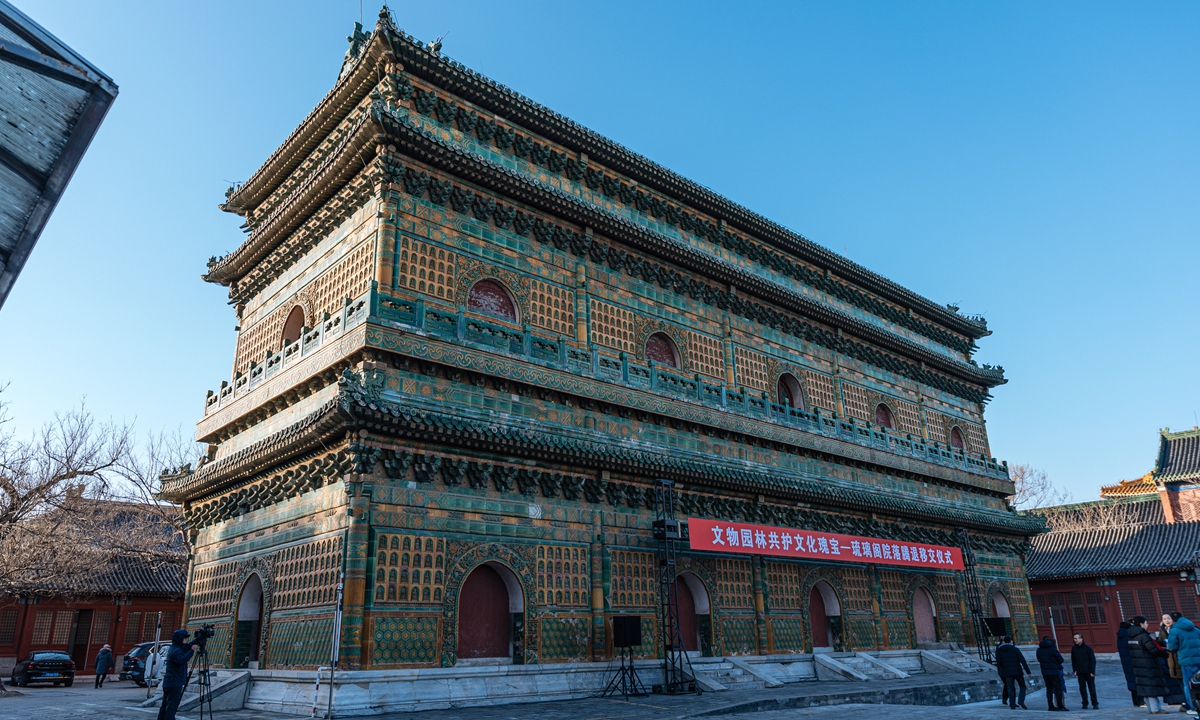
The Liuli Pavilion in Beijing's Beihai Park Photo: Li Hao/GT
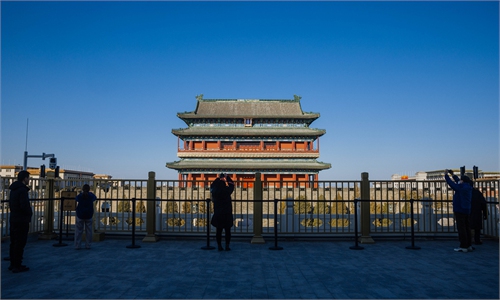
As several historical sites along Beijing's Central Axis have been brought back to life and set to open to the public soon, the capital will advance the opening of the Zhengyangmen Gate Tower in 2026, demonstrating its latest efforts in promoting the creative reuse of cultural relics and historical architecture, and allowing heritage to live and breathe within the rhythm of the modern city.The Liuli Pavilion courtyard was officially transferred to the management of the capital's Beihai Park on January 22, restoring the integrity of the 400-year-old "Xitian Fanjing" (Western Paradise of the Buddhist Realms), which is also set to open. The handover marks the first time in 70 years that the Xitian Fanjing, a historical architectural complex within Beihai Park dating back more than 400 years, has been completely restored.
Earlier, following the relocation of a school inside its walls, Xiannongtan Temple - one of the major cultural sites along the Central Axis - has officially reconnected its inner and outer areas, taking an important step in restoring its historical layout.
These restorations and re-openings expand the possibilities for protecting, interpreting, and using the cultural heritage of the Central Axis, Liu Zheng, a member of the Chinese Society of Cultural Relics, told the Global Times on Wednesday.
The restoration of the Yongdingmen Gate Tower is also planned, according to information released at the fourth session of the 16th Beijing Municipal People's Congress.
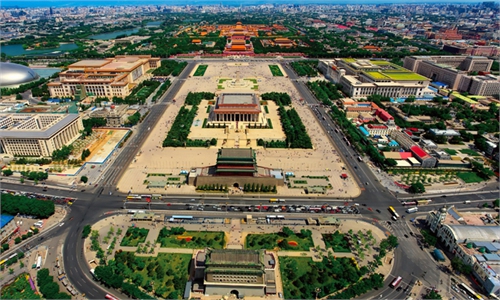
Stretching 7.8 kilometers from the Yongdingmen Gate in the south to the Bell and Drum Towers in the north, the Beijing Central Axis was constructed based on ancient architectural philosophies to create an ideal layout for a capital city. The Central Axis can be traced back to the Yuan Dynasty (1279-1368), while its length was extended in the Ming (1368-1644) and Qing (1644-1911) dynasties.
Built in 1759, the Liuli Pavilion is a masterpiece of mid-Qing imperial garden architecture and a powerful symbol of the Chinese nation's unity in diversity and cultural integration. Its façade is inlaid with 1,424 glazed tile statues of the Buddha, making it one of the few surviving examples of imperial-style glazed architecture from the Qing Dynasty.
For many years, the Beijing Institute of Archaeology operated out of the Liuli Pavilion, where limited space constrained its development. The public, meanwhile, was unable to access this part of Beihai Park. With the pavilion returned to public use, Beihai Park has gained an essential new attraction, and the Central Axis has become more complete as a cultural landscape, according to Liu.
This signals a fundamental shift in China's approach to heritage conservation. Cultural relics are no longer treated as static relics sealed away from the public. Instead, Beijing is moving toward a new phase of "living conservation," in which heritage sites interact deeply with the urban fabric and everyday public life. This is not only about restoring structures, but about regenerating functions and reassigning cultural meaning in a contemporary context, said Liu.
The upcoming opening of Xitian Fanjing turns once-restricted imperial spaces into public cultural areas that can be felt, understood, and enjoyed. Similarly, the relocation of a school from the heritage zone of Xiannongtan Temple shows respect for the integrity of the building itself, while freeing space for more professional, open, and diverse cultural displays and experiences. In this process, formerly enclosed spaces are re-imagined as shared urban visiting sites, elevating heritage to a civic asset.
The revitalization of the Central Axis has reflected Beijing's holistic approach to old-city conservation and urban renewal. The relocation of residents and the restoration of heritage ensures that heritage revitalization is not admired from afar, but part of a larger landscape embedded in the city's renewal. Residents become beneficiaries and participants in heritage protection, creating the social foundation for long-term sustainability.
More than being merely tourist attractions, some future openings of heritage sites along the Central Axis support academic research, public education, and artistic experimentation, allowing heritage sites to host richer layers of cultural life.
Another three revitalized heritage sites that will soon open to the public are Peking Opera master Mei Lanfang's ancestral home, Wudao Temple and Yongquan An (a nun convent). Mei's ancestral home will be developed into a Mei Lanfang aesthetic art exhibition center, integrating digital art and immersive costume experiences. Wudao Temple will be revitalized as a Beijing dialect hall while Yongquan An will be transformed into an art museum for precious nanmu wood.
Through creative transformation and innovative development, the heritage sites along the Central Axis can breathe with the modern city, becoming a source of cultural identity, a resource for contemporary life, and an inspiration for future generations.
The author is a reporter with the Global Times. life@globaltimes.com.cn
RELATED ARTICLES