Hainan FTP draws nearly 20% more foreign capital y-o-y in 2025; outbound investment up 20.7%: official
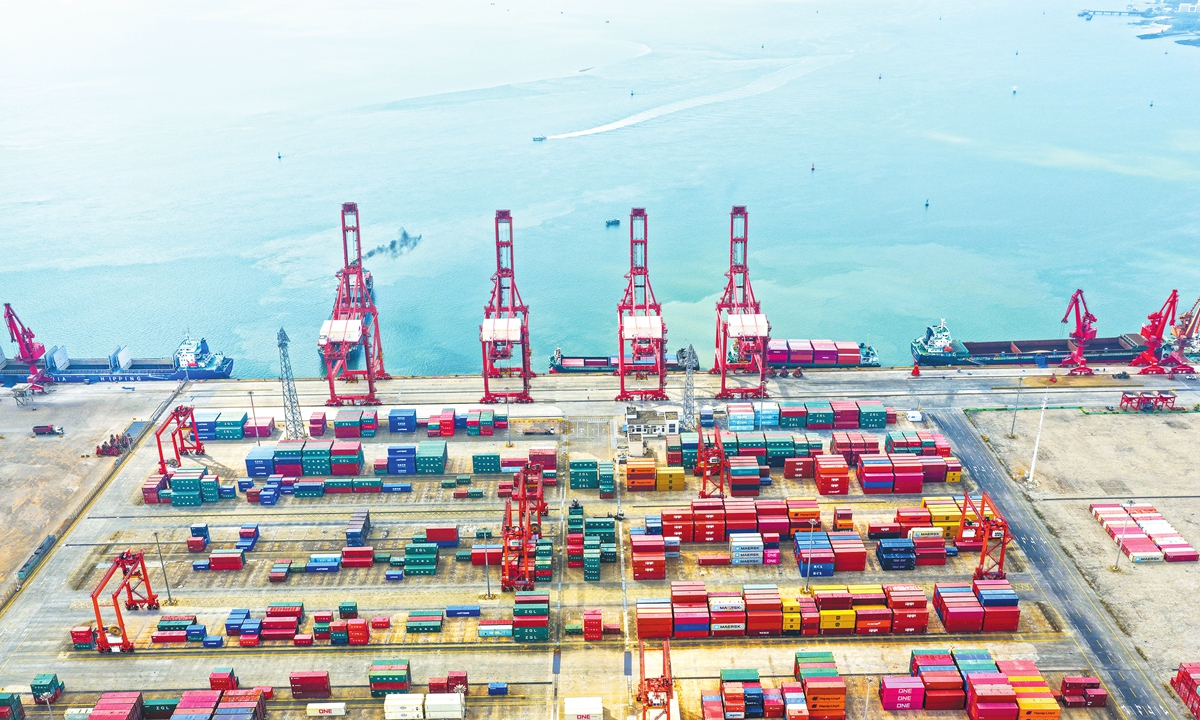
An aerial view of the busy and orderly scene at Yangpu Port in Danzhou, South China's Hainan Province, on December 20, 2025 Photo: VCG
Business activity and foreign investment in Hainan Free Trade Port (FTP), South China's Hainan Province picked up in 2025, with actual use of foreign capital reaching 25.1 billion yuan ($3.61 billion), a year-on-year increase of 19.9 percent, according to a press conference held by the provincial government on Wednesday.
Hainan's outward investment also expanded rapidly. Non-financial outward direct investment in 2025 totaled $3.62 billion, up 20.7 percent year-on-year, according to Zhang Yueqiang, deputy director of the Department of Commerce of Hainan Province, per a meeting transcript released by the Hainan Provincial Department of Commerce.
As new policies began to take effect, the data underscored rising market vitality and investor confidence. The policy dividends generated by the island-wide special customs operations are already being translated into concrete benefits for market entities both from home and abroad, said a Chinese expert.
Zhang said that 2025 was a year of "quantity and quality" gains in two‑way investment for Hainan. Flagship projects from foreign investors landed in Hainan last year — including Siemens Energy and Swire Coca‑Cola - and the province also welcomed its first wholly foreign‑owned hospital, according to the chinanews.com report.
During the 14th Five-Year Plan (2021-25) period, Hainan's actual use of foreign capital grew at an average annual rate of 16.7 percent, attracting investment from 180 countries and regions, according to the provincial government work report released on Tuesday.
Starting this year, Hainan plans to build a high-quality platform to support companies going global and has set a target of 10 percent growth in actual outbound direct investment. The province also aims for more than half of its outward investment to flow to Belt and Road countries, chinanews.com reported on Wednesday.
The special customs operations, launched in the Hainan FTP on December 18, 2025, are already delivering early results. Preliminary data from the first month showed a 13 percent rise in newly established foreign-funded enterprises in Hainan, per the provincial government.
The island-wide special customs operations are designed to facilitate trade, investment, and customs clearance to create a new environment for developing high-end manufacturing clusters and positioning the island as an open economy hub, Yin Chen, a professor at Fudan University and general secretary of the university's Shanghai Institute for Free Trade Zone Research, told the Global Times on Wednesday.
Yin noted that rapid growth in foreign investment in high-tech manufacturing and modern services has become the main engine of foreign-invested transformation and innovation. "Hainan has seized the opportunity of becoming a free trade zone and free trade port and aligned itself with new international development trends," Yin said, adding that the province still has substantial room and potential for further trade and investment development.
Chinese enterprises can leverage the Hainan FTP to access global markets more conveniently, while foreign companies can use Hainan as a bridgehead to enter the Chinese mainland market, said Yin.
Italian enterprise Hainan Zambon Pharmaceutical Co told the Global Times that it views Hainan as a key strategic hub in deepening its presence in the Chinese market. Hainan's institutional innovation, cross-border facilitation, and international business environment provide an important platform for integrating global resources and serving patients in China, the company said.
"China's continued high-level opening-up, including the full removal of foreign investment restrictions in manufacturing, sends a clear and positive signal to foreign investors. We have seen improvements in regulatory transparency, policy stability, and government support for foreign-invested enterprises. Overall, China's business environment has become more mature and predictable, which is conducive to long-term development," it said.
Global Times
RELATED ARTICLES