China’s 2026 spring travel rush set to hit record-breaking 9.5b trips
Rise signals stronger economic confidence, early-year consumer spending momentum
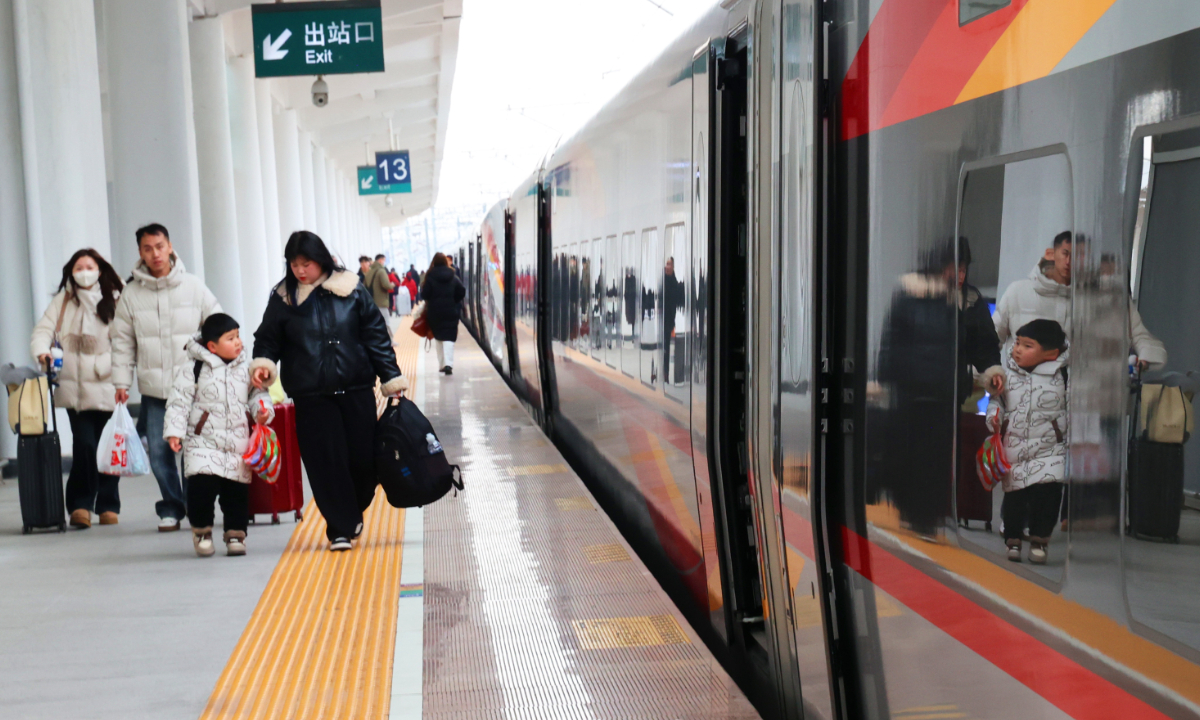
Passengers prepare to board an electric multiple unit train at a railway station in Lianyungang, East China's Jiangsu Province, January 1, 2026. Photo: VCG
Chunyun, the world's largest annual human migration, will span a longer period than the nine-day Spring Festival holiday, running from February 2 to March 13 and lasting 40 days.
Self-driving trips are expected to remain the dominant mode of travel, accounting for about 80 percent of the total, according to official national data released on Thursday. Also, railway and civil aviation passenger trips are projected to reach 540 million and 95 million, respectively, with both overall volumes and daily peaks likely to surpass previous records for the same period.
As a key pillar of the Spring Festival travel rush, major Chinese airlines have released updated forecasts and put in place proactive arrangements to meet the expected surge in demand, according to statements they sent to the Global Times on Thursday.
To ensure smooth travel during the Spring Festival travel rush, China Southern Airlines plans to operate more than 126,000 passenger flights, with about 13,000 additional services scheduled across more than 260 routes.
China Eastern Airlines said that it will deploy 822 passenger aircraft during chunyun, including 14 domestically developed C919 jets, operating a total of about 125,000 flights.
Overall, civil aviation authorities will prioritize adding flights to major hub airports and popular tourist destinations, with daily flight operations expected to average 19,400, up 5 percent year-on-year, Li Chunlin, a deputy director of the National Development and Reform Commission, told a press conference on Thursday.
On the capacity front, the railway sector has rolled out new support measures, introducing an updated timetable. On peak travel days, more than 14,000 passenger trains are expected to be in operation, with seating capacity up 5.3 percent year-on-year, according to Li.
Insiders noted that the extended holiday and more flexible travel arrangements are expected to push tourism to new highs, while income-driven consumption effects continue to strengthen.
Chinese travel platform Fliggy told the Global Times on Thursday in a statement that hotel bookings during the Spring Festival holiday are up 71 percent year-on-year.
Fliggy's data showed clear trends of both longer-distance "three-hour flights" and shorter "two-hour self-driving" journeys, with the former concentrated in emerging tourist cities within about 300 kilometers of major first- and second-tier cities, and the latter focused on popular destinations in Southwest, Northwest and Northeast China.
As of Thursday, mid-holiday air ticket bookings were up 55 percent year-on-year, while car rental bookings had surged 97 percent and chauffeured tour bookings had jumped 111 percent.
Large-scale travel and tourism are expected to provide a clear and direct boost to services consumption, Dong Shaopeng, a senior research fellow at the Chongyang Institute for Financial Studies at Renmin University of China, told the Global Times on Thursday. Concentrated demand for transportation, accommodation and catering will help lift activity across the services sector, underscoring the economy's growing momentum and resilience, Dong said.
In 2025, domestic tourist trips in China reached 6.522 billion, a year-on-year increase of 16.2 percent, data from the Ministry of Culture and Tourism showed on Monday.
More notably, domestic tourism spending rose to 6.30 trillion yuan ($880 billion), up 9.5 percent, the ministry's figures showed. Spending by urban residents climbed to 5.30 trillion yuan, up 7.5 percent year-on-year, while spending by rural residents reached 1.00 trillion yuan, surging 21.4 percent.
Tourism, dining and travel-related spending serve as leading indicators of consumer sentiment, Dong said. A willingness to travel during holidays not only points to rising demand for better living standards and experience-based consumption, but also signals improving confidence in income growth and the broader economic outlook, he added.
"From both an actual spending and expectations perspective, such trends provide solid support for economic momentum at the start of the year."
Dong noted that a moderate recovery in services prices would also be positive, helping the sector restore reasonable profit margins and move toward a more balanced footing after the pandemic and recent structural adjustments. At the same time, he cautioned that the surge in travel demand will place higher requirements on transport capacity, accommodation and destination management, calling for better coordination by transport and cultural tourism authorities.
Drawing on experience, Dong said that a rebound in tourism and travel consumption typically generates spillover effects for regional economies and GDP, adding that temporary price increases in areas facing tight supply should be managed prudently and viewed as part of the normal economic recovery process.
RELATED ARTICLES