ARTS / CULTURE & LEISURE
Dainty blossoms emerge as new trend at Chinese New Year flower markets
Taking spring home
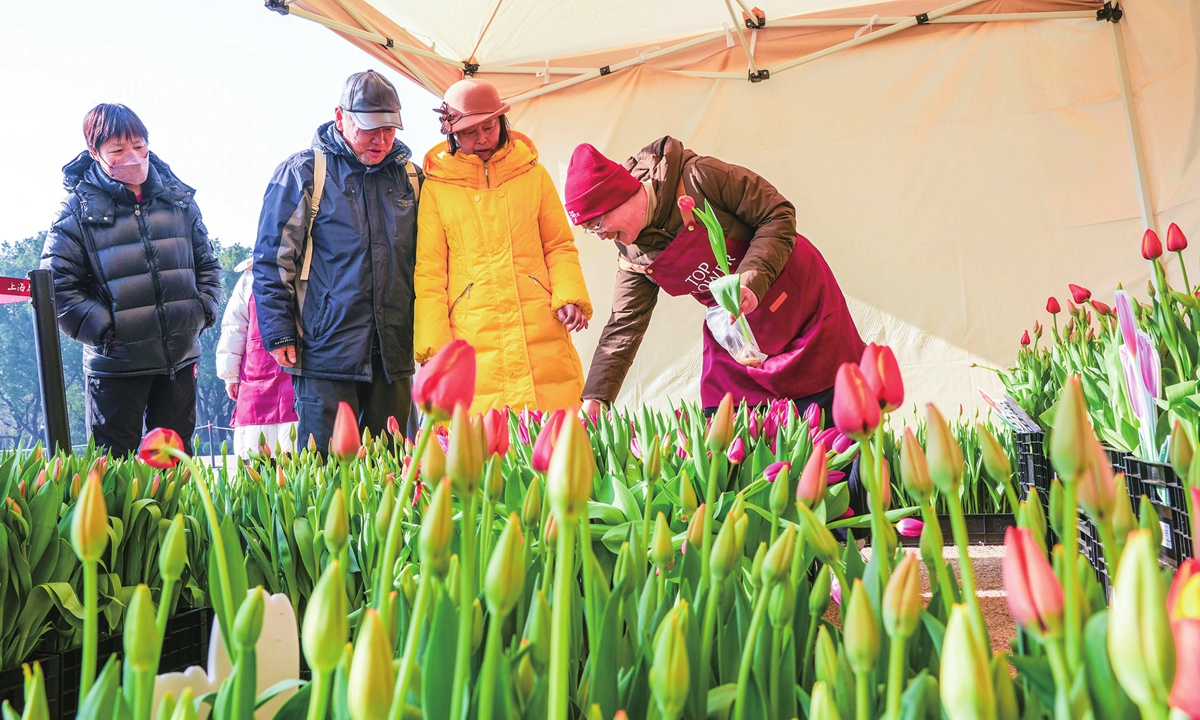
Citizens select flowers at a Chinese New Year flower market in Shanghai, on January 24, 2026. Photo: Courtesy of Wang Jinxiu
At Shanghai's Fuxing Park Chinese New Year flower market, flower enthusiast Wang Jinxiu paused in front of a bed of tulips. While outside, the winter air was cold, inside the greenhouse it was comfortably warm, and the pleasant scent of soil and flowers filled the air. Standing behind a group of young visitors, scissors in hand, Wang carefully selected a few stems. Here, tulips can be cut on the spot, wrapped, and taken home immediately. After making her choice, she wandered along the park's paths and came upon another floral display designed for visitors to step into and take photos. Some lifted their phones, adjusting angles, others crouched down to capture close-up details of the blooms.
"This isn't just about buying flowers," Wang, who has long followed flower markets, told the Global Times. "It feels more like a blend of old Shanghai's New Year traditions and contemporary, trendy floral experiences."
With two venues set up in the city center and pathways deliberately spaced out, the layout allows visitors to stroll through the market with ease. "You can follow the route and finish browsing without effort," Wang shared, adding buying flowers has become a very relaxing experience.
"Prices start at 15 yuan ($2.16). If you see something you like, you can simply pick up a pot and take it home," Wang said. "The flower market is more like a neighborhood New Year carnival, where flowers, food, photography, and lingering all naturally coexist."
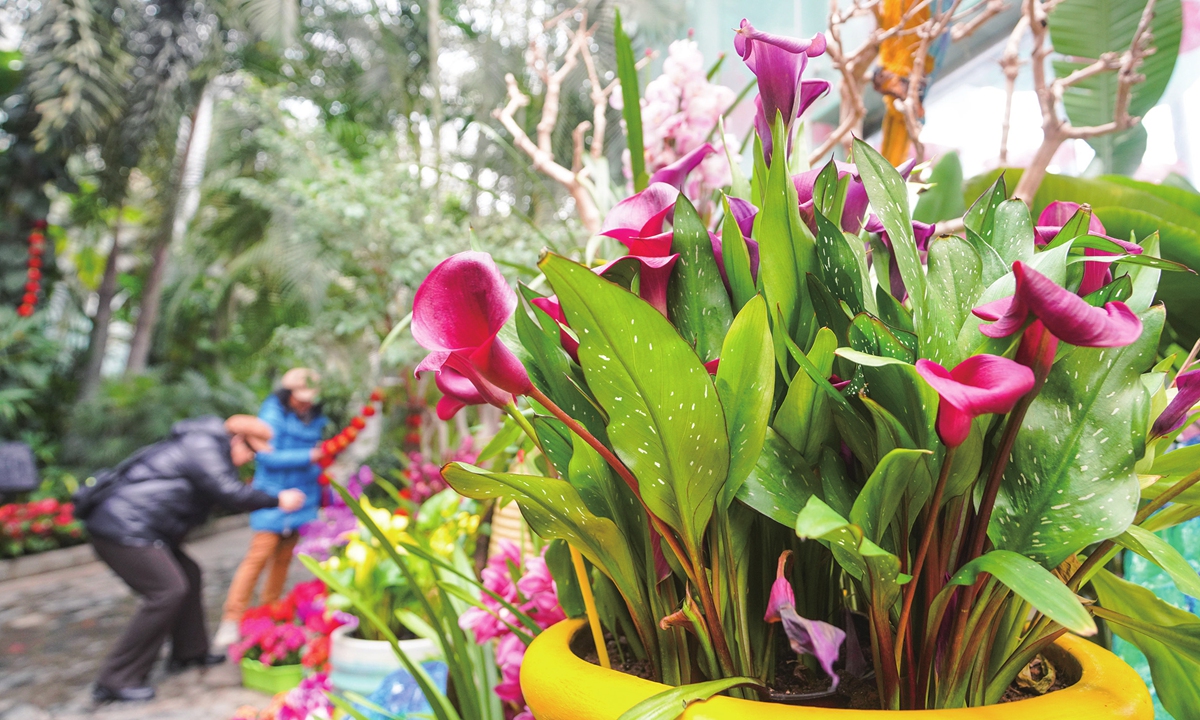
Calla lily on display at the Zhengzhou Botanical Garden Photo: VCG
Going smaller
This sense of ease, of being able to "pick up and go" is increasingly becoming a shared feature of Chinese New Year flower markets across cities. Smaller flowers, more affordable prices, and flexible ways of displaying them, are quietly weaving themselves into everyday life.
As the Spring Festival approaches, flower markets are once again entering their busiest season, but for many regular visitors, this year's markets feel subtly different.
The most visible change lies in scale. Large potted plants that once took up a corner of the living room, and required making space in advance, are increasingly being replaced by lighter, tabletop-sized arrangements.
Zhang Junmei, a small-scale flower market vendor based in Beijing who has been running her stall for more than a decade, has clearly felt the shift.
"Young people live in smaller homes now. Big pots are actually harder to place, while smaller ones are more popular," she told the Global Times. This year, she has seen a noticeable rise in inquiries about calla lilies, small kumquat trees, and fingered citron. "They look good, require minimal care, and don't take up much space."
At her stall, individually wrapped branches of red berries are neatly arranged in one corner. "These are the new favorites," Zhang explained. "Single-stem arrangements for vases. Young customers say it looks 'high-end.' At 25 yuan per branch, you take it home, put it in a glass bottle, and it immediately feels like the New Year has arrived."
After browsing the market, Chen Yu, a 28-year-old designer based in Beijing, was seen carrying only a small paper bag: inside was a white calla lily in a pot.
"My place isn't big, and I don't want anything too grand," she told the Global Times. Rather than making a visual statement, she cares more about the plant's lines and the atmosphere it creates. "Put it by the window or on the dining table, and it just lifts your mood."
While younger consumers are redefining Lunar New Year flowers through aesthetics and experience, traditional "top sellers" remain steady.
A well-packaged pot of orchids still sells for around 260 yuan and remains a go-to choice for many households. North American winterberry, anthuriums, and cymbidium orchids, all associated with auspicious meanings, continue to post stable sales. Vendors note that the real peak has yet to arrive, as it usually comes in the final 10 days before the holiday, according to China National Radio.
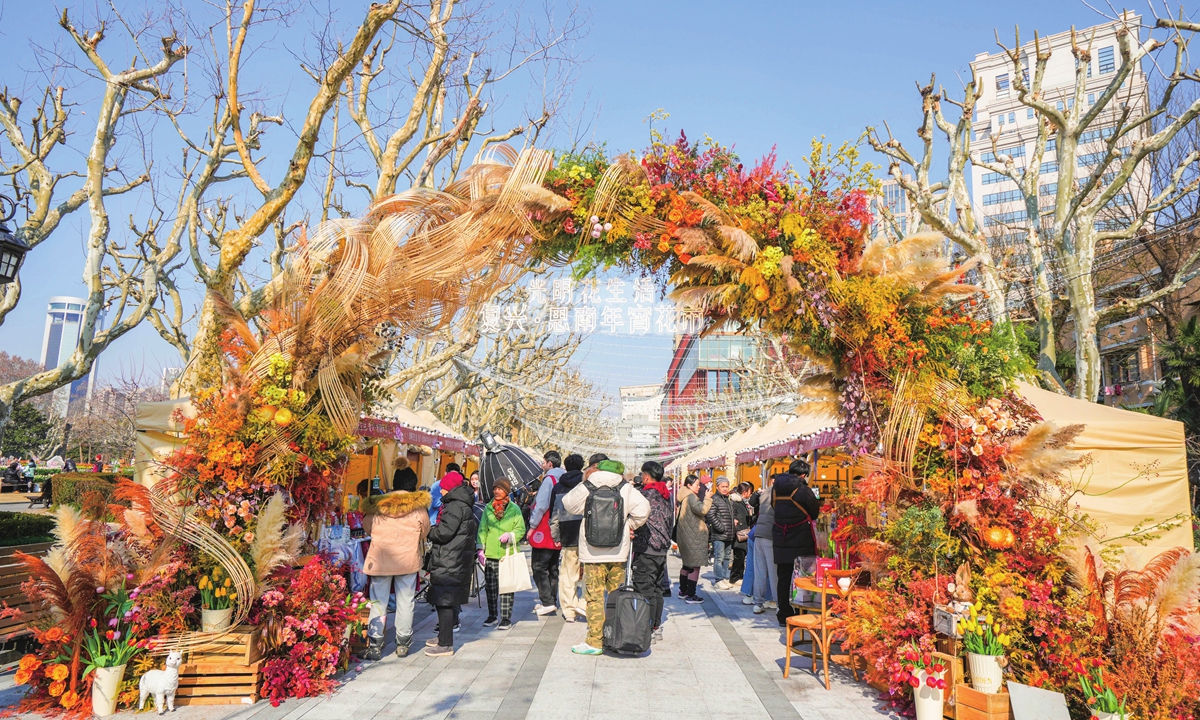
Fuxing Park Chinese New Year flower market in Shanghai Photo: Courtesy of Wang Jinxiu
Emotional anchors
Beyond these familiar "old faces," subtler changes are emerging, reflecting how different age groups understand the festive spirit.
Older customers may tend to focus on color and symbolism, favoring large pots that immediately feel celebratory; younger buyers pay more attention to overall styling, how the flowers fit into their spaces, and even whether they are "Instagrammable."
"First, it has to look good and be photo-worthy; the meaning comes second," 26-year-old Lin Gang shared with the Global Times. "Flowers no longer need to be displayed in grand arrangements or carry the weight of 'filling the space.' Instead, they are finding more flexible roles in everyday life."
Lin said he bought small kumquat trees for his team of programmers: "One for each desk, hoping for fewer bugs in our code this year."
For Shanghai-based Xiaohongshu, or RedNote app, content creator "Baozi's Travel Diary," the significance of the flower market is also shifting toward a more leisurely, recreational experience. "The flower market doesn't make you feel the pressure of a 'market rush,' it's more like coming to the park for a weekend stroll," she said. "There's a wide variety of flowers, with opportunities for picking them yourself, and the overall layout has a sense of style. It's perfect for taking one's time, snapping photos, and maybe bringing home a little bit of spring with you."
This shift from "big and all-encompassing" to "small and refined" also reflects broader changes in urban lifestyles.
RELATED ARTICLES