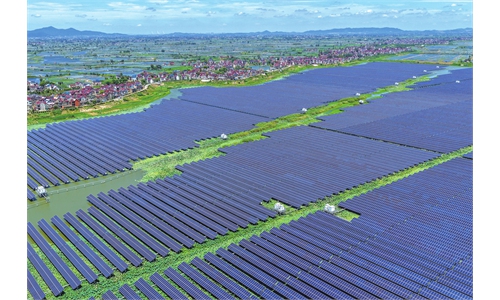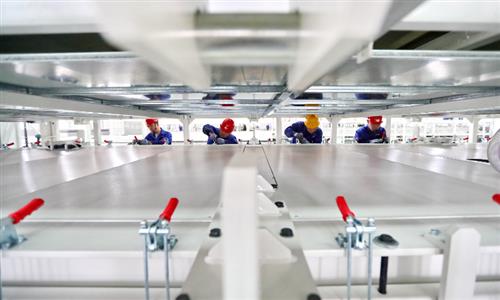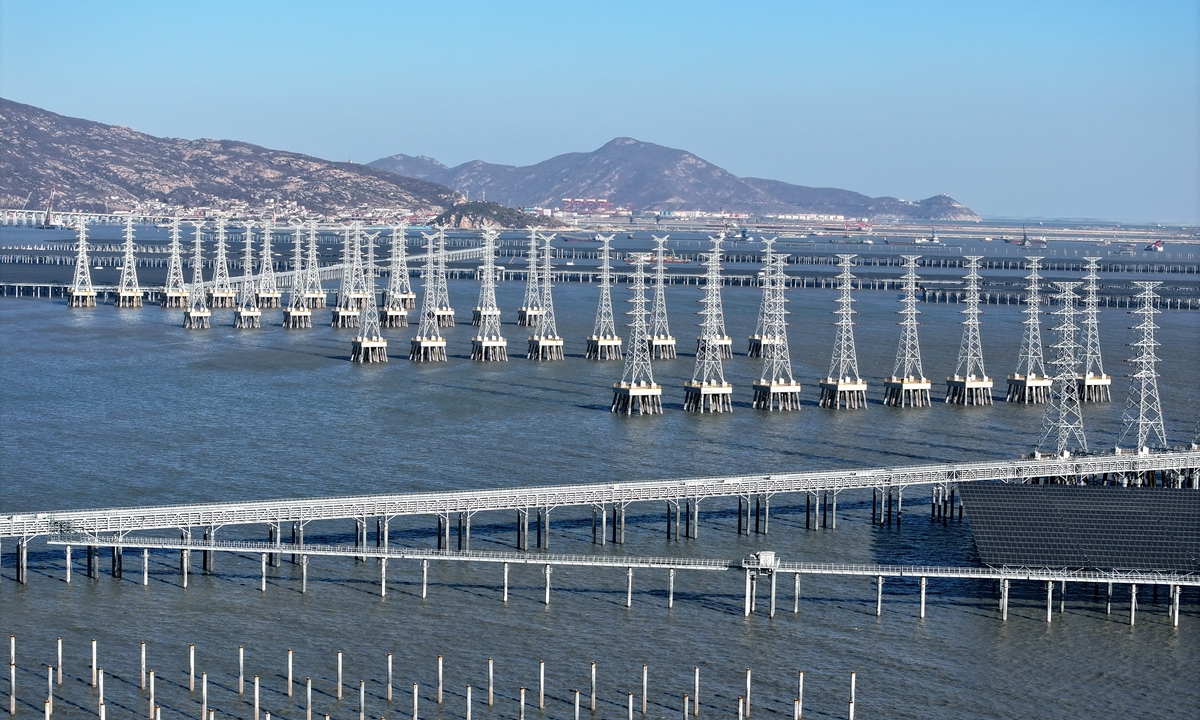
China's largest offshore photovoltaic (PV) project, the CNNC Tianwan 2 million kilowatt tidal flat PV demonstration project, is under construction in the warm discharge waters near the Tianwan Nuclear Power Plant in Lianyungang, East China's Jiangsu Province, on January 11, 2026. Developed by CNNP Rich Energy Co under the CNNC, the project involves an investment of 9 billion yuan ($1.29 billion) and covers 1,875.77 hectares. Photo: VCG
China's Ministry of Industry and Information Technology (MIIT) convened a symposium with photovoltaic (PV) industry entrepreneurs on Wednesday, listening to opinions and suggestions from key enterprises and industry association on efforts to combat "involution," and deployed measures to advance governance in the PV sector, according to a press release issued by the MIIT on Thursday.
Under the current circumstances, combating "involution" is the primary contradiction in the standardized governance of the PV industry, officials said. Relevant departments should strengthen coordination, comprehensively employing tools such as capacity regulation, standards guidance, quality supervision, price enforcement, prevention of monopoly risks, intellectual property protection, and promotion of technological progress.
Through market-oriented and rule-of-law approaches, they should jointly push the industry back onto the track of healthy competition and rational development, according to the press release.
The PV industry association should also actively fulfill its functions, promoting industry self-discipline in accordance with laws and regulations as well as innovating methods and approaches, in order to resolutely tackle "involution-style" competition in the sector.
Pan Helin, a member of the expert committee of the MIIT, told the Global Times on Thursday that the meeting conducted an in-depth summary of the current issues facing the PV industry, pooled collective wisdom and jointly explored pathways to combat "involution" in the sector.
A market participant in the PV sector, who requested anonymity, told the Global Times on Thursday that the meeting was a reaffirmation and further deployment of the established governance direction. "Its systematic approach is welcomed, and we look forward to seeing tangible results," he said.
Relevant authorities have taken multiple actions since the second half of 2025 to advance governance efforts against "involution" in the PV sector.
On August 19, 2025, the MIIT and five other departments jointly held a symposium, highlighting measures to further regulate the competitive order in the PV sector. These moves include strengthening industrial capacity regulation, curbing low-price disorderly competition, standardizing product quality, and supporting industry self-discipline.
On December 26, China's State Administration for Market Regulation (SAMR) held a compliance guidance session in Hefei, East China's Anhui Province, targeting the PV industry's price competition practices. During the meeting, the SAMR highlighted price violations and risks in the sector, requiring enterprises to prevent price-related illegalities and unfair competition practices.
The Ministry of Finance and the State Taxation Administration issued an announcement on January 9, stating that the value-added tax export rebate for PV systems and other products will be canceled starting from April 1. In the long run, this move is expected to help drive a rational return of prices in overseas markets, improve the domestic industrial landscape, promote the industry's shift toward high-end transformation, and enhance international competitiveness, stcn.com reported.
Pan noted that combating "involution" is a complex and systematic endeavor, but the PV industry will inevitably shift toward value-based competition and technological competition. This is both an industrial law and an unstoppable trend.
"The core variables in the next round of competition will be technology and processes. Whoever can achieve low costs with high performance in technology will stand out and emerge victorious in the competition," the expert said.
RELATED ARTICLES