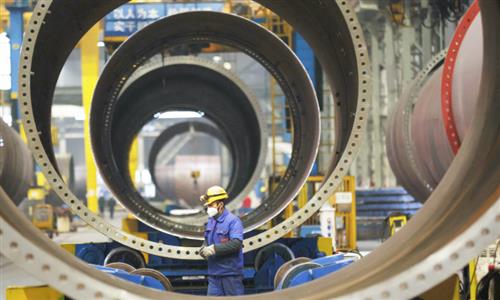
18 localities post GDP growth faster than 5% in 2025; fostering new quality productive forces, a focus in new year
By Published: Jan 29, 2026 11:01 PM

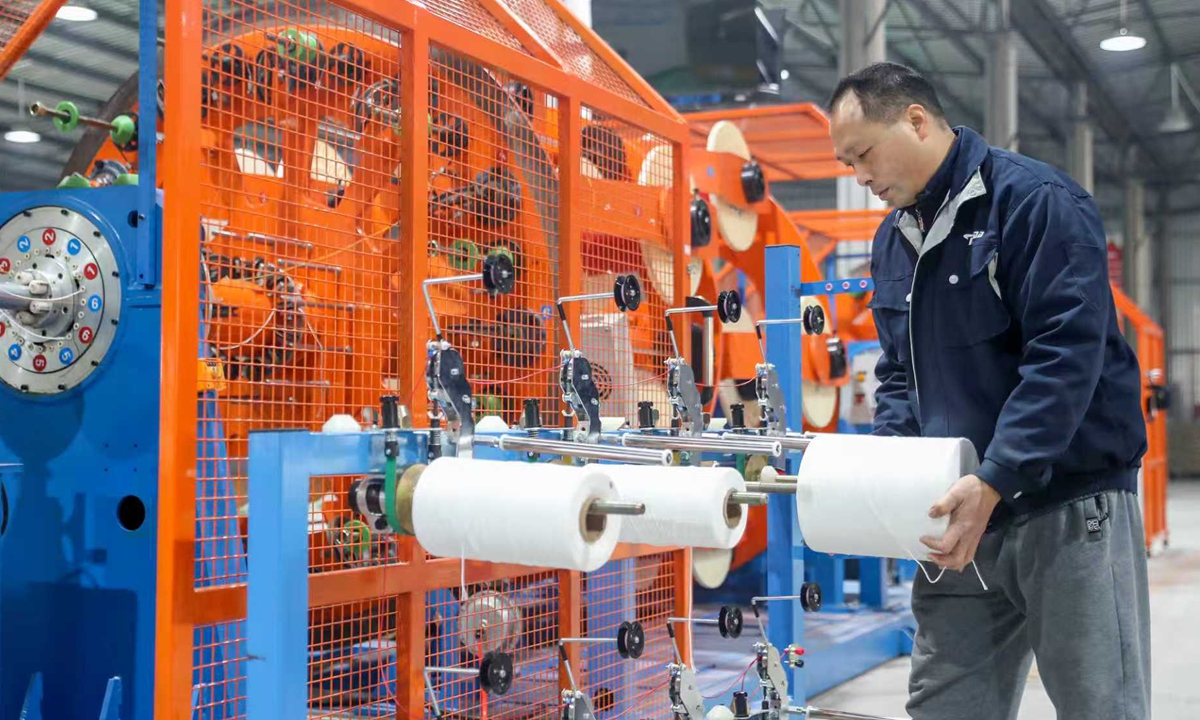
A worker at a wire and cable manufacturer in Huaying, Southwest China's Sichuan Province, prepares raw materials for producing ultra-flexible cables after assigning production orders to smart equipment at an "intelligent workshop" on January 13, 2026. Photo: VCG
A total of 18 Chinese localities have announced GDP growth rates that exceeded the national level of 5 percent in 2025, the Securities Times newspaper reported on Thursday, citing recent announcements by local governments.
Many localities gained growth momentum last year from sectors related to new quality productive forces, which is also a catchphrase in localities' plans for development in the new year, the newspaper reported.
All 31 localities on the Chinese mainland have posted their GDP growth figures for 2025.
In 2025, Southwest China's Xizang Autonomous Region topped the country in GDP growth rates, with a reading of 7.0 percent and an output value of 303.189 billion yuan ($43.6 billion).
The GDP of South China's Guangdong Province and East China's Jiangsu and Shandong provinces exceeded the 10 trillion yuan mark, according to the newspaper, which cited local data.
In 2025, China's GDP grew 5 percent year-on-year to 140.19 trillion yuan, data from the National Bureau of Statistics showed, meeting the annual growth target of about 5 percent and surpassing the threshold of 140 trillion yuan for the first time, the Xinhua News Agency reported.
Notably, high-tech industries, the digital economy, and the green economy grew rapidly in many provinces, with new quality productive forces becoming a key driver of economic development, according to the newspaper.
New quality productive forces also appeared as a key phrase in many localities' plans for development in 2026.
East China's Zhejiang Province, for example, aims to promote the development of industries such as humanoid robots, brain-computer interfaces, brain-like intelligence, quantum information and biomanufacturing, and establish a mechanism for increasing investment and sharing risks in future industries. The province aims to add 10 new pilot zones for future industries and accelerate the formation of the most active leading element in new quality productive forces.
East China's Fujian Province plans to continue focusing its development efforts on the real economy, accelerating the cultivation and expansion of new quality productive forces, and creating new advantages for development with strong new momentum.
The province vowed to accelerate the development, expand the scale, and increase the proportion of emerging industries such as new energy, new materials, high-end equipment, biomedicine, and the low-altitude economy, and vigorously develop future industries such as new batteries, bio-manufacturing, green hydrogen energy, and embodied artificial intelligence; and implement more than 1,500 key provincial technological upgrading projects on a rolling basis.
Tian Lihui, a professor of finance at Nankai University, told the Global Times on Thursday that the core focus on fostering new quality productive forces in 2026 lies in concentrating on internal drivers and implementing targeted regulation.
The development of new quality productive forces across regions must adhere to the principle of "doing something while refraining from other things," with differentiated layouts based on their comparative advantages to avoid redundant development and resource waste caused by rushed initiatives, Tian said.
The Recommendations of the Central Committee of the Communist Party of China for Formulating the 15th Five-Year Plan (2026-30) for National Economic and Social Development stipulated that efforts will be made to accelerate the development of strategic and emerging industry clusters, including new energy, new materials, aerospace and the low-altitude economy, and to foster future industries, such as quantum technology, biomanufacturing, hydrogen energy and fusion energy, brain-computer interfaces, embodied intelligence, and 6G mobile communications.
In the new year, innovation capacity, a massive production base and ultra-large market have become key advantages of China's high-quality development, the expert noted.
RELATED ARTICLES