ARTS / CULTURE & LEISURE
Urban health logic for Beijing's 6,000 regular winter swimmers
Cold water, heart rates and safety
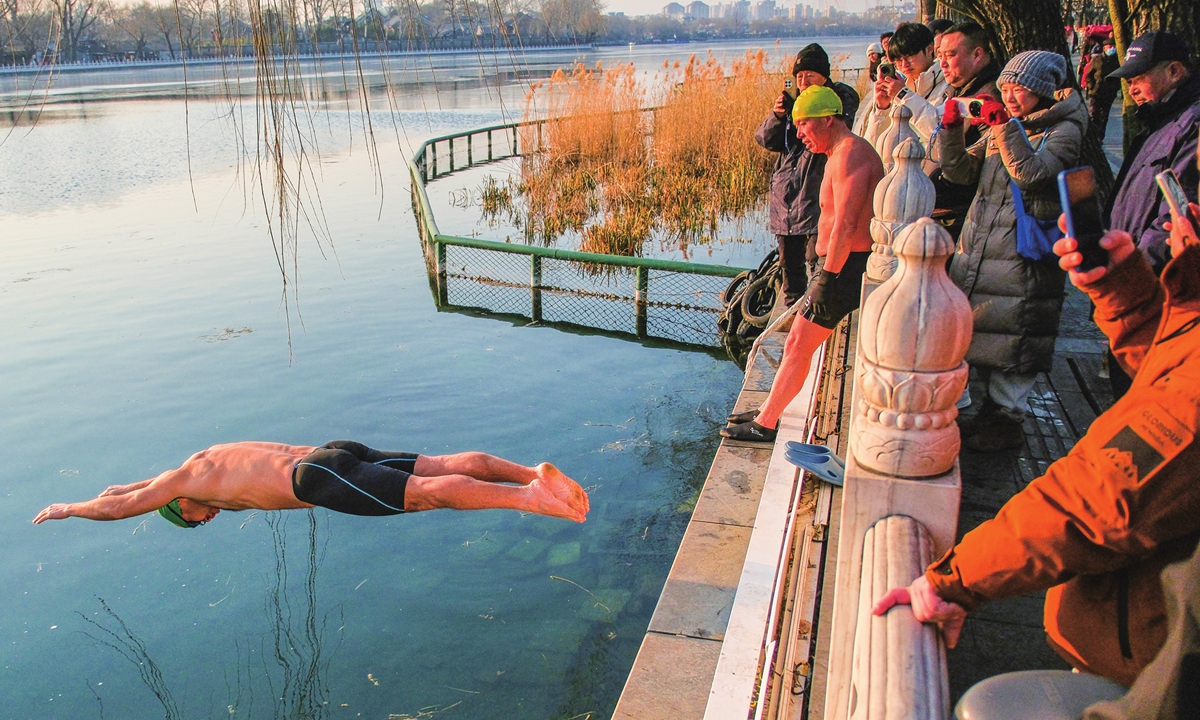
A winter swimming enthusiast jumps into the Shichahai Lake in Beijing, attracting many onlookers on January 8, 2026. Photos: VCG
Around 1 pm, the surface of Beijing's Shichahai Lake carries a bite of cold. The wooden boardwalk along the shore feels damp and chilly, as several middle-aged and elderly swimmers adjust their caps and loosen up their shoulders and necks.Some set their thermos flasks in familiar spots, others fasten safety ropes around their waists.
A few minutes later, they enter the water one by one, sending ripples across the lake's otherwise still surface.
Sixty-two-year-old Yang Yuefeng, a member of the Beijing Winter Swimming Club, is among them.
"Before every swim, my body instinctively reminds me not to take it lightly," Yang told the Global Times.
For more than a decade, he has come here almost every winter for a few minutes in the water, which has gradually moved from cautious trial and error to a steady, well-controlled routine.
"At the beginning, it was definitely hard to adapt," Yang recalled.
"The moment I got into the water, my heart rate would shoot up and my breathing would become chaotic. But with gradual, step-by-step training, the body has adjusted to it."
In recent years, he said, his blood pressure and heart rate have remained stable in medical checkups.
"I used to catch colds easily during seasonal changes. That hardly happens anymore."
Groups and gains
Most members of the Beijing Winter Swimming Club are retirees, with the elderly making up the majority. The group also includes workers, veterans, civil servants and ordinary residents, as well as a small number of students. Around 6,000 people in the city practice winter swimming on a regular basis each year, according to the Beijing Sports Federation.
In Yang's view, winter swimmers generally fall into two categories. One consists of middle-aged and elderly participants who have kept up morning exercise routines for many years, with practiced movements and a fixed rhythm. The other group is made up of younger participants who have joined in recent years, often combining winter swimming with running or strength training and treating it as a form of "physical challenge."
Thirty-one-year-old Zhang Ding, an internet industry professional who often swims alongside Yang, belongs to the latter group. He has an irregular schedule and had long felt persistently fatigued before taking up the sport.
"I started trying winter swimming after running this winter, and those first few times in the water were extremely intense," Zhang told the Global Times. "The cold water feels like it yanks you straight back into the present moment, and your focus becomes razor-sharp."
For him, that powerful physical sensation has become a way to step away from the pace of everyday life.
"In those few minutes in the cold water, phones, work and pressure all disappear," Zhang said. "You're only thinking about your breathing, your heartbeat, and when it's time to get out."
Swimming in such conditions produces what experts describe as a "combined effect." Swimming itself is an aerobic exercise that accelerates metabolism, strengthens cardiopulmonary function and boosts immunity. Exposure to cold water further stimulates blood circulation, training blood vessels to contract and expand. This moderate stimulation can help maintain vascular elasticity, improve vascular function and enhance cardiovascular performance, according to the Xinhua News Agency.
"The dual stimulation of cold and exercise can reduce blood viscosity, improve endothelial function and lower the risk of atherosclerosis, effectively slowing the aging of blood vessels," Luo Chaofan, a rehabilitation therapist registered with the National Health Commission, told the Global Times. "For healthy individuals, with sufficient preparation and short exposure, the body can gradually adapt," Luo said. "But for people with cardiovascular disease or poorly controlled blood pressure, the risks are significantly higher."
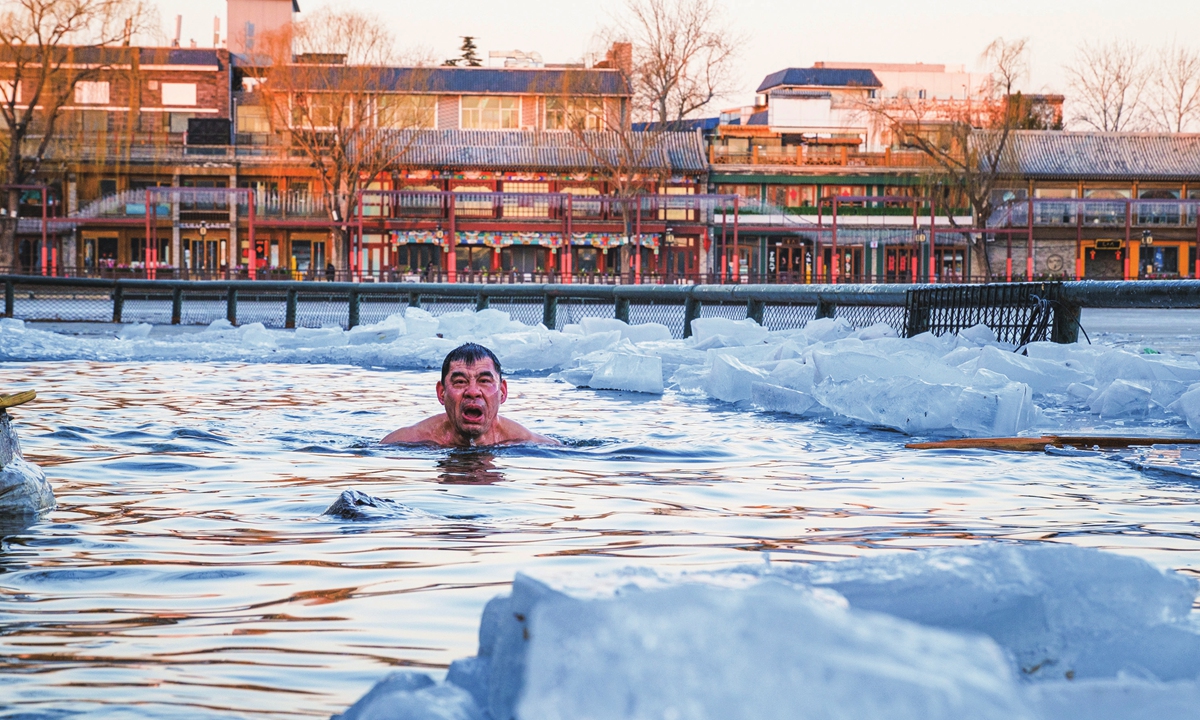
A winter swimmer at Shichahai Lake in Beijing
Risk and rhythmTo onlookers along the shore, the scene appears calm and unhurried. Beneath that quiet surface, however, winter swimming remains a high-risk activity that demands careful management.
Luo cautioned that first-time participants who lack gradual, systematic training are more likely to encounter problems in the initial moments after entering the water, such as muscle stiffness or disordered breathing, which in severe cases can lead to hypothermia or cramps.
"Many dangers don't occur in the water itself," he said, "but in the first few minutes after getting in."
This awareness of risk, paradoxically, is more common among long-time winter swimmers.
According to Yang, before every swim he puts on an insulated cap, fastens a safety rope, and never enters the water alone. "Younger people are sometimes bolder and think they can just push through," he said. "I remind them not to overdo it."
At several regular spots around Shichahai, volunteers can also be seen on duty, along with basic first-aid equipment. While these measures are far from systematic, they have gradually formed an informal safety network through daily practice.
Even so, risks remain ever-present. The lake's surface is not uniformly even, and changes in water depth and the stability of ice edges are inherently unpredictable. Yang noted that this is why winter swimming often sits at the boundary between "self-management" and "public risk": It relies heavily on individual judgment, yet takes place in open urban public spaces. "Winter swimming isn't about colder being better, nor longer being healthier," Luo said. "It's more like a high-risk activity that needs to be rationally approached."
With proper preparation and basic safety measures in place, winter swimming offers urban residents a bodily experience unlike that of gyms or running tracks: relearning the rhythm of one's heartbeat in icy water, practicing restraint at the edge of risk.
RELATED ARTICLES