You wish! China’s military delivers a resounding response: Global Times editorial
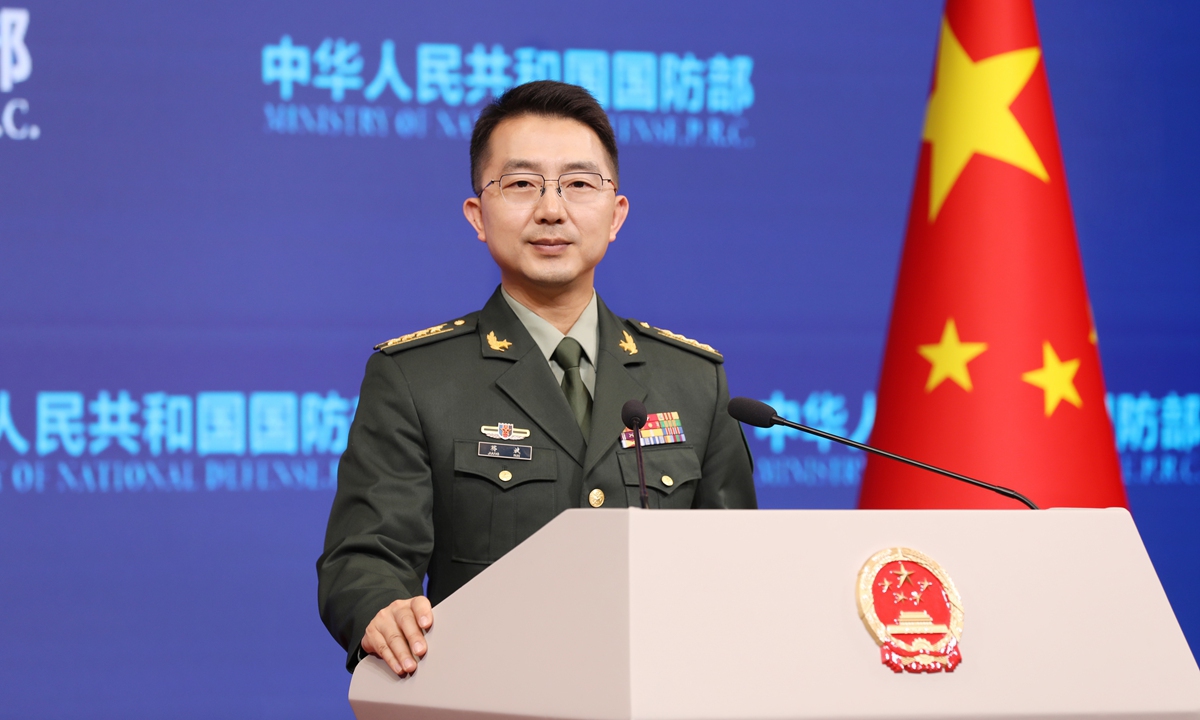
Jiang Bin Photo: China's Ministry of National Defense
The Chinese military's use of the phrase "You wish" has gone viral online. On Thursday afternoon, during a regular press briefing at the Ministry of National Defense of China, when asked for comments about reports that relevant arms firms and institutions from Sweden, the UK, the US, Japan and other countries have released so-called animated videos depicting the "sinking" of Chinese naval vessels, Senior Colonel Jiang Bin, spokesperson for the Ministry of National Defense, responded: "For such self-indulgent acts, I want to say to them: You wish." Facing the West's arms manufacturers' self-directed shows, the Chinese military did not harshly denounce them; instead, it used a colloquial English phrase to deliver an instant "knockout" - sharp and powerful.Treating China's advanced equipment as a hypothetical enemy in weapons advertisements reflects the West's recognition of China's rising military power and the perceived loosening of their dominant position in the global order. Twenty to thirty years ago, the standard hypothetical enemies in such promotional videos were often Russian-made equipment such as Sukhoi Su-27, T-90 tanks, or Kilo-class submarines. Today, the hypothetical enemies in these videos have gradually shifted to Type 055 large destroyer, Type 054 frigates, and carriers suspected to be the Liaoning - this "new standard for marketing" did not arise by chance. As netizens joke, these companies treat Chinese weapons and equipment as a "wish list" to showcase their own capabilities - a most honest acknowledgment of China's military.
The spokesperson's labeling of simulated "sinking" of Chinese warships as "self-indulgent" strikes at the heart of the matter. These promotional videos are not rigorous operational exercises; their sole purpose is to exaggerate the ability of their "magic weapons" and entice customers to spend. The so-called easy-to-sink targets are nothing more than commercial hype. The People's Liberation Army (PLA), however, adheres to building a politically guided, reform-driven, technologically advanced, talent-rich, and law-abiding military, with an increasingly complete equipment system.
Through long-term revolutionary struggle and modernization efforts, China's military has been continuously approaching the goal of becoming a world-class force. In the face of any external threats, it has the capability to firmly safeguard national unity and territorial integrity, and protect the lives and safety of the people.
Framing Western military products and Chinese warships in staged "head-to-head combat" is the work of Cold War "remnants" who peddle a logic of confrontation. The Chinese vessels that are made to take the hit in these videos are innocent bystanders, serving as a distorted insinuation that a "hypothetical enemy is here and war is imminent." Such promotional clips are not merely selling missiles; they are selling anxiety and pushing bloc-based alignment. For some, the so-called "China threat" theory is less a matter of perception than a business. From portraying China as the "only rival capable of comprehensively challenging the US" and hyping the "Indo-Pacific Strategy" to concentrating arms sales in the Asia-Pacific region (including Japan, Australia, the Philippines, and China's Taiwan region), this constitutes a massive war industry chain. Fabricating false footage of "sinking" Chinese vessels to cater to the confrontational emotions born of hegemonic thinking is clearly a key link in that chain. It is reported that the Swedish arms firm has taken down the relevant video, and China has also urged other relevant parties to "do the right thing." We cannot allow the Western military-industrial complex's pursuit of exorbitant profits to push the world toward an abyss of arms races and division.
It must be made clear that China's strengthening of its national defense has never been about seeking global hegemony. China adheres to the principle that "we will not attack unless we are attacked, if we are attacked, we will certainly counterattack", and unswervingly pursues a defense policy that is defensive in nature, never regarding any country as an enemy. From escort missions in the Gulf of Aden to international humanitarian relief, from participation in UN peacekeeping to joint maritime exercises, every step in the development of China's defense capabilities is a firm defense of national territorial sovereignty and security and development interests, as well as an important contribution to world peace and stability.
China remains committed to the path of peaceful development and to a security vision that is common, comprehensive, cooperative and sustainable. This stands in sharp contrast to the practices of certain countries that pursue militarism and interfere in the internal affairs of others.
Two months ago, a spokesperson for China's Ministry of National Defense responded with "it is nothing but sheer fantasy and an overestimation of one's own abilities" to remarks by individuals within Japan's Self-Defense Forces claiming that Japanese and US forces will have the capability to sink the Fujian aircraft carrier. Over the past year, China's military has achieved leapfrog progress that has drawn global attention: "fighter of national pride" J-10 has gained international recognition; the commissioning of the Fujian marks the arrival of the three-carrier era; and the "September 3 parade" became a highlight showcasing the modernization of China's national defense and military. You wish! The Chinese military's response rings loud and clear. This confidence comes from the steady strengthening of China's defense capabilities, and from the resolve of a force for peace to safeguard tranquility around the world.
RELATED ARTICLES