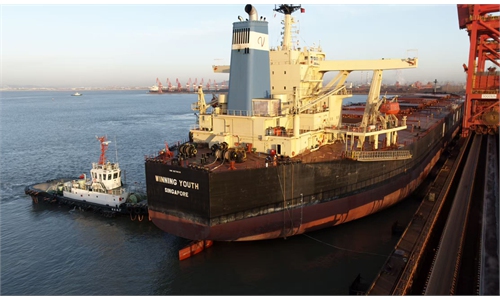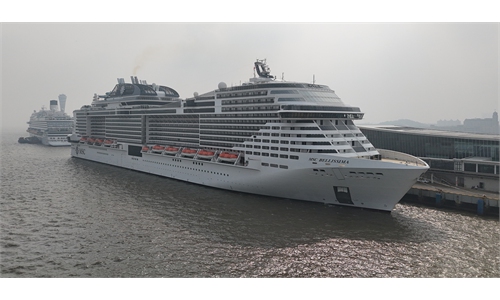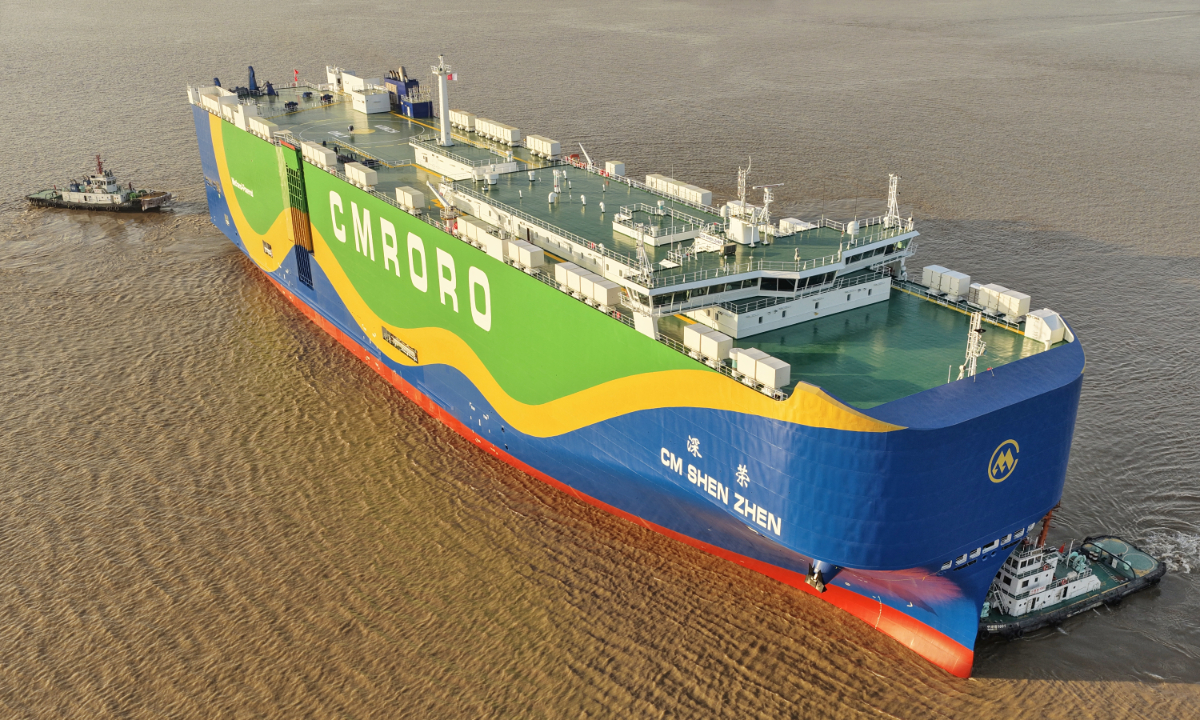
China's first independently developed ultra-large methanol dual-fuel roll-on/roll-off (ro-ro) ship begins its maiden voyage in Nantong, East China's Jiangsu Province, on December 8, 2025. Photo: VCG
China's shipbuilding industry maintained its global lead across all three major metrics in 2025 for the 16th year in a row, according to data released by the Ministry of Industry and Information Technology (MIIT), China Media Group (CMG) reported on Sunday.
The shipbuilding sector completed construction of 53.69 million deadweight tons (DWT), an 11.4 percent year-on-year increase, accounting for 56.1 percent of the global market, according to the MIIT. New orders totaled 107.82 million DWT, representing 69 percent of the global market. As of the end of December, the order backlog reached 274.42 million DWT, up 31.5 percent year-on-year, accounting for 66.8 percent of the global total and standing at a new high, CMG reported.
China's key shipbuilders further strengthened their international competitiveness in 2025. Six Chinese companies ranked among the world's top 10 in terms of ship completions, new orders and order backlogs. Of the 18 major vessel types, China led the world in new orders for 16, while multiple world-class green and intelligent vessels were delivered, representing major breakthroughs in high-end upgrading and clear progress in the industry's high-quality development, according to the MIIT's data.
Bian Yongzu, executive deputy editor-in-chief of Modernization of Management magazine, told the Global Times that China's shipbuilding industry has firmly secured the world's top position across most major indicators - a strength closely tied to the country's overall economic fundamentals. As the world's largest trader in goods and a leading global trading partner, China also hosts multiple ports among the world's top 10, creating enormous and sustained demand for maritime transport that strongly underpins its shipbuilding sector.
Li Yanqing, a vice chairman of the China Association of the National Shipbuilding Industry, said that beyond maintaining a global lead across the three major indicators, China's key shipbuilders significantly enhanced their international competitiveness in 2025.
Bian noted that China's comprehensive industrial system represents another decisive advantage. As a capital-, technology- and supply-chain-intensive sector, shipbuilding places high demands on a country's manufacturing foundation.
China boasts the world's most complete industrial system and has sharply increased research and development investment in recent years, laying a solid technological foundation for high-end shipbuilding. Meanwhile, a steadily advancing financial system has provided further backing for the industry's financing requirements, he said.
In addition, China's large pool of skilled labor constitutes a competitive edge. Shipbuilding relies heavily on seasonal technical professionals, such as welders and assembly specialists, expertise that many countries struggle to cultivate at scale. China's strong manufacturing and equipment industries have continuously nurtured a large workforce, guaranteeing an ample talent supply for the shipbuilding sector and helping it avoid the development bottlenecks encountered in some other major shipbuilding nations, Bian said.
Wang Peng, an associate research fellow at the Beijing Academy of Social Sciences, told the Global Times that the record-high figures point to a structural shift in global maritime power rather than mere output growth. As shipping goes green, orders are increasingly clustering in China, underscoring its rising ability to allocate shipbuilding resources globally and shape industry norms, he said.
China's shipbuilding industry has achieved a qualitative leap toward the high end of the value chain. Breakthroughs in technically demanding vessels such as large cruise ships and liquefied natural gas carriers have ended long-standing monopolies, while progress in green propulsion and intelligent navigation highlights growing mastery of core technologies. This transformation reflects a shift from cost-based competitiveness to system- and technology-driven strengths, marking China's entry into the front ranks of high-end manufacturing, he said.
Li said that China's shipbuilding industry currently holds orders for three to four years of production, keeping workloads full. He added that the industry will continue to pursue high-quality development, integrate more deeply into the global division of labor, and jointly shape a new industrial landscape centered on green and intelligent development, CMG reported.
RELATED ARTICLES