Chinese AI large model firms roll out digital red packet campaigns for Spring Festival
By and Zhang Weilan Published: Feb 01, 2026 07:24 PM

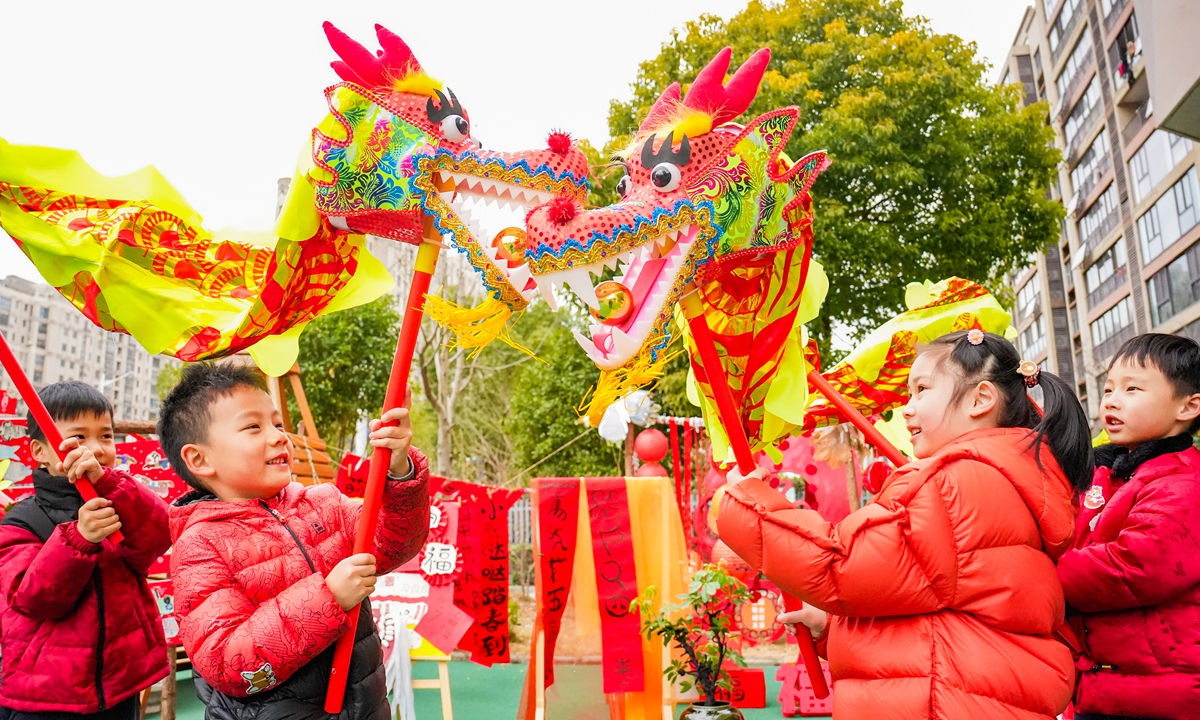
Children from a local kindergarten in Nantong, East China's Jiangsu Province, perform a dragon dance on the playground to welcome the Spring Festival on January 29, 2026.
With Chinese tech companies including Tencent, Baidu, Alibaba and ByteDance rolling out digital hongbao (red packet) incentives for the upcoming Spring Festival holidays, the rivalry among China's large-language artificial intelligence (AI) model companies has been moving palpably from the underlying technological race to the next pivotal stage - aggressively vying to become the first consumer-facing AI agent that boasts a large number of users in China.
On Sunday, Tencent's AI chatbot app Yuanbao climbed to the No.1 spot among free apps on the Apple App Store, as it launched a Spring Festival red packet campaign on the same day. Under the initiative, the app will distribute up to 1 billion yuan ($144 million) in digital red packets to users, with individual red packets worth as much as 10,000 yuan.
The initiative was initially announced last week. On January 26, Tencent's CEO and founder Pony Ma Huateng said that in launching the campaign, the company "hopes to recreate the success of WeChat's red-packet boom" going back 11 years, news portal thepaper.cn reported. In 2015, the company distributed 500 million yuan in cash red packets via WeChat's "shake" feature during the Spring Festival gala. Through this promotion, it successfully gained a firm foothold in the mobile payment industry.
In a similar move, Chinese tech company Baidu's AI assistant Ernie announced that from January 26 to March 12, people who use Ernie within the Baidu app will have the chance to share 500 million yuan in cash red packets.
Alibaba's Qianwen app will launch a red packet campaign and distribute rewards to users during the Spring Festival holidays. The total amount being offered is expected to reach hundreds of millions of yuan, though the exact figure is still being finalized, news portal jiemian.com reported.
In December, Chinese tech company ByteDance's cloud unit Volcano Engine announced that the company had secured an "exclusive AI cloud partnership" with the Spring Festival Gala, the most-watched annual television event in China.
ByteDance's AI assistant Doubao will roll out a range of interactive features in conjunction with the event.
As 2026 is set to "be the year of AI application," the number of users and usage frequency will become the core in excelling in the white-hot competition, analysts said.
Wang Peng, an associate research fellow at the Beijing Academy of Social Sciences, told the Global Times on Sunday that he expected the race in the AI industry this year would move from "AI large models" to "AI ecosystems and AI commercialization." He stressed that the battle for "rising as the next generation of the AI super gateway" is very strategic, as whoever succeeds first in cultivating the habit of "asking AI first" among users will secure a ticket to the next era of the internet ecosystem.
"This is why all the Chinese tech giants are stepping up efforts to build a comprehensive consumer-facing AI agent that deeply integrates their existing ecosystem advantages, such as Baidu's search function, Tencent's social network app WeChat, ByteDance's short-video platform Douyin and Alibaba's e-commerce service," Wang explained.
Tian Feng, president of the Fast Think Institute and former dean of SenseTime's Intelligence Industry Research Institute, told the Global Times on Sunday that the build-up of AI agents could be compared to bridging the "last commercial mile" of large models into broader real-world applications. He predicted that areas such as AI wallet payments, AI shopping assistants, and AI marketing assistants would emerge as key battlegrounds for competition.
This new round of Spring Festival red packet campaigns by internet giants may signal their entry into the competition for a consumer-end AI application super gateway, with the promotions likely to drive sharp increases in downloads and daily active users of Yuanbao, Qianwen, and Ernie, according to a research note from Kaiyuan Securities.
China's AI user base has already become considerable. The number of domestic generative AI users had reached 515 million by June last year—doubling within six months—with a penetration rate of 36.5 percent, according to a report released by the China Internet Network Information Center in October.
While distributing digital red packets could be an efficient way to garner traffic, it remains to be seen whether AI assistant apps will be opened for a second, third, or 10th or 100th time. In other words, do they have the capacity to enhance user stickiness, analysts said.
RELATED ARTICLES