Overseas firms, investors show stronger confidence in HK: Paul Chan
By Published: Feb 01, 2026 07:58 PM
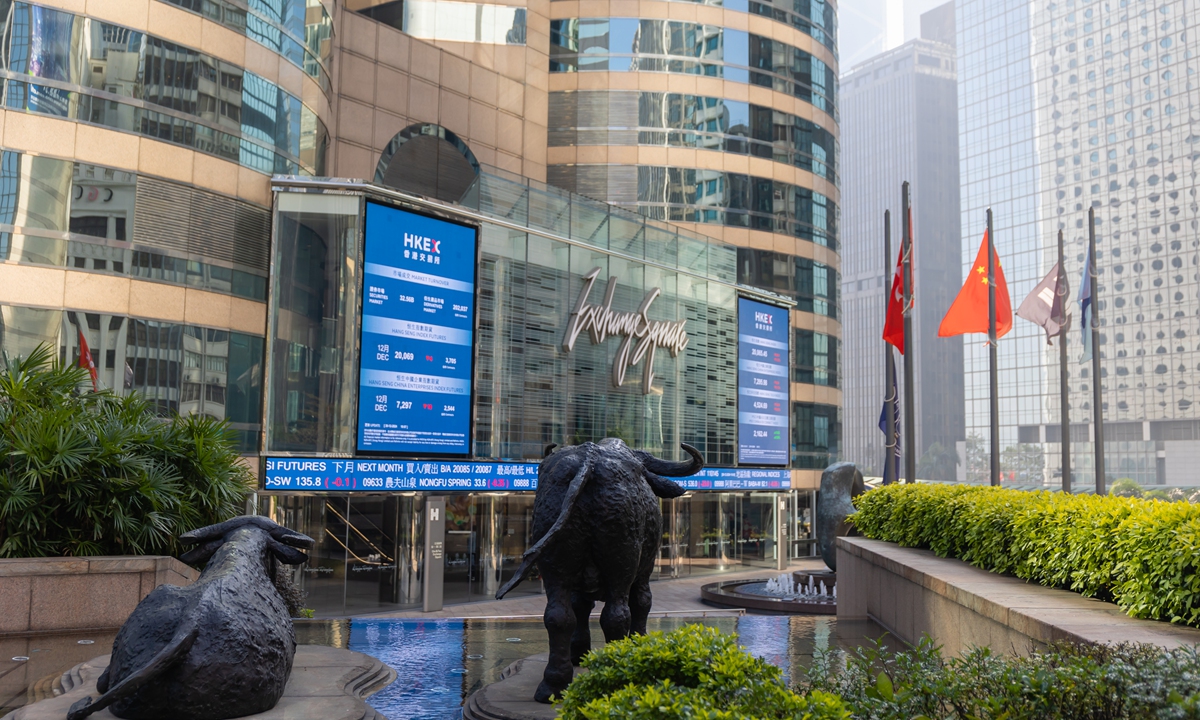
View of Hong Kong Exchanges and Clearing Ltd Photo: VCG
Overseas enterprises and investors are growing more confident about investing in Hong Kong. In a blog post on Sunday, Paul Chan, financial secretary of the Hong Kong Special Administrative Region (HKSAR) government, disclosed that the number of overseas and Chinese mainland companies with a presence in Hong Kong and local start-ups each increased by more than 10 percent last year, with the former exceeding 11,000 and the latter surpassing 5,200.
Also, according to recent surveys conducted by some foreign chambers of commerce, the majority of their member companies remain optimistic about Hong Kong's business prospects, with the proportion holding positive expectations reaching a multi-year high, Chan wrote.
"Last week, during the 19th Asia Financial Forum, I met with political and business leaders from Europe, the US, and the Middle East, as well as representatives from the Chinese mainland and international multilateral organizations. They unanimously expressed a positive outlook on Hong Kong's future and noted the emergence of more new opportunities," Chan wrote in his blog.
The start of January 2026 has reinforced market expectations that this year will bring greater volatility to global markets, especially given the unpredictable shifts in international geopolitical dynamics, which may intensify the flow and speed of cross-border capital movements, according to the financial secretary.
In the face of inevitable external market fluctuations and volatility, Hong Kong must not only maintain strong buffers in its financial system but also reserve sufficient fiscal resources to cope with potential shocks, Chan said.
With a series of major events taking place and a recovery in asset markets, private consumption expenditure in the HKSAR increased by 1.6 percent in 2025, reversing the decline from the previous year. Retail sales figures for December 2025, to be released soon, are also expected to show continued growth, with the pace of increase slightly faster than the previous month, noted Chan.
Amid rapid changes in the global political and economic landscape, the coming year will undoubtedly bring risks and volatility, Chan noted, adding that Hong Kong will continue to work diligently to align with the national 15th Five-Year Plan (2026-30), accelerate integration into and support for the country's overall development strategy and leverage finance to empower technological innovation and traditional industries.
The HKSAR government will also promote deeper integration between technological innovation and industrial development, and strengthen workforce training - particularly in skills and technology application - to enhance the quality and scale of economic growth, according to Chan.
Sun Chuanwang, a professor at Xiamen University, told the Global Times on Sunday that further economic integration with the Chinese mainland will continue to fuel Hong Kong's growth and provide a buffer for the city amid increasing global volatility.
Policies under the 15th Five-Year Plan are expected to focus on enhancing Hong Kong's growth resilience, industrial upgrading, scientific and technological innovation, and regional integration, Sun said. These measures aim to strengthen Hong Kong's status as an international financial, shipping and trade center, promote the development of high-end and high value-added services, and support Hong Kong in more proactively complementing the strengths of mainland cities in the Guangdong-Hong Kong-Macao Greater Bay Area (GBA).
By playing a key role in the development of the GBA, Hong Kong is set to contribute to building a world-class fintech hub cluster together with its regional partners, Sun said.
Hong Kong's GDP grew by 3.5 percent year-on-year in real terms in 2025, the HKSAR government said on Friday in an advance estimate. The city's GDP increased by 3.8 percent in the fourth quarter of 2025, the Xinhua News Agency reported.
The Hong Kong economy is expected to maintain good momentum in 2026. Sustained moderate expansion of the global economy, coupled with persistently strong global demand for artificial intelligence-enabled electronics-related products, will lend support to Hong Kong's export performance, a spokesperson for the HKSAR government said.
RELATED ARTICLES