‘Taiwan independence’ separatist forces’ resistance attempts meaningless, mainland experts say on Taiwan regional authorities’ hype of PLA aircraft sorties around island
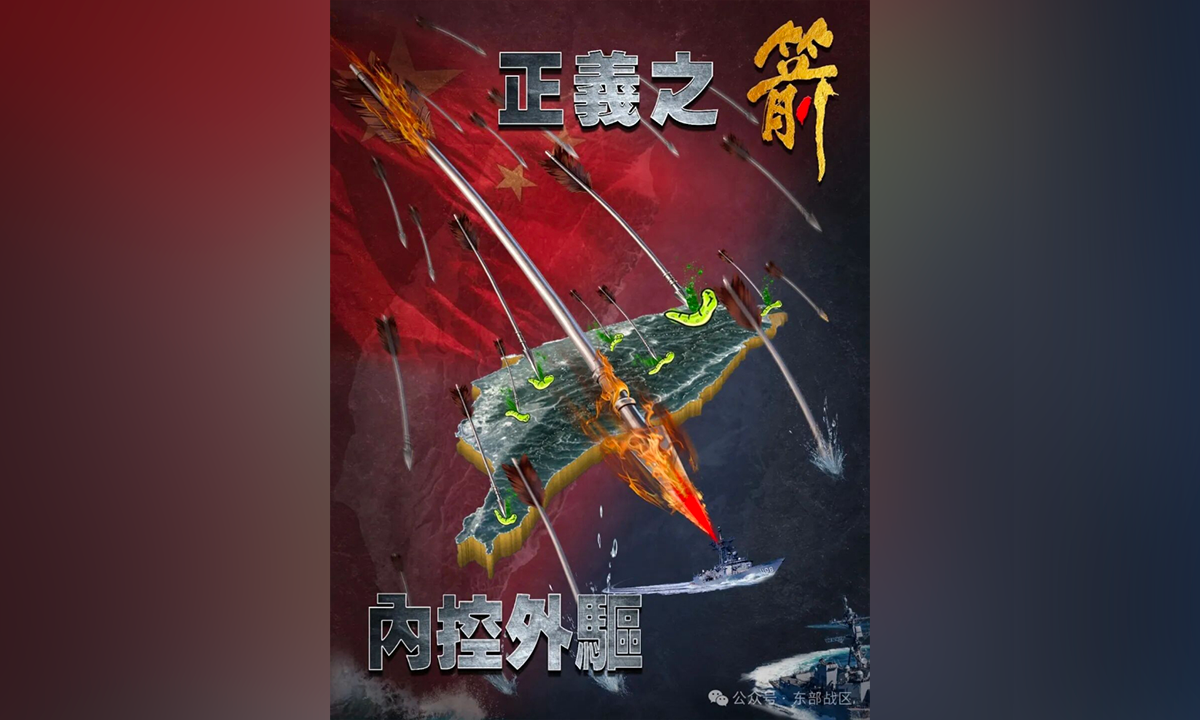
The PLA Eastern Theater Command launches on December 29, 2025 the "Justice Mission 2025" military exercises surrounding Taiwan Island, and issues a poster showing the operational advantages of modern unmanned equipment, including full-domain coverage, flexible maneuverability and precision strikes. Photo: PLA Eastern Theater Command
Taiwan regional authorities on Sunday claimed that the number of PLA military aircraft conducting patrols around Taiwan has surged from 380 sorties in 2020 to 5,709 sorties in 2025, an increase of nearly 15 times. Chinese mainland military affairs experts told the Global Times that the Democratic Progressive Party (DPP) authorities released this set of data to create a public narrative of the so-called "PLA exerting pressure on Taiwan," but as the PLA's resolve and confidence in resolving the Taiwan question have been multiplying, attempts by "Taiwan independence" separatist forces to resist are completely futile.
A relevant DPP authority posted on Facebook on Sunday claiming that the PLA military aircraft’s sorties around Taiwan has evolved from sporadic activities into a high-frequency, routine and normalized operation, with the number of sorties surging sharply over the past five years. According to the so-called data released by the DPP authorities, the PLA military aircraft sorties have soared to a high frequency of 5,709 in 2025, rising from 380 in 2020, 960 in 2021, 1,738 in 2022, 4,734 in 2023 and 5,107 in 2024, an increase of nearly 15 times.
The latest figures released by the DPP are far higher than those previously announced by Taiwan's so-called security authority. The latter claimed that PLA military aircraft conducted nearly 3,600 sorties around the island of Taiwan in 2025, a record high in history. In response to this, Senior Colonel Zhang Xiaogang, a spokesperson for the Chinese Defense Ministry, said at a regular press conference on December 25, 2025 that "Taiwan is an inalienable part of China's territory. The PLA conducts regular combat readiness exercises around Taiwan Island, organizes anti-secession and anti-interference operations to safeguard national sovereignty and territorial integrity, which is completely justified, necessary, reasonable and legitimate. The PLA will never cease its efforts to crack down on 'Taiwan independence' forces and promote reunification. For every provocation by the 'Taiwan independence' separatist forces, we will increase pressure and advance one step further, until the complete reunification of the motherland is achieved."
“The so-called claim of ‘disrupting Taiwan’ by the Taiwan regional authorities is totally groundless. Taiwan is an inalienable part of China, and it is entirely up to the PLA to decide when its aircraft approach Taiwan and how many sorties are dispatched," Zhang Xuefeng, a Chinese mainland military affairs expert, told the Global Times Monday. He noted it is obvious that the DPP authorities released this set of data to create a public narrative of the so-called “PLA exerting pressure on Taiwan,” yet the figures also vividly demonstrate the steady growth of the PLA's strength.
Zhang said that behind these numbers lies a dramatic shift in the balance of strength across the Taiwan Straits, and the attempts of the "Taiwan independence" separatist forces to resist are utterly meaningless.
The so-called data released by the DPP authorities actually reflects the PLA's commissioning of new fighter jets, expansion of its pilot teams, intensification of training, improvement of the logistical support system, as well as the ever-growing resolve and confidence of the PLA in resolving the Taiwan question.
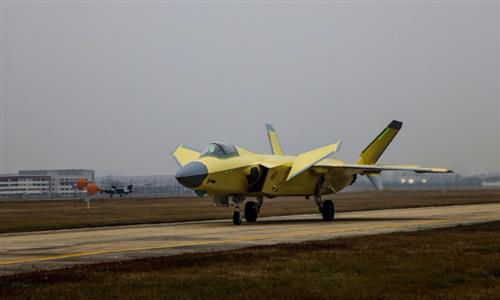
Song noted that this set of data should in fact be an incomplete one. Public reports indicate that due to the limited intelligence and reconnaissance capabilities of the Taiwan Island’s military, it is simply unable to detect the PLA's aviation forces conducting military training and exercises on some occasions. For instance, the J-20 stealth fighter jets have participated in patrol drills surrounding Taiwan Island on multiple occasions, yet the Taiwan military has never detected any trace of them.
According to Zhang, the number of fighter jet sorties alone cannot fully reflect the air power balance between the two sides of the Taiwan Straits, and it is merely an epitome. Modern warfare is, in essence, a confrontation between systems. The PLA’s modern joint operations system is large in scale, powerful in strength and highly coordinated. In sharp contrast, the so-called combat system of the Taiwan Island’s military is fraught with weaknesses and loopholes at every turn, making it impossible for it to form an effective overall combat capability.
"In air power, for example, the performance of the PLA’s main fighter jets is more than a generation ahead of Taiwan’s, enabling the PLA to have overwhelming advantages against the Taiwan Island’s forces," Zhang said.
While releasing the so-called data on the number of PLA aircraft sorties, the DPP authorities have avoided mentioning its own response measures, such as how many fighter jets it scrambled to respond, Zhang said, noting that this evasion precisely shows that the Taiwan Island’s military is completely helpless and at a loss in the face of the PLA's advances, despite the provocative remarks made by “Taiwan independence” separatist forces.
Each time such data are released, the Taiwan regional authorities should feel a deeper sense of fear, for they ought to be well aware that the PLA has sufficient capabilities to resolve the Taiwan question, and as these capabilities continue to grow, it will be able to settle the Taiwan question at a much lower cost, Song said.
RELATED ARTICLES