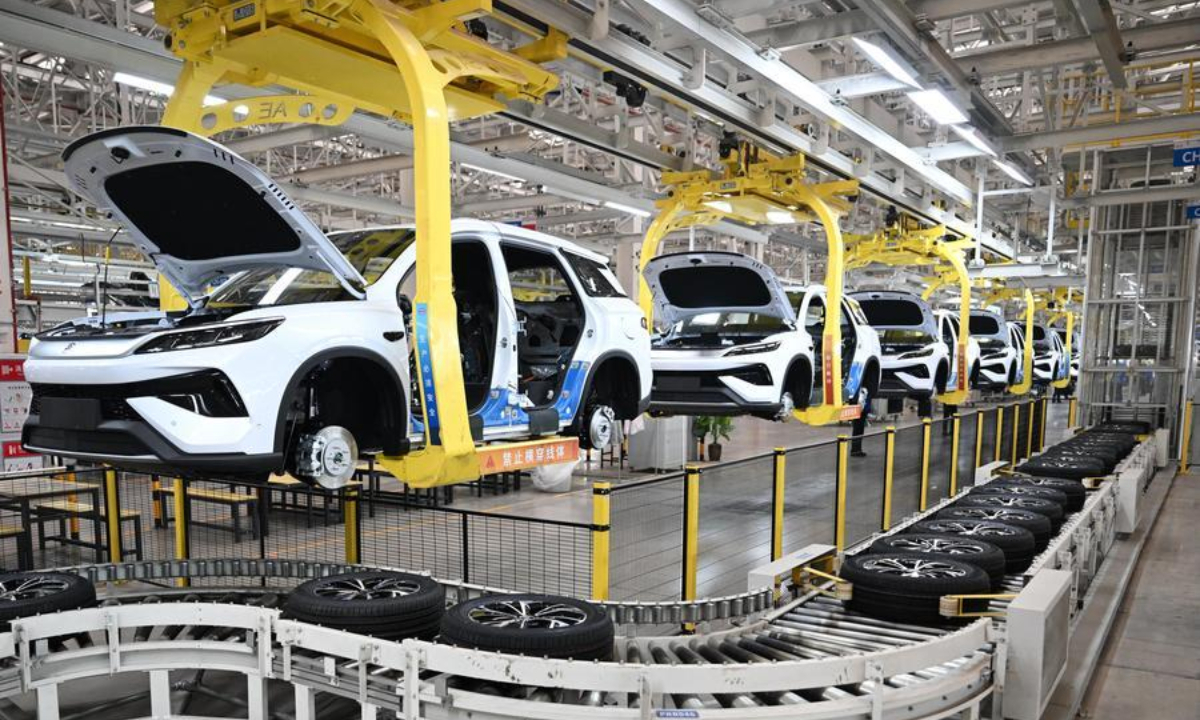
This photo taken on Nov. 3, 2025 shows a new energy vehicle (NEV) assembly line of BYD, China's leading NEV manufacturer, at the plant of BYD in Zhengzhou, central China's Henan Province. (Xinhua/Li Jianan)
China's Ministry of Industry and Information Technology (MIIT) and seven other government agencies on Tuesday jointly released a guideline regarding the automotive data security, vowing to promote the establishment of an efficient, convenient, and secure cross-border data flow mechanism for automotive data.
The guideline targets scenarios such as automotive research and development design, production and manufacturing, auto self-driving, software updates, and internet-connected auto operations.
It will refine the rules for identifying important data, clarify methods such as conducting security assessments for cross-border auto data transfers and signing standard contracts for cross-border transfer of personal information, to guide enterprises in standardizing auto data use and enhance automotive data security protection.
Market watchers said that, currently, the global digital economy and industrial cooperation are becoming increasingly integrated, and countries are strengthening the governance of cross-border data flows.
As to China's auto sector, the rapid development of intelligent self-driving and China's expansion into global markets require standardized norms, and phasing in reasonable regulations are essential, Cui Dongshu, secretary-general of the China Passenger Car Association, told the Global Times on Tuesday.
In his view, the introduction of the new rules is a response to both market demands and technological developments as China has witnessed a meteoric rise of the auto industry.
China's automobile production and sales both exceeded 34 million units last year, setting new record highs, according to the China Association of Automobile Manufacturers, which will offer new cooperation opportunities and help set up a global win-win ecosystem.
With the rapid development of industrial intelligence and connectivity, automotive data has become a key issue in the world.
A high-level self-driving vehicle can generate up to 10 terabytes of data each day. From research and development to after-sales services, the entire automotive industry chain generates plenty and important data, according to the CCTV News on Tuesday.
The guidelines pertain to three categories of outbound automotive data activities, applicable to data handlers that provide automotive data to destinations outside of China. The categories are cross-border transmission of data collected or generated during domestic operations; data stored domestically but made accessible for querying, retrieving, downloading, or exporting by overseas institutions, organizations, or individuals; and other activities involving the processing of personal information of individuals within China from outside the country, in accordance with the relevant provisions of the Personal Information Protection Law, CCTV News said.
Wei Liang, vice-president of China Academy of Information and Communications Technology said that the automotive data handlers include entities, encompassing automobile manufacturers, component and software suppliers, telecommunications operators, self-driving service providers, and online platform operators, as well as auto dealers and auto repair and maintenance bodies, according to CCTV News.
RELATED ARTICLES