Multiple countries reportedly interested in JF-17; Pakistan’s questioned production capacity a manageable ‘sweet problem’ with China’s support: Chinese expert
By Liang Rui and Published: Feb 03, 2026 10:14 PM

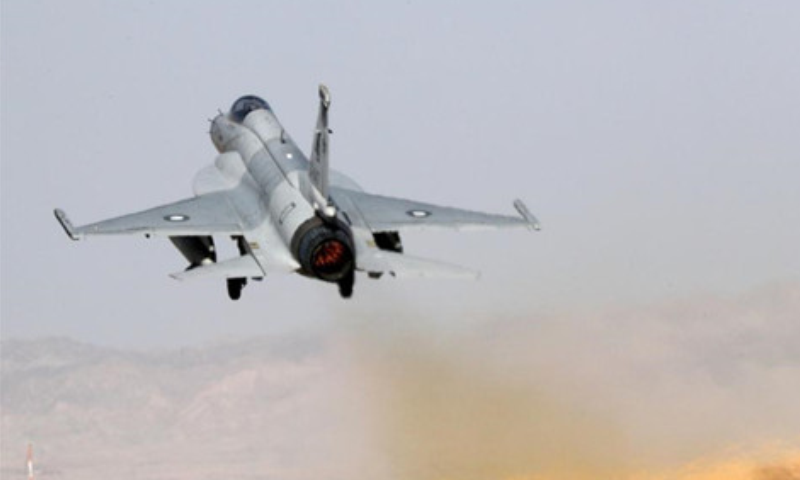
A JF-17 fighter jet attached to the Pakistan Air Force flies towards the designated airspace during an air-to-ground offensive operation drill conducted by two Chinese JH-7 fighter bombers and two Pakistani JF-17 fighter jets on Sept. 20, 2017, which is part of the "Shaheen VI " joint training exercise launched by the air forces of China and Pakistan on Sept. 8 and scheduled to conclude on Sept. 27, 2017. (Photo/eng.chinamil.com.cn)
Amid Pakistan's remarks that multiple countries have expressed interest in acquiring the JF-17 fighter jets, a Bloomberg report on Tuesday questioned whether Pakistan's production capacity of the China-Pakistan jointly developed aircraft can meet a potential sudden surge in demand. A Chinese aviation expert said that this could be a "sweet problem" for Pakistan, as backed by strong order demand, the country's aviation industry is expected to develop rapidly, and potential capacity constraints are ultimately not a true concern given China's support for Pakistan in manufacturing this type of fighter jet.
Bloomberg reported on Tuesday that in the past month, Iraq, Bangladesh and Indonesia have expressed interest in acquiring the JF-17 Thunder, according to Pakistan's Armed Forces. Saudi Arabia and Libya are also exploring the aircraft, Reuters reported separately, after Pakistan hailed the performance of its Chinese-made jets during its conflict with India in May 2025, per Bloomberg report.
The Bloomberg report claimed that Pakistan makes fewer than 20 JF-17s per year, and almost all go to its own air force. The report claimed that it's not clear whether Islamabad can expand capacity to meet the sudden demand.
"So far it was like whatever Pakistan can make, the capacity was just enough for Pakistan. We had a long view for exports, but you don't build capacity for exports before there are orders," Pakistan's former Air Vice Marshal Faaiz Amir, was quoted by the Bloomberg as saying.
While it could be true that Pakistan's current production capacity could face limits, but this could be described as a "sweet problem," Wang Ya'nan, chief editor of Beijing-based Aerospace Knowledge magazine, told the Global Times on Tuesday.
First of all, producing additional JF-17s has a positive effect on Pakistan's aviation industry, Wang said. In the past, limited domestic demand from the Pakistan Air Force meant slower production, fewer assembly lines, and lower demand for skilled workers. As export demand rises, however, Pakistan will need to scale up investment, expand production capacity, and cultivate a larger pool of technical talent - further driving industrial growth.
The international interest in the JF-17 could represent a key step forward for Pakistan, which has never been considered a major player in the defense industry, Bloomberg claimed.
"If Pakistan does face capacity shortages, a likely solution could be Chinese assistance in expanding production. This could include increasing production speed or adding new assembly lines — measures that pose no major technical difficulties," Wang said.
Under the current arrangement, 58 percent of the production, as well as the final assembly, is carried out in Pakistan, which makes the airframe, and 42 percent in China, which supplies the avionics, the Bloomberg report claimed.
A second possibility would be a deeper division of labor between the two sides, Wang said. China could take on a more significant role in manufacturing major components, while Pakistan focuses on final assembly and delivery.
At the Singapore Airshow that kicked off on Tuesday, China's state-owned Aviation Industry Corporation of China (AVIC) showcased a wide range of products including fighter jets, training aircraft, transport aircraft, helicopters and drones, including the JF-17, according to a Sina Weibo post by AVIC.
RELATED ARTICLES