ARTS / CULTURE & LEISURE
Hospital takeaway meals, beverages offer public health guidance
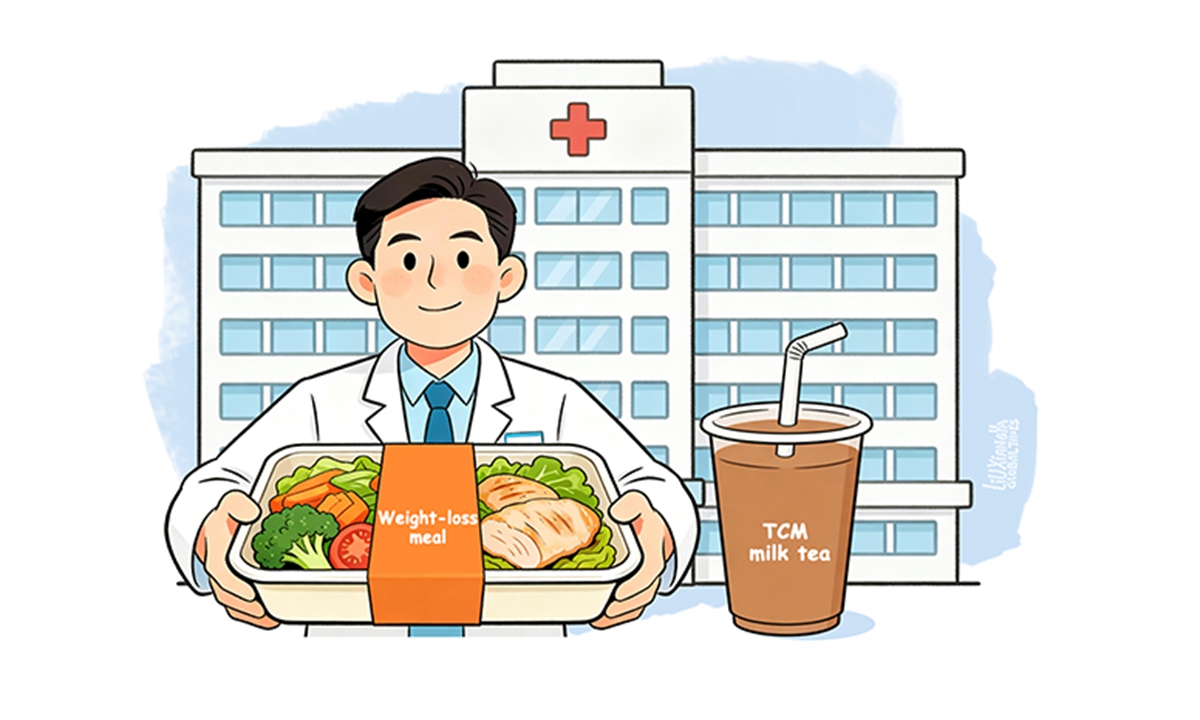
Illustration: Liu Xiangya/GT
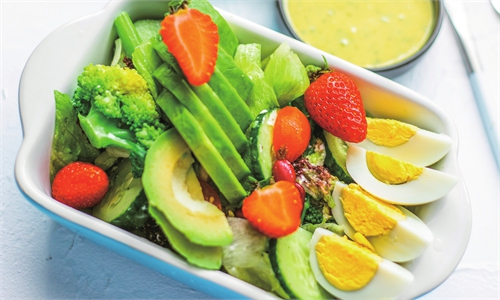
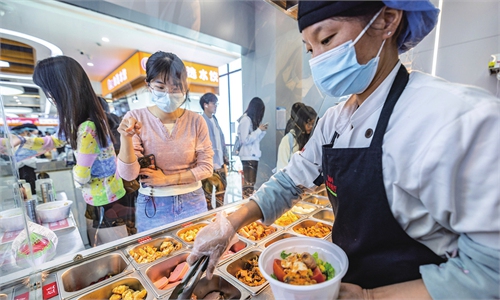
In modern society, with a growing focus on health management, many people are going out of their way to choose less processed, nutritious meals made from raw ingredients. On food delivery platforms, a diverse range of restaurants now offer nutritious meal options. Recently, a distinctive new player has emerged: Some top-tier public hospitals have joined the online marketplace, launching nutritious meals prepared in their own cafeterias.These meals are not being launched by random medical organizations, but specially by "Tertiary A" hospitals in China, and are tailored to diverse dietary needs. Take a hospital in Nanning, South China's Guangxi Zhuang Autonomous Region as an example. Its "Ren'ai Meal" targets weight management, aligning with the current "weight-loss meal" dining trend.
In Haikou, South China's Hainan Province, a maternity hospital has leveraged its specialized expertise to launch "postpartum recovery meals."
Nutritious meals launched by "Tertiary A" hospitals - public institutions dedicated to healthcare - symbolize innovative outreach as much as a new concept philosophy: "Healthcare" is not just about "treating illnesses" but promoting a holistic approach to public health.
This approach can be observed in the recipes of the hospital meals. The "Ren'ai Meal" categorizes its menus into winter and all-season selections. Accompanied by side dishes such as fern root noodles, multigrain rice and vegetable platters, diners can choose from a variety of protein options, including braised duck leg, basa fish steak and lemon pork chop.
Ingredients like basa fish and lemon pork are commonly found in many restaurant menus. But what makes these hospital meals innovative is not merely the ingredients, but the meticulous nutritional formula carried out by the hospital.
For instance, each "Ren'ai Meal" maintains a calorie count of around 600 while delivering balanced nutrition. This standard is derived from "research based on extensive clinical cases," according to Sun Guili, director of the Nanning hospital's Clinical Nutrition Department. On food delivery platforms, the "Ren'ai Meal" has garnered numerous positive reviews featuring keywords such as "professionally formulated," "good value for money" and "peace of mind while eating."
Produced by hospital cafeterias, these meals' success reveals two things. First, hospitals' professional authority has now become a business asset, transforming clinical credibility into a trusted daily service. Second, the public's desire for health is now being met with a response grounded in trusted expertise.
Rather than an extreme pursuit of taste, the public seems more willing to pay for a "health guide." The hospital's cross-border venture into the food industry is, in fact, a direct response to consumer demand, especially as this demand becomes increasingly difficult to meet in a time when pre-made meals are trending.
On top of all this, food offerings from many hospitals are also reshaping consumers' perceptions of health.
While a cup of "milk tea," one of the better-known tea-based beverages, is often seen as a "lifesaver" for many, its high sugar and creamer content raises health concerns. Yet in Beihai, Guangxi, a traditional Chinese medicine (TCM) hospital has introduced beverage products featuring TCM ingredients.
The beverage, combining dark plum and "Pang Dahai" (lit: boat-fruited sterculia seed), is a specialized drink for gastrointestinal discomfort. To cater to female customers, another beverage called "Goddess Seven Whites" incorporates herbs such as white atractylodes, poria and angelica root. On social platform RedNote, a consumer of the hospital's beverage called "Didi Yue" told the Global Times that after getting used to such drinks, she "has gradually given up artificial milk teas."
From the "Ren'ai Meal" to the "Goddess Seven Whites," the health-focused meals and beverages offered by hospitals help consumers recognize intrinsic connections between "eating" and well-being. Though a cup of herbal drink may seem small, it transforms health knowledge, such as the pairing of traditional Chinese herbs, and dietary habits, like rejecting artificial ingredients, into a tangible, experiential reality.
If the responsibility of hospitals and other health organizations lies in safeguarding public health, then providing these nutritious options is, in a sense, a fulfillment of that duty.
Unlike nutritious meals and beverages solely at cafeterias and passively waiting for consumers to discover them, hospitals are actively promoting their nutritious meals online. This move shows the self-innovation of public service mechanisms and their willingness to engage with the public through digital platforms.
Such an approach not only enhances approachability but also strengthens hospitals' branding. However, more important than self-promotion is consistently maintaining the quality of such nutritious meals, ensuring they do not become a mere marketing gimmick or a tool for profit-seeking, but instead serve as a lasting benefit to the public. Hospitals should focus their core expertise on research, supervision and public education, rather than deeply involve themselves in the entire chain of meal production and delivery.
The author is a reporter with the Global Times. life@globaltimes.com.cn
RELATED ARTICLES