Illustration: Chen Xia/GT
At a time when some Western countries are grappling with power shortages driven by soaring electricity demand from artificial intelligence (AI) infrastructure development, certain Western media outlets have turned their attention to China's coal-fired power plants. Citing a research report released on Tuesday, some claimed that China opened many more coal power plants last year than in previous years, raising concerns over whether the country will "reduce carbon emissions enough to limit climate change."However, the narrative that equates coal power expansion with a slowdown in green energy adoption not only overlooks the realities of China's current energy development, but also reflects Western ignorance of China's pragmatic approach in pursuing energy security along with its dual-carbon goals.
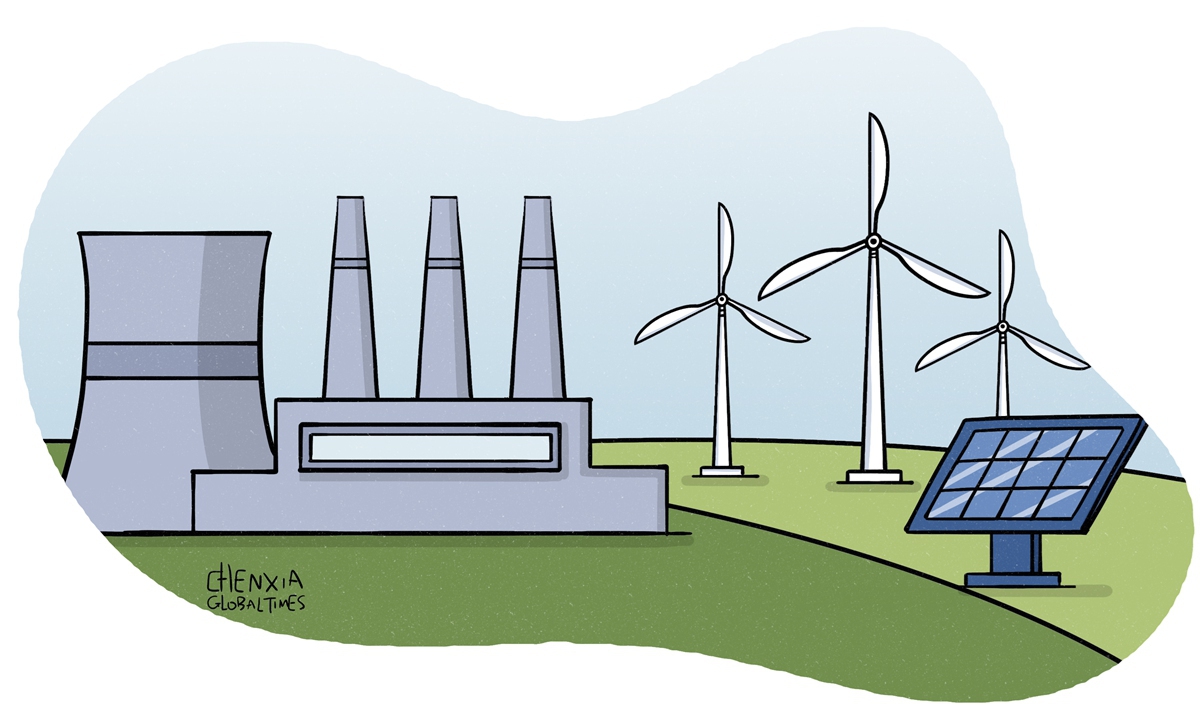
Many may wonder why China continues to expand its coal power capacity even as wind and solar generation grows rapidly. This approach actually reflects the pragmatism of China's energy strategy. While new energy is undoubtedly the future direction, its intermittent and volatile nature remains a global challenge. In this context, the role of China's new coal power plants is shifting from providing baseload power supply to serving as flexible support for the grid. As reported by China Energy News, citing industry insiders, the role of coal-fired power will shift from being the "main force" supplying electricity to serving as a "regulator" ensuring system stability in the next five years.
When wind and solar output is high, coal plants reduce generation to make way for green electricity; during windless, sunless periods or during peak demand, they can respond rapidly to ensure grid security.
At a stage when large-scale energy storage technology has not yet achieved a fundamental breakthrough, the rapid-adjustment capability of coal power remains indispensable for maintaining real-time balance across the power system.
China's position as the world's premier powerhouse in the renewable energy sector serves as compelling evidence of the transformation within its power system. China's installed solar power capacity is on track to surpass coal for the first time in 2026, according to estimates of the China Electricity Council. China will add more than 400 million kilowatts of new generation capacity in 2026 alone, with new energy sources - primarily wind and solar power - expected to contribute more than 300 million kilowatts.
Data from the National Energy Administration further illustrates this transition. As of the end of 2025, China's total installed power generation capacity reached 3.89 billion kilowatts, a year-on-year increase of 16.1 percent. Installed capacity of solar energy surged 35.4 percent to 1.2 billion kilowatts, while that of wind energy rose 22.9 percent. Notably, the cumulative average utilization of power generating equipment (for power plants rated 6,000 kilowatts and above) was 3,119 hours in 2025, a decrease of 312 hours compared with 2024. Behind this was the direct embodiment of coal power reducing output to accommodate renewables.
Furthermore, China's newly added coal power capacity is in no way a return to the traditional model of high consumption and high pollution. These new facilities typically employ advanced ultra-low emission and high-efficiency technologies. Through intelligent upgrades, they also enable flexible and precise operational controls.
China's efforts to phase out outdated coal power capacity have continued. Over the past year, provinces and regions across the country have retired multiple small, inefficient coal-fired units, according to industry reports. This dual-track approach of "adding advanced capacity while retiring outdated plants" reflects China's commitment to promoting the overall clean and efficient transformation of its coal power sector - a strategy that is fundamentally distinct from the mere expansion of coal power capacity.
Through concrete and targeted measures, China is making pragmatic efforts to ensure national energy security while also actively and firmly participating in global climate governance. This practical and rational energy transition path not only supports China's high-quality development but also offers valuable insights for other developing countries in their energy transitions.
If the West only judges China's climate actions solely by the new coal power capacity in a particular year, it will undoubtedly ignore the structural changes taking place in its energy system, and may even miss a profound grasp of the dynamics of the global energy transition.
RELATED ARTICLES