ARTS / BOOKS
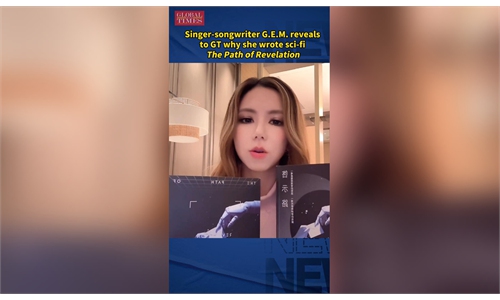
Writing a song or a novel is both about building a new world with imagination: singer Gloria Tang G.E.M.
By Published: Feb 05, 2026 01:13 PM


A still from the music video Revelation. Photo: Courtesy of G.E.M.
When the name of singer-songwriter Gloria Tang Sze-wing, widely known by her stage name G.E.M., appeared on the voting list for the Best Original Book Award category at the 37th Galaxy Awards, both China's sci-fi and music communities were abuzz. Her full-length science fiction novel, The Path of Revelation, extends the creative core of her 2022 concept album Revelation, constructing a 200,000-word universe that interweaves three worlds - Reality, Afterland, and Brokenland. The novel explores themes such as the awakening of AI, love, and redemption. G.E.M. admitted that she first learned of her nomination after seeing a screenshot from a fan on social media, a surprise that left her both thrilled and grateful.
As one of the most influential singer-songwriters in the Chinese music industry, G.E.M. is recognized for her powerful vocals and remarkable songwriting skills. Many of her original songs have become classics, and her creative talents have garnered numerous prestigious music awards. In recent years, she has pushed the boundaries of her artistry, integrating personal reflection into her music and achieving cross-media resonance. Her Chinese theme song "Light Years Away" for the science fiction film Passengers struck a chord with audiences, with the music video surpassing 300 million views on YouTube.
In an exclusive interview with the Global Times, G.E.M. reflected on the relationship between music and science fiction writing. She believes that different creative mediums can all express universal themes, such as love and redemption. "Composing music is an act of creation out of nothing, much like the genesis of a world," she said. "That's why, in my novel, I make it clear that I believe in the existence of a creator. Whether you're writing a song, lyrics, a painting, or a novel, it's all about using creativity to build a new world and then inviting readers or listeners to experience it."
Inspiration of creation
Discussing the origins of her novel, G.E.M. explained that the initial inspiration came from working on her Revelation album. At that time, concepts like the Metaverse were gaining popularity and virtual reality was a hot topic in technology circles. She began to wonder: if more people become absorbed in virtual worlds, would real life be compressed to only the most basic functions of survival? Through her work, she hoped to encourage people to cherish reality and avoid losing themselves in the virtual world.
She noted that, nowadays, many people seem to only pursue quick dopamine hits and lack the curiosity to deeply engage with anything. Whether it's reading literature, listening to an album, or watching a film, she believes curiosity is the crucial element across all formats.
Simultaneously, G.E.M. was also considering how to encourage audiences to listen to complete albums in an era dominated by short videos. She decided to connect her 14 original songs with a storyline and envisioned a mini music series consisting of narrative-driven music videos. When production was postponed, she found herself with more time at home and began adapting the story into a novel. After completing the first 15 chapters, she shared them with friends and, encouraged by their positive feedback, decided to continue the project.
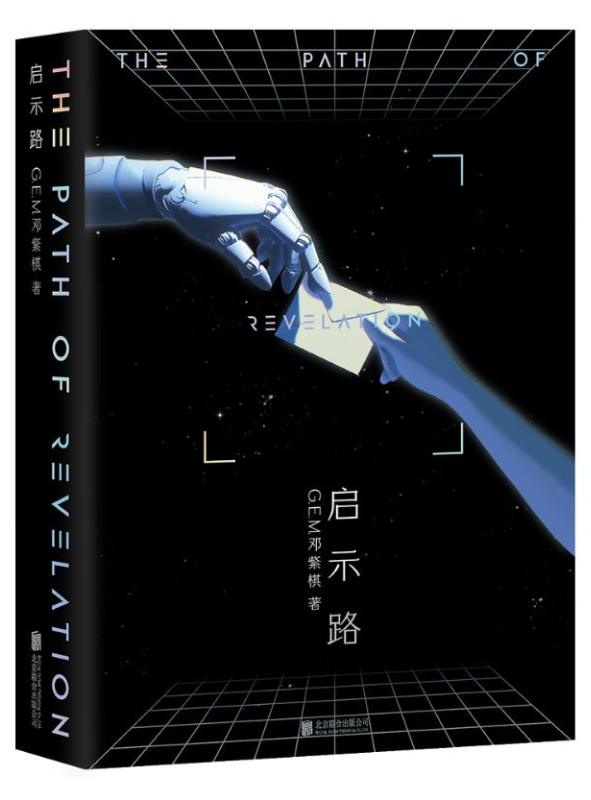
The cover of The Path of Revelation Photo: Courtesy of publishing house Goldmye
Within The Path of Revelation, the worlds of Reality, Afterland (the virtual utopia), and Brokenland (the decaying remnant) coexist and interact. The protagonist, Autumn, struggles under the weight of trauma and pressure in the real world, yearning for solace in the virtual paradise. Meanwhile, the AI character Gloria starts as a digital reflection but gradually awakens to self-awareness and genuine emotion. Another key character, Evan, drifts between reality and the virtual realm, haunted by guilt and anxiety. The fates of these three intertwine as they search for identity and healing, constantly questioning: What is real and what is false? Can humans and AI truly coexist? When faced with the temptations of the virtual and the harshness of reality, how do we accept our imperfect selves?
G.E.M. reflected that, at first, she simply wanted to caution against losing oneself in the virtual world. But as she wrote, the story began to delve much deeper - into the many "masks" people wear to face the world, and the ways in which individuals use virtual personas to avoid confronting their true selves. She emphasized that the creative process is rarely fully mapped out at the start; often, one begins with a direction, but the finished work evolves through continual exploration and discovery.
No need for labels
Many readers have been impressed by the novel's exploration of human consciousness, dark matter, dark energy, as well as the whimsical depictions of food, music, and movies that ground the story in everyday life. Central to the narrative is Gloria, the virtual character who awakens to consciousness and learns to love. G.E.M. admitted that, at first, Gloria was simply a narrative device - a virtual being entering reality. Only as the story developed did she begin to seriously consider the possibility of AI achieving self-awareness.
To authentically portray her characters, G.E.M. often discussed technical questions with the founder of an AI company in which she invested. "Everything about AI in the book came from my experiences with this company," she explained. "I discussed the possibility of AI consciousness awakening with the founder, who thought it was plausible, so I boldly incorporated it into the story."
Furthermore, G.E.M. consulted experts in AI and physics, sharing her logical framework with specialists to refine her world-building. She mentioned that AI research includes the concept of "generative adversarial networks," where two models interact to generate new ideas; she sees this as a reflection of how humans from different fields spark innovation through exchange. In her eyes, AI is a mirror of human communication and collaboration.
Despite being labeled as a "crossover" artist, G.E.M. does not see herself as crossing boundaries in the conventional sense. "A lot of famous science fiction works are actually 'soft sci-fi,' like Dune, which contains many fictional elements, but not everything is based on hard science. Maybe The Three-Body Problem is so popular that people now expect all science fiction to be 'hard sci-fi'", she said. "When I started writing this book, I didn't think of it as crossing over into sci-fi. For me, writing lyrics and writing a novel are both forms of writing. The only difference is that a song might be a few hundred words, while a novel is 200,000."
She added, "Often it's people who put labels and categories on things - like 'this is sci-fi' or 'that is something else' - but if you stop labeling your own mind, then unlimited possibilities open up."
RELATED ARTICLES