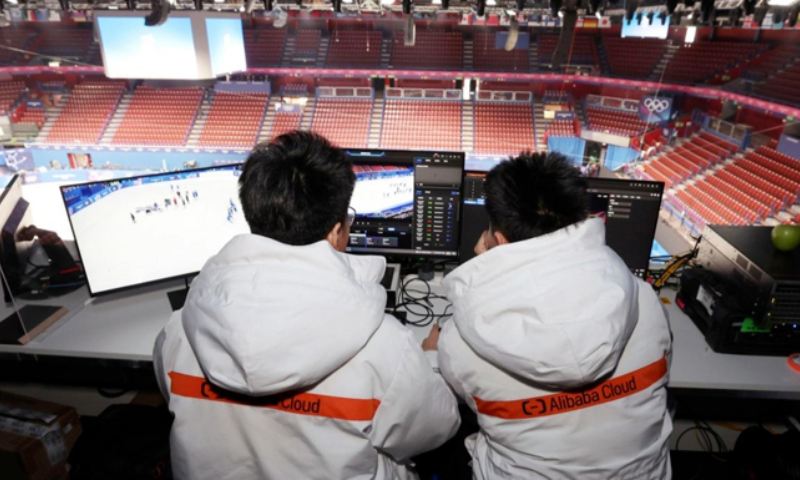
Engineers of Alibaba Cloud work inside the venue of the 2026 Milan-Cortina Winter Olympics. Photo: Courtesy of Alibaba Cloud
While the 2026 Milan-Cortina Winter Olympics kicks off on Friday local time, Chinese companies quietly emerged as a major force behind the scenes. From ultra-light carbon-fiber ski poles to cloud service provider empowering the "smartest Games ever," together with artificial intelligence (AI) model improving service, China's cutting-edge tech and robust supply chains are delivering standout performance, the Global Times learned from products and services providers.
"We have developed freestyle aerials skiblades for China's national team, having passed four rounds of testing. The product is expected to make its debut at the 2026 Winter Olympics. The national team needs to adjust equipment usage according to changes in competition venues. We are still awaiting confirmation to see whether this skiblade model will ultimately appear on the slopes of the Games," Li Zhibo, general manager of Harbin Q.M.xuelong Sports Equipment Co, told the Global Times on Friday.
The skiblade model filled the gap in China's reliance on imported competitive-level skiing equipment, said Li, adding that this product innovatively uses aerospace-grade composite materials and employs 3D printing technology for precise shaping.
"The new material significantly reduces weight while greatly enhancing toughness, with a price only half that of similar imported products," said Li.
"Our products are the lightest and strongest - customers label them exactly that way and trust our quality completely," General Manager Zhang Xionghui of a Xiamen-based leading supplier of high-end carbon fiber and aluminum ski poles for the Games, told the Global Times.
The company supplies the world's top five ski equipment brands and has progressively reduced pole weight from 63 grams per meter in 2010 to 48 grams today, targeting 45 grams in the future, said Zhang.
At Milan 2026, the company's poles will be widely used in cross-country skiing, as well as alpine giant slalom and slalom events.
Zhang attributed their edge to China's robust supply chain, deep talent pool in carbon fiber, and consistent innovation - delivering reliable high-quality products.
Beyond equipment, Chinese tech giants provide essential support across training, accommodation, transportation, broadcasting, and operations.
Alibaba's Qwen powers the first use of AI large language model technology at the Olympics and a next-generation Olympic archive, a person-in-charge of Alibaba Cloud, told the Global Times, adding that such technology will make the Milan Games the "smartest Olympics in history." Alibaba Cloud is an official partner of the Olympics.
Advanced cloud and AI technologies are designed to enhance viewing experience for global audiences, improve operational efficiency for broadcasters, and create new ways to capture, manage, and preserve Olympic content at scale, the person said.
For Milano Cortina 2026, Alibaba Cloud is introducing upgraded Real-Time 360 degree replay systems that deliver immersive replays with fluid camera movement and stroboscopic visual effects. Powered by AI algorithm that separates athletes from complex backgrounds such as snow and ice, the system enables three-dimensional reconstructions of key moments in as little as 15-20 seconds - fast enough for live broadcast use, according to a statement sent from Alibaba Cloud to the Global Times on Friday.
TCL supplied cutting-edge displays - including hundreds of large-screen HD TVs, digital signage, and LED screens - for the International Broadcast Center and across opening/closing ceremonies, venues, broadcast centers, media centers, Olympic Village, and security operations, creating an "Olympic screen universe" that enhances athlete performance and spectator experience, the company told the Global Times.
TCL also equipped the Olympic Village with AI smart terminals such as air conditioners, refrigerators, washers, dryers, AR/AI glasses, digital signage, and audio systems.
Experts attributed this deep participation to multiple reinforcing factors. Liu Chunsheng, a professor at the Central University of Finance and Economics, told the Global Times on Thursday that Chinese companies' rising influence at Milan 2026 builds on technical, industrial, and brand advantages accumulated during the Beijing 2022 Winter Olympics, plus the domestic ice and snow industry's rapid growth.
Before Beijing Winter Olympics, core technologies and market power of the ice and snow sport industry were dominated by foreign brands, but the "300 million people on snow and ice" campaign spurred massive demand, driving R&D investment and breakthroughs, said Liu.
Official data showed that China's ice and snow equipment sector expanded from about 300 enterprises in 2015 to roughly 900 by 2023, with sales revenue rising from under 5 billion yuan ($720.6 million) to around 22 billion yuan. Products like snow-making machines, ice skates, and protective pads have steadily gained global market share.
Liu emphasized that national ice and snow policies, combined with market demand and the global platform of the Olympics, have created a virtuous cycle from policy support, technological advancement to industrial collaboration, market empowerment, enhanced international brand influence and cooperation leverage.
RELATED ARTICLES