Alibaba’s Qwen launches Spring Festival subsidy drive as Chinese firms push AI adoption to unlock consumption potential
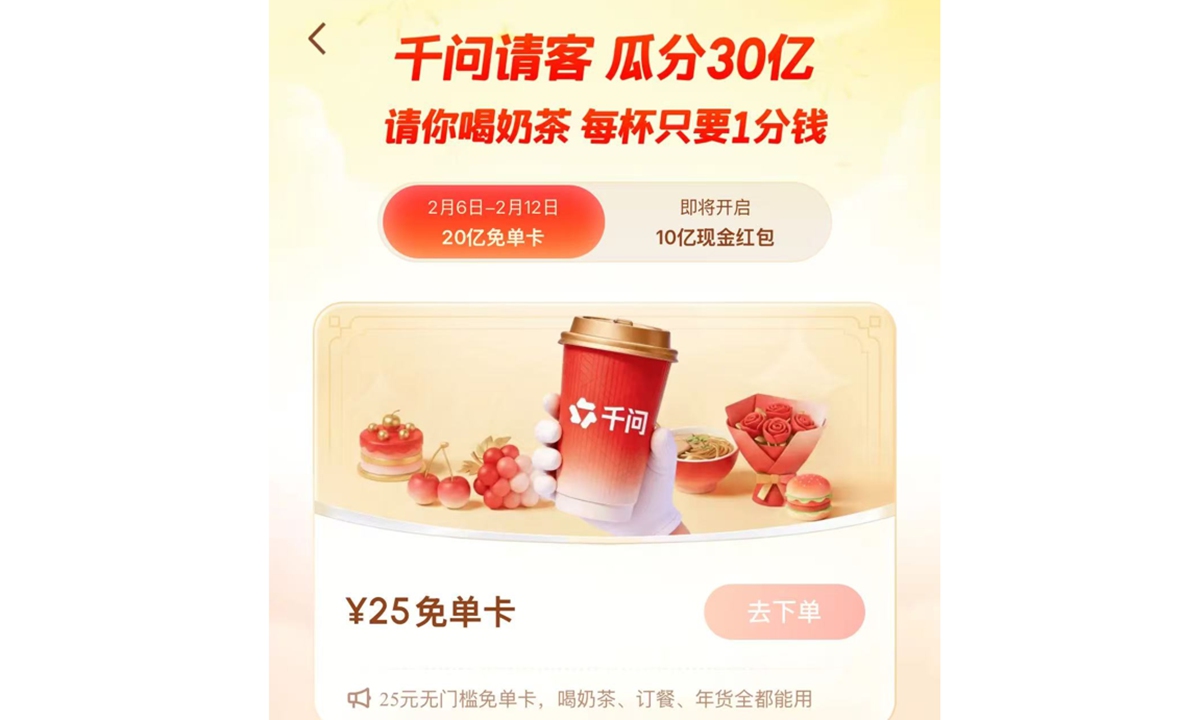
A screenshot of the Qwen app's in-app interface showing its milk tea subsidy promotion during the Spring Festival Photo: Qwen app
China's leading AI companies have rolled out in-app subsidy campaigns to cultivate user application and consumption habits during the upcoming Spring Festival, highlighting a shift in the country's AI competition toward real-world consumption scenarios and an AI deployment model that allows practical use cases to pull technological progress and unlock tangible commercial value.
On Friday, Alibaba's Qwen app, an AI assistant developed under the company's large language model ecosystem, launched its "Spring Festival 30-billion-yuan ($4.2 billion) giveaway" campaign, highlighting the shift. Through AI voice or text prompts, users can order milk tea and other consumer services at more than 300,000 beverage outlets nationwide.
The Qwen campaign allows users to receive up to 21 no-threshold discount vouchers, each worth 25 yuan. In addition to free milk tea orders, the vouchers can also be used for instant retail purchases on Taobao and food delivery services, according to information displayed on the app's activity page.
The 30-billion-yuan Spring Festival initiative represents Alibaba's largest-ever holiday promotion and the biggest single investment among this year's AI-focused campaigns by major platforms, according to Beijing Daily.
Within less than three hours of the campaign's launch, more than one million milk tea orders were placed through the Qwen app, according to the Securities Times citing platform data. Some users encountered interface messages indicating the system was temporarily overloaded, reflecting the intensity of market demand.
The widely discussed and heavily participated campaign came amid a broader wave of AI-related red packet initiatives launched by China's major internet platforms ahead of the Chinese Lunar New Year. Companies including Baidu, Tencent and Alibaba have together rolled out AI-linked promotional programs totaling more than 45 billion yuan ($6.3 billion), according to media estimates.
Industry analysts said the model marks a shift in how consumption is organized, allowing users to bypass fragmented apps and complete decision-making, transactions and fulfillment through a single AI agent, a change that could reshape everyday consumption patterns.
The promotion quickly translated into higher download volumes. On Friday, the Qwen app rose to the top of China's Apple App Store free app rankings, surpassing Tencent's Yuanbao and ByteDance-backed Doubao.
Unlike in previous years, major internet companies have shifted the core of Spring Festival red packet campaigns away from payment tools and social platforms and into their own AI applications, aiming to cultivate user interaction habits and compete for the primary AI entry point, said Xiang Ligang, director-general of the Beijing-based Information Consumption Alliance.
By embedding AI into high-frequency everyday scenarios during the holiday consumption peak, platforms are strengthening user awareness and product stickiness while offering the industry a practical, scalable model for driving AI application and broader industry development, Xiang told the Global Times on Friday.
Similar strategies have also been adopted by other major platforms, underscoring the intensifying competition around AI-driven user engagement.
On February 1, Tencent launched a 1-billion-yuan red packet campaign via its Yuanbao app, giving users a chance to win cash rewards that can be withdrawn directly. The app topped Apple's App Store free rankings on the first day of the campaign and briefly faced server disruptions amid heavy traffic.
Baidu rolled out a 500-million-yuan incentive program through its Ernie-powered assistant within the Baidu app, running from January 26 to March 12, with individual rewards reaching up to 10,000 yuan. Also, ByteDance introduced a card-collection campaign with a total prize pool of 300 million yuan.
Xiang said the trend highlights a key application-layer breakthrough, showing that AI's capacity to generate profits beyond upstream segments such as chipmaking, which he noted has dominated value creation in the US market. Some Chinese companies have already seen tangible gains from deep AI integration, though these remain underrecognized, he added.
As AI applications continue to extend into everyday services, their commercial and social value is expected to be further released, Xiang noted.
However, the high-intensity campaigns have also attracted regulatory scrutiny, as platforms sought to limit excessive marketing behavior. WeChat has restricted the sharing of red packet links related to apps such as Yuanbao and Qwen.
On Wednesday, WeChat imposed restrictions on Yuanbao's red packet links, with a notice stating that the webpages involved inducive sharing behavior and requiring users to copy the links into a browser to access them. After Qwen launched its campaign on Friday, its sharing links were blocked in a similar manner, prompting the app to switch to a passcode-based sharing format.
The WeChat Security Center said in a statement on Wednesday that the measures were taken in response to user complaints, noting that some Spring Festival marketing activities had encouraged high-frequency sharing in group chats, disrupting platform order and user experience.
Analysts said the episode reflects platform governance considerations, but does not alter the broader trend. AI-driven campaigns continue to play a role in upgrading user interaction habits while unlocking significant digital economy and consumption potential, supporting China's ongoing efforts to boost domestic demand, Xiang said.
RELATED ARTICLES