China reclaims spot as top German trade partner in 2025 from US; data shows interdependent nature of bilateral trade ties, expert says
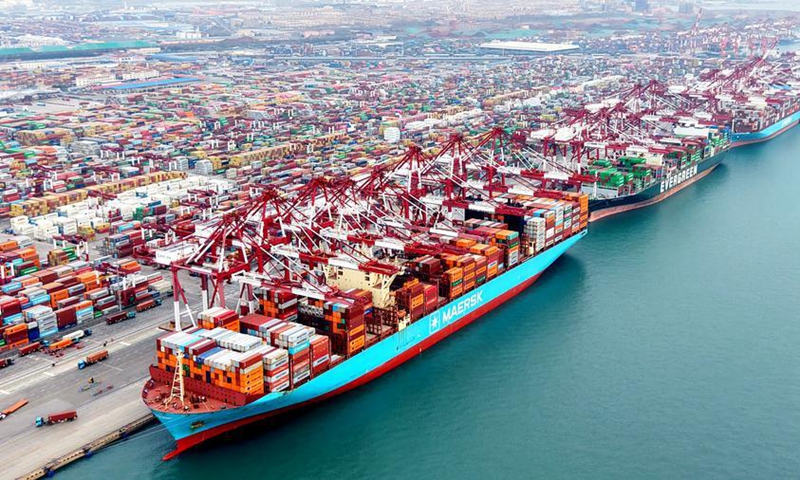
This aerial drone photo taken on Dec. 27, 2025 shows cargo ships loading and unloading containers at Qingdao Port in east China's Shandong Province. (Photo by Yu Fangping/Xinhua)
Germany’s trade volume with China grew by about 2.7 percent year-on-year to reach 253 billion euros ($299.05 billion) in 2025, making China Germany’s most important trading partner last year, ahead of the US, the Xinhua News Agency reported on Friday, citing data released by the Federal Statistical Office of Germany. The outcome came just one year after the US claimed the position in 2024.
The data showed that Germany’s imports from China hit 171.2 billion euros in 2025, while exports to China reached 81.8 billion euros.
In 2025, the foreign trade turnover between Germany and the US was 241.6 billion euros, down about 4.4 percent year-on-year. Due to being significantly affected by US tariff policies, Germany’s exports to the US decreased by 9.3 percent year-on-year to 146.9 billion euros over the period, while imports from the US increased by 2.9 percent year-on-year to 94.7 billion euros, per Xinhua.
“The reasons why China has once again become Germany’s largest trading partner are multifaceted. US trade protectionist policies serve as an external stimulus factor, but the more critical and fundamental reason lies in the deep, historical, and structural economic interdependence that has long been established between China and Germany,” Jian Junbo, director of the Center for China-Europe Relations at Fudan University’s Institute of International Studies, told the Global Times on Friday, noting that the trend of current bilateral industrial cooperation will not be reversed in the short term.
German companies’ investment in China reached a four-year high from January to November 2025, according to data compiled by Reuters. Jian said that in the context of rising global uncertainty, the stability of the Chinese economy, along with its high-quality development in areas such as high technology, provides strong support for the investment environment for German companies in China.
For the past year, German enterprises have continued to strengthen their “in China, for China” strategy, with major German automakers and engineering firms stepping up their investment as well as expanding their research and development (R&D) in China.
For example, The Chinese branch of Germany’s Volkswagen Group recently said that it had started on-schedule production of the first vehicle built on its China Electronic Architecture, the group’s first zonal electronic architecture, according to a press release sent to the Global Times. With 18 months from concept to production, the project marks the fastest timeline Volkswagen Group has ever achieved for an all-new electronic architecture, it said.
Under the circumstances where the US is exerting political and economic pressure on its allies, many Western countries – including Germany – are diversifying their markets and adopting a more pragmatic attitude toward China, Jian said, noting that strengthening cooperation with China on the basis of mutual trust can achieve win-win outcomes.
According to data from the Federal Statistical Office of Germany, from 2016 to 2023, China maintained its position as Germany’s largest trading partner for eight consecutive years. In 2024, the US was ranked higher than China among Germany’s top trading partners.
RELATED ARTICLES