New-energy vehicles an example of inclusive development in Chinese modernization: Global Times editorial
GT
Figures from international data platform Dataforce show that in December 2025, Chinese automakers' sales in the European car market surged 126 percent year-on-year, with monthly sales breaking the 100,000-unit mark for the first time. During the same period, Chinese brands captured a 9.5 percent share of the European market, astonishing the world. "The advance was strongest for the electrified cars that account for the bulk of Europe's growth," Bloomberg reported.Observers point out that many Western automakers are now forming delegations to visit China, eager to learn about Chinese electric vehicle (EV) battery technology, intelligent control systems, and even to learn from China's industrial development model.
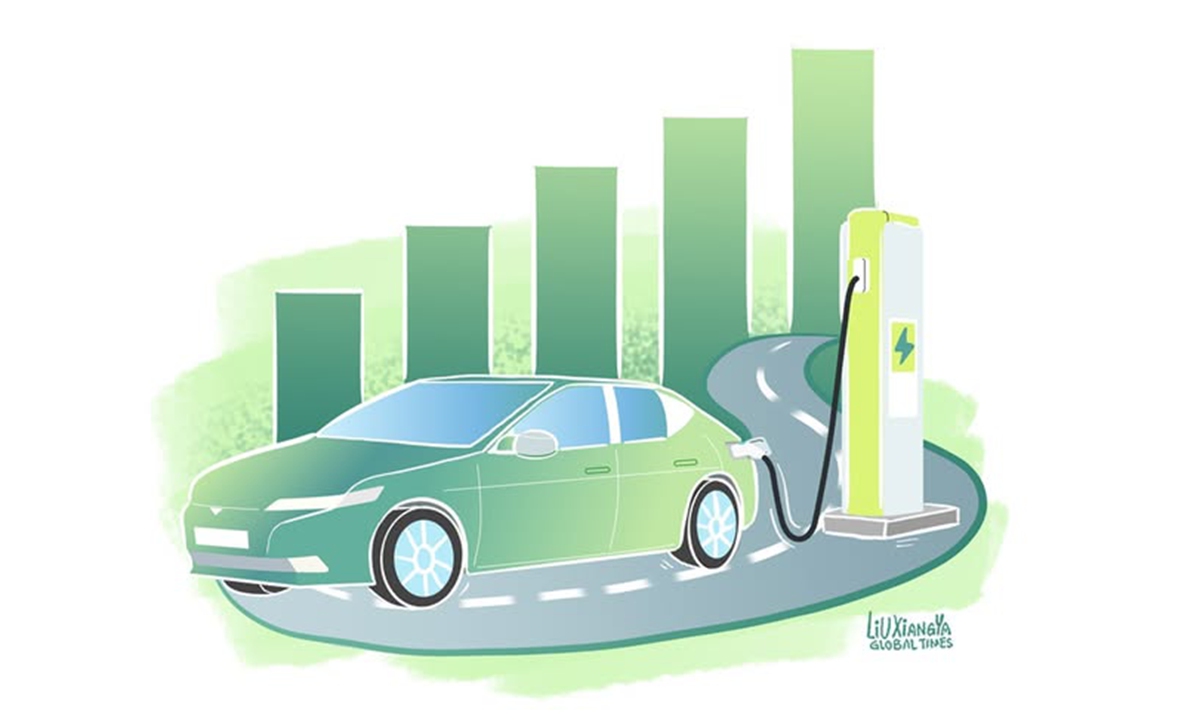
This scene would have been almost unimaginable just over a decade ago. Back then, China's auto market was dominated by European, American, Japanese, and Korean brands, while its industrial chain remained largely stuck in low-end manufacturing. Now, China's new-energy vehicle (NEV) sector has leaped from an annual output of less than 100,000 units more than a decade ago to a world-leading force with production and sales exceeding 16 million units with NEV's share surpassing 50 percent of domestic car market.
Driven by China, global NEV sales in 2025 have surpassed 20 million units, powerfully advancing the adoption of clean energy. As the website of The New Yorker once noted, China's EV industry, which developed "practically from scratch," owes its success primarily to long-term policy persistence, the encouragement of innovation and competition, and encouraging local firms to partner with foreign companies.
The NEV track is crowded with competitors. Tesla was the earliest leader to stake out a position in the sector, yet it has not driven holistic development across the US EV industry. So why has China been able to achieve this "overtaking on a curve"? The most crucial factor is likely the strategic vision of "carry the blueprint through to the end" combined with resolute execution. In May 2014, during an inspection of SAIC Motor, Xi Jinping, general secretary of the Communist Party of China Central Committee and Chinese president, emphasized that developing new-energy vehicles is essential for China to evolve from an automobile power to an automobile powerhouse. This important statement scientifically foresaw the direction of technological evolution in the global auto industry and has guided China's new-energy vehicle sector to unswervingly pursue a path of independent innovation.
From the initial proposal of the "three verticals and three horizontals" technology roadmap, to multiple revisions of the "energy-saving and new-energy vehicle technology roadmap," from the precise fulfillment of the "China Energy-Saving and New Energy Vehicles Industry Development Program (2012-2020)" to the effective advancement of the "New Energy Vehicle Industry Development Plan (2021-2035)" - all these demonstrate the power of Chinese planning.
While many Western countries are constrained by vested interest groups, and their industrial planning frequently falls into wavering, China, through forward-looking top-level design, has identified the automobile industry, particularly NEVs, as a national strategic emerging industry. By working steadily and persistently from one stage to the next, China has made impressive achievements, while also sending a strong signal of stability and certainty to the world. The success of China's EV lies not only in producing high-quality cars, but more importantly in building a complete, coordinated, and competitive industrial ecosystem. A simple example is that the core of an EV consists of the "three electric systems": the battery, the motor, and the electronic control system. During the critical phase of technological breakthroughs, China has consistently leveraged the advantages of its new type of national system, using top-level coordination to integrate resources nationwide, uphold enterprises as the main drivers, follow market-oriented principles, and promote the integration of industry, academia, research, and application, concentrating efforts to accomplish major tasks.
Take battery technology of EV as an example: from initial reliance on imports to today's mastery of technologies across the entire industrial chain and commanding roughly half of the global power battery market, China's progress has been driven by the combined strength of a "nationwide coordinated effort."
The new stage of global new-energy industry development led by Chinese technology has not only injected fresh momentum into economic growth worldwide, but has also shown developing countries a new path toward green, low-carbon, and sustainable development, boosting confidence in joint efforts to address climate change. As Chinese NEVs and new-energy technologies enter more and more countries, the quality of life of ordinary people continues to improve, and the idea of technology benefiting the public is becoming increasingly tangible. Claims once popular in the West - if everyone on the planet consumed as much as the average US citizen, four Earths would be needed to sustain them, or that the Earth cannot sustain a second US - are being disproved by reality.
On Thursday, Canadian Prime Minister Mark Carney announced a new strategy, stating that Canada would work with China to promote domestic production of EVs, and diversify exports. The New York Times commented that Canada's plan aligns the country with a shift to EVs that is well underway in Europe and China. One EV after another is building bridges that connect China with the world, telling the story of the warmth and strength of Chinese modernization. Looking ahead, as more Chinese EVs travel roads across the globe, China will continue to uphold the vision of a community with a shared future for humanity and work hand in hand with other countries, ensuring that the achievements of Chinese modernization benefit more nations and peoples. This will further affirm that "China can only do well when the world is doing well. When China does well, the world will get even better."
RELATED ARTICLES

