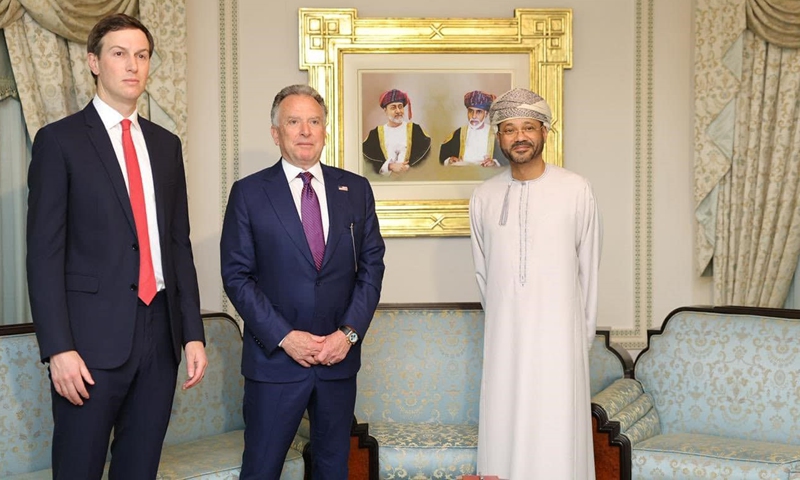
A photo posted on the official website of Oman's Foreign Ministry shows Jared Kushner and Steve Witkoff during meetings in Oman on January 6, 2025. Photo: Oman's Foreign Ministry
The US appears to be using what a Chinese expert called a "parallel strategy of pressure and talks" on Iran as US President Donald Trump signed an executive order on Friday that could impose a 25 percent tariff on countries that do business with Iran, while saying on Saturday that Washington had held "very good talks" with Tehran.
Iranian authorities also described the latest round of contacts in Oman as "positive," but Iran's Foreign Minister Abbas Araghchi said a decision on how to proceed with further rounds would be taken after "consulting with the capitals," media reported.
The two sides held several hours of nuclear negotiations in Oman on Friday night, with officials from both countries indicating that further meetings could follow in the coming days, according to US media outlet Axios.
According to Axios, the meetings between the US and Iran were conducted through mediators. Trump's advisers Steve Witkoff and Jared Kushner also met directly with Araghchi, two sources briefed on the meeting told Axios.
The meeting marked the first face-to-face engagement between the US and Iran since the 12-day war last June, Axios said, noting that the talks took place amid a massive US military buildup in the Gulf and warnings from Trump that he could pivot to military action if an agreement can't be reached quickly.
In those indirect exchanges, US Navy Admiral Brad Cooper, head of the US military's Central Command, was also present. The Associated Press reported that the setting "served as a reminder that the aircraft carrier USS Abraham Lincoln and other warships were now off the coast of Iran in the Arabian Sea."
Despite the diplomatic engagement, Washington has continued to ramp up pressure on Tehran. Trump signed an executive order on Friday that could impose a 25 percent tariff on countries doing business with Iran. Separately, the US has sanctioned 15 entities and 14 "shadow fleet" vessels linked to what it described as illicit trade in Iranian petroleum, petroleum products and petrochemicals, the State Department said on Friday, according to Reuters.
The executive order says it will apply to goods imported into the US from any nation that "directly or indirectly purchases, imports, or otherwise acquires any goods or services from Iran", BBC reported. At the time, no further detail was provided on how the tariffs would work in practice.
Iran, for its part, stressed principles it sees as essential to any durable outcome. "Iran enters diplomacy with open eyes and a steady memory of the past year. We engage in good faith and stand firm on our rights. Commitments need to be honored. Equal standing, mutual respect and mutual interest are not rhetoric—they are a must and the pillars of a durable agreement," Araghchi wrote on social media platform X on Friday.
The Iranian Student News Agency, linked to the Iranian government, reported that the supposed in-person meeting was nothing more than a formal diplomatic greeting. It said the talks proceeded as reported, with Oman's Foreign Minister Badr bin Hamad Al Busaidi acting as intermediary, according to Al Jazeera .
A Chinese expert said the parallel tracks of talks and pressure underscore Washington's broader strategy. The US is attempting to use economic and military pressure to force negotiations and extract concessions it wants from Iran, while both sides also hope talks can help avoid a direct military confrontation, Tian Wenlin, a professor at Renmin University of China's School of International Studies, told the Global Times on Saturday.
At the same time, Tian noted that the scope for compromise remains limited. From available information, the US hopes to fold constraints on Iran's missile capabilities and its support for so-called "Axis of Resistance" into the talks, while Iran has rejected putting these issues on the table.
Even on the nuclear issue, Tehran is unwilling to completely abandon its program, Tian said, adding that these differences mean the room for negotiation is "very limited" at present, and whether an agreement can be reached will depend on whether both sides are prepared to make compromises in the next phase.
Ultimately, a return to negotiations reflects a broader trend, as military conflict would be a lose-lose outcome, Tian said, adding that reaching results acceptable to both sides is unlikely in the short term.
China has reiterated its support for dialogue between the US and Iran. On Friday, Chinese Foreign Ministry spokesperson Lin Jian said that Deputy Foreign Minister Miao Deyu and Assistant Foreign Minister Liu Bin met separately with Iranian Deputy Foreign Minister Kazem Gharibabadi, who was visiting China on Thursday, in response to a media query about Tehran consulting Moscow and Beijing ahead of US-Iran nuclear talks.
China has maintained communication with other parties on relevant issues and hopes that all parties will resolve differences through dialogue and jointly maintain regional peace and stability, Lin said.