Spring Festival offers insight into China’s explosive NEV growth, market vitality
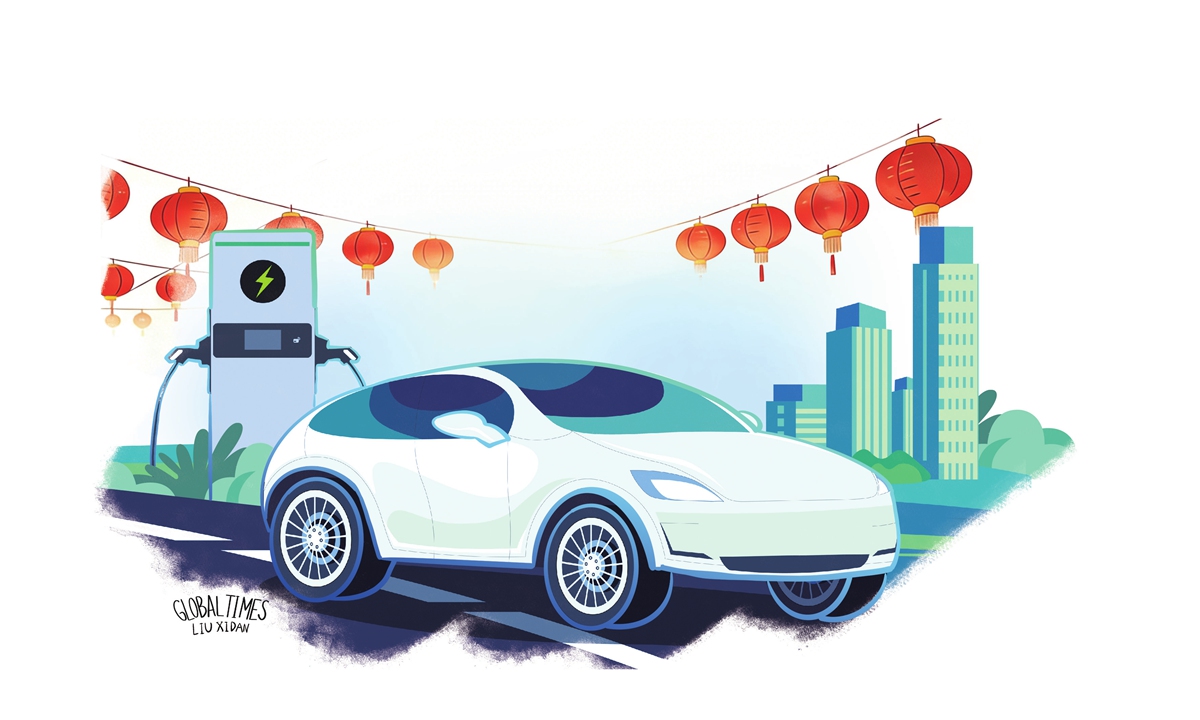
Illustration: Liu Xidan/GT
China's annual Spring Festival travel rush has long served as a stress test for the country's transport system. This year, private car travel is again expected to account for the majority of the journeys. According to the Ministry of Transport's preliminary analysis and assessment, trips made by new-energy vehicles (NEVs) are projected to reach a record 380 million during the period.Against this backdrop, questions about the reliability of NEVs for long-distance holiday travel have attracted increasing public attention.
The holiday period also provides insight into how China's NEV industry fares under growing demand. Travel is concentrated into a relatively short and intense window, placing simultaneous pressure on the vehicles as well as the nation's charging network. Daily driving range, the availability of charging points along expressways, and the likelihood of queues at busy stations become especially relevant.
In this context, the focus shifts to how NEVs perform under continuous, large-scale market adoption.
The estimate of 380 million NEV trips provides a clear measure of consumer confidence. It indicates trust not only in the vehicles themselves but also in the supporting infrastructure - quintessentially charging points, the key for long-distance travel. Few drivers would embark on extended holiday journeys if access to charging was uncertain or frequently delayed. The anticipated scale of use suggests that NEVs are increasingly regarded as a practical choice for a wide range of journeys, even during the most demanding travel period of a year.
One way to account for this consumer confidence is to look at the development of China's NEV infrastructure across three dimensions, beginning with scale.
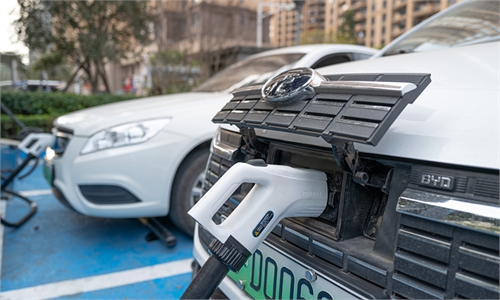
As of December 2025, China had 20.09 million charging facilities, comprising 4.72 million public chargers and 15.37 million private units. This represents the world's largest electric vehicle charging network, supporting more than 40 million vehicles, according to the China Energy News, citing data from the National Energy Administration. In 2025 alone, some 7.27 million charging poles were added, a 72.3 percent year-on-year increase, highlighting the pace of expansion.
The second dimension is coverage of chargers. So far, 19 Chinese provinces have achieved full rural coverage, while national highway service areas now host 71,500 charging stations, covering more than 98 percent of service areas. The widespread availability of chargers across highways, urban streets, residential areas, and communities has markedly reduced charging anxiety, ensuring that NEV drivers of all brands have convenient access to power.
The third dimension is convenience. While early charging stations were sometimes restricted to a single brand, many public chargers now offer cross-brand compatibility, enabling drivers to access different providers' stations using a single app or QR code. Beyond interoperability, the network has become increasingly data-driven: apps provide real-time information on charger availability and power levels, while also supporting reservations and seamless payments, further improving ease of use for drivers.
Looking ahead, innovations such as vehicle-to-grid technology - currently featuring in pilot programs in several cities - allow NEVs to discharge electricity back to the grid. These developments illustrate China's approach to combining infrastructure expansion with technological innovation to meet the evolving demand of this rapidly expanding NEV market.
Beyond the vehicles themselves, NEV infrastructure has become an important element of the sector, supporting market growth. Accessible and reliable charging networks reduce range anxiety and reinforce user confidence, allowing NEVs to become a viable option for longer journeys. Infrastructure is no longer merely supportive - it has become a driver of adoption.
Market growth is a common focus for all economies pursuing green and electric mobility. Scaling usage creates network effects: more vehicles justify more charging facilities, which in turn encourage wider adoption. This dynamic shows that widespread uptake depends as much on enabling conditions as on the vehicles themselves.
International discussion often emphasizes competition for market share, yet a more consequential dimension is how infrastructure can broaden the sector's boundaries. Expanding the overall market, rather than seizing existing segments, shapes the potential for sustainable growth. Investment in charging networks, interoperability, and intelligent systems not only supports adoption but also defines the sector's long-term resilience. In this sense, infrastructure development can determine which economies are able to cultivate large, self-reinforcing NEV markets, and which will remain dependent on incremental growth.
In 2025, Chinese carmakers produced 16.626 million NEVs and sold 16.49 million, maintaining the nation's position as the world's largest market for the 11th consecutive year. The role of NEVs during the Spring Festival travel rush provides a revealing lens on how China's industry has achieved market growth, illustrating the interplay of infrastructure, consumer confidence, and large-scale adoption that underpins the sector's continued development.
The author is a reporter with the Global Times. bizopinion@globaltimes.com.cn
RELATED ARTICLES