ARTS / CULTURE & LEISURE
Epitaph validates ancient administration of Xinjiang
Artifacts show exquisite craftsmanship
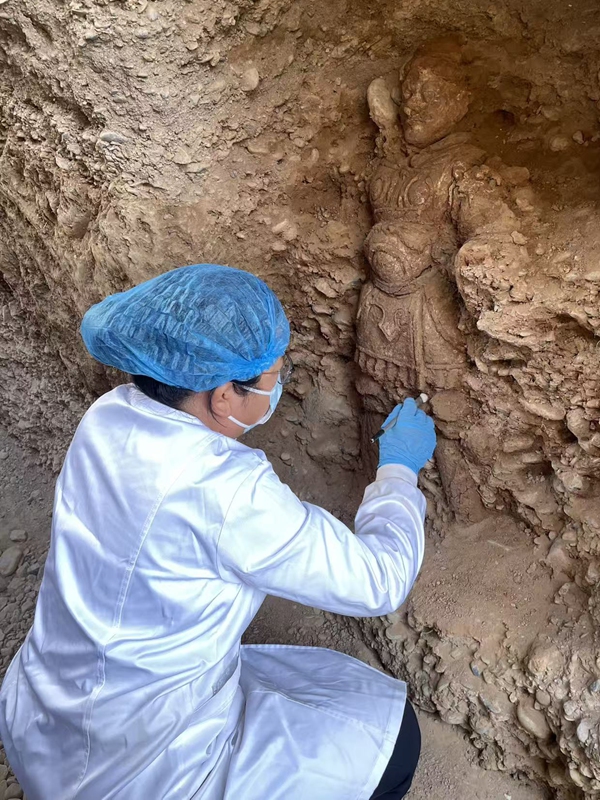
An archaeologist carries out protection and restoration work in Kuche, Northwest China's Xinjiang Uygur Autonomous Region. Photo: Courtesy of Xinjiang Institute of Cultural Relics and Archaeology
Including a Tang Dynasty (618-907) official's epitaph discovered at an administrative organ established by the Central Plains government in what is today Northwest China's Xinjiang Uygur Autonomous Region, new discoveries at the region's Youyi Road tomb cluster were revealed on Sunday, exemplifying the Tang Dynasty's administration of the Xinjiang region in ancient times.
The Youyi Road tomb cluster is located in the city of Kuche, Xinjiang's Aksu prefecture. It is so far the largest excavated burial site by area in southern Xinjiang. The latest findings related to this site were introduced at a work report meeting in Beijing focusing on Xinjiang's archaeological achievements in 2025.
A brick-chambered tomb with a long ramp and an epitaph found inside it represents the Youyi Road site's biggest discovery of 2025.
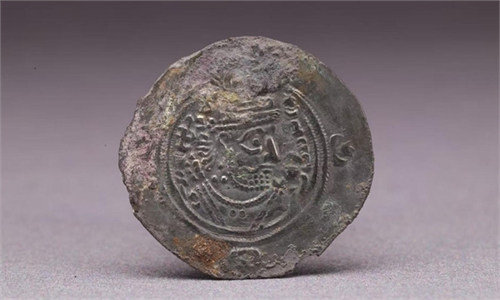
Through the discovery of warrior clay figurines and coins with the characters "Kaiyuan Tongbao," a major currency in circulation during the Tang Dynasty, archaeologists confirmed that the tomb belonged to a high-ranking official. They then cleaned and identified 686 characters inscribed on the excavated epitaph and its cover, ultimately determining that the epitaph was about "Yin Gong" or "Official Yin."
Alifujiang Niyazi, who discovered the epitaph and leads the archaeological work at the site, told the Global Times that "Yin Gong" once served as a deputy protector-general of the Anxi Protectorate, a military-administrative organ allocated by the Tang central regime in the western region of Xinjiang.
Due to partial damage of the inscriptions that make up the epitaph, the full name of "Yin Gong" remains unidentifiable. Yet, Niyazi unveiled that the epitaph still shows that "the official was a native of Tianshui [in Northwest China's Gansu Province], and that he passed away in the seventh year of the Zhenyuan era of the Tang Dynasty (791)."
"During this period, the Anxi Protectorate continued to maintain normal governance, safeguarding social stability in the Western Regions," said Niyazi.
He added that the discovery of the epitaph archaeologically validates the Tang Dynasty's effective administration of the Xinjiang region in ancient times.
Further details about the official's life were revealed by the epitaph. It was discovered that apart from serving as the deputy protector-general in Xinjiang, the official also held various positions, such as managing rites, music, punishment, transportation, and canal maintenance in regions that correspond to present-day Binzhou and Baoji in Shaanxi Province and more.
The deputy protector-general was found buried at the "eastern side of the Anxi Protectorate." The Youyi Road tomb cluster is located just outside the eastern wall of the ruins of the ancient city of Kuche. It is also known as the "ancient 'city of Qiuci'"- the ancient name of "Kuche." Based on this evidence, archaeologists infer that the administrative seat of the Anxi Protectorate was once located within the ancient city of Kuche.
A total of 310 burial objects have been unearthed from the tomb cluster, including double-eared and triple-eared pottery wares, jade wares, gold objects and more.
These artifacts show exquisite craftsmanship. Taking a pottery jar unearthed from tomb M168 as an example, it is decorated with painted lotus-petal patterns. Another excavated ewer was found featuring grape and grape vine patterns that are characteristic of the distinctive aesthetics of the Western Regions.
The Youyi Road tomb cluster was originally discovered in 2007. During the initial excavation, a group of brick-chamber tombs dating back to the Sixteen Kingdoms period of the Eastern Jin Dynasty (317-420) was uncovered at the site. From its first discovery to the present day, a total of five archaeological excavations have been conducted at this site.
These efforts have led to the discovery of over 2,200 tombs and the recovery of more than 2,800 artifacts. The tombs span four distinct historical periods: the Spring and Autumn and Warring States periods, the Wei (220-265), Jin (265-420) and Northern and Southern Dynasties (386-589) periods, the Tang Dynasty, and the Yuan (1279-1368) and Ming (1368-1644) dynasties.
RELATED ARTICLES