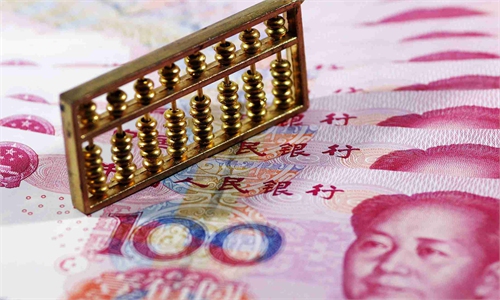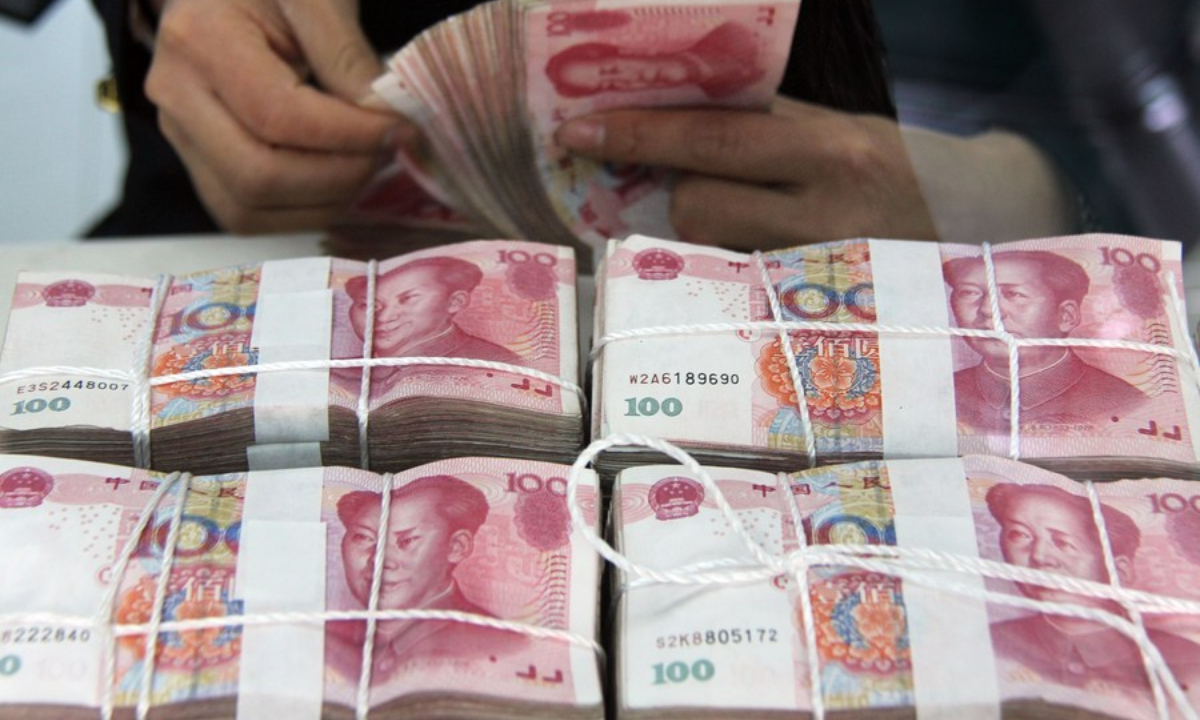
File photo shows a worker counts Chinese currency Renminbi banknotes at a bank in Tancheng County of Linyi City, East China's Shandong Province. Photo: Xinhua
The yuan's central parity rate strengthened 67 pips to 6.9523 against the US dollar on Monday, according to the China Foreign Exchange Trade System. It marks the currency's strongest level since May 2023.
In China's spot foreign exchange market, the yuan is allowed to rise or fall by 2 percent from the central parity rate each trading day.
The yuan strengthened significantly against the US dollar on Monday, with both the onshore and offshore markets at the highest points since May 10, 2023, the Paper.cn reported.
The spot exchange rate in the onshore market breached the 6.93 threshold during afternoon trading, reaching an intraday peak of 6.9290, appreciating more than 100 basis points from the previous session's close. Meanwhile, the offshore yuan climbed to 6.9250, hitting a 33-month high — its highest level since May 10, 2023, according to the report.
The yuan's appreciation comes against a backdrop of shifting geopolitical dynamics and bullish sentiment toward Chinese assets, Pan Helin, a Beijing-based veteran economist, told the Global Times on Monday.
According to a report by the China Center for Economic Research at Peking University, the Greenland crisis has triggered fissures within the US alliance network, eroding confidence in the long-established international credit system anchored by the dollar. Concurrently, a wave of high-level diplomatic engagements — including visits to Beijing by leaders and senior officials from South Korea, Canada, and multiple European countries — has bolstered the yuan's appeal, the Paper.cn reported.
The yuan's exchange rate is expected to remain stable overall, the report said. Overall, the report predicted that the yuan exchange rate would fluctuate between 6.85 and 7.05 in February.
Furthermore, the decreased probability of further interest rate cuts by the Federal Reserve in the first half of the year will be detrimental to the yuan's performance.
The yuan has gained for 11 straight weeks in its longest winning streak since early 2013, helped by US dollar weakness, China's resilient exports and the growing appeal of China's capital markets, the Business Times reported on Monday.
The newspaper cited a Goldman Sachs report saying that improved sentiment on China's growth outlook, greater policy tolerance for the yuan's strength, and significant foreign exchange undervaluation has reinforced expectations for further yuan appreciation.
According to Pan, the recent yuan appreciation stems from a confluence of factors. Externally, weakness in US economic data, particularly rising unemployment, has reinforced market expectations for the Federal Reserve's rate-cutting trajectory, depressing the dollar and creating headroom for non-US currencies including the yuan.
Domestically, China's economic fundamentals have shown sustained signs of stabilization and improvement, while stable financial market operations further underpin the currency's relative strength.
China's foreign trade and foreign investment remain resilient, cross-border capital flows and foreign exchange market expectations are stable, and foreign exchange transactions are being conducted in a steady and orderly manner, said Li Bin, deputy director and spokesperson of the State Administration of Foreign Exchange.
China's foreign exchange reserves totaled $3.3991 trillion as of the end of January up 1.23 percent from the end of December, official data showed.
Global Times
RELATED ARTICLES