World's first humanoid robot free combat league kicks off in Shenzhen, highlighting China’s tech advances

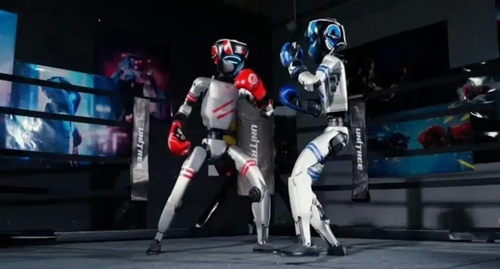
The world's first humanoid robot free combat league kicks off on February 9, 2026 in Shenzhen, South China's Guangdong Province, for the 2026 season. Photo: Courtesy from EngineAI
The world's first humanoid robot free combat league kicked off on Monday in Shenzhen, South China's Guangdong Province, for the 2026 season, with the winner to be awarded a gold championship belt worth 10 million yuan ($1.44 million), the Global Times learned from the event's organizer.
Chinese experts noted that such events would not only highlight technological advances in the humanoid robot industry, which is undergoing rapid development, but also help expand application scenarios.
The Ultimate Robot Knockout Legend (URKL) 2026 season will follow a tiered competition schedule through December. Participating teams will receive T800 humanoid robots free of charge, enabling them to engage in practical hands-on development, according to a press release from EngineAI, the organizer.
The T800 is a humanoid robot developed by EngineAI. The robot can perform martial movements such as 360-degree aerial rotation and sidekicks, according to its website.
EngineAI stated that the innovative integration of technology and sports has become a new trend in industrial upgrading. Through this competition, the company hopes to create a unique format inspired by "Chinese robot kung fu," serving as an important bridge connecting Chinese culture with international pop culture and infusing global industrial development with Chinese ingenuity.
This is one of the latest competitions held in China that aim to expand the reach of humanoid robots.
Pan Helin, a Beijing-based veteran analyst, told the Global Times on Monday that such competitions help enhance public awareness of humanoid robots and expand potential application scenarios.
Pan noted that humanoid robots still face technological and practical limitations, and real-world application is key to their further development. Such events could yield positive effects in the entertainment and performance market, which is a necessary step forward in paving the way for further applications in factories or households, Pan said.
Tian Feng, former dean of SenseTime's Intelligence Industry Research Institute, said that the free provision of T800 robots will lower research and development barriers for smaller companies and promote the integration of applications involving industry, academia and research bodies.
Robot combat has strong virality and distinctiveness, effectively shattering the stereotype of robots as "cold mechanical arms" and attracting the younger generation to engage with, learn about, and pursue hard-core technology, Tian told the Global Times on Monday.
The event covers many metrics such as motion control, dynamic balance, and impact resistance, serving as a high-pressure testbed for key components such as reducers, lead screws, and dexterous hand tendons, Tian said.
Industry experience shows that such real-world combat can shorten technology iteration cycles by more than 30 percent, and accelerate the process for companies to carry out real-world physical validation of laboratory simulation parameters, according to Tian.
However, the expert cautioned that combat scenarios demand extreme high-impact and short-burst performance, risking the deviation of robot optimization away from mainstream industrial or service applications.
In the meantime, consumer-grade application still awaits breakthroughs in cost reductions and rigid-demand scenarios such as elderly companionship, maternal and infant care and patient rehabilitation, Tian said, adding that the competition's role is to "plant seeds," not to "harvest."
Driven by rapid advances in embodied intelligence, China's humanoid robots are evolving at an accelerated pace, extending their reach into both industrial and household applications.
According to the Chinese Institute of Electronics, China's humanoid robot market is projected to reach 870 billion yuan by 2030, the Xinhua News Agency reported.
RELATED ARTICLES