ARTS / BOOKS
Enduring warmth: Chinese folklorist’s new book presents holistic picture of Spring Festival, including ethnic traditions
Enduring warmth
By Published: Feb 09, 2026 11:10 PM

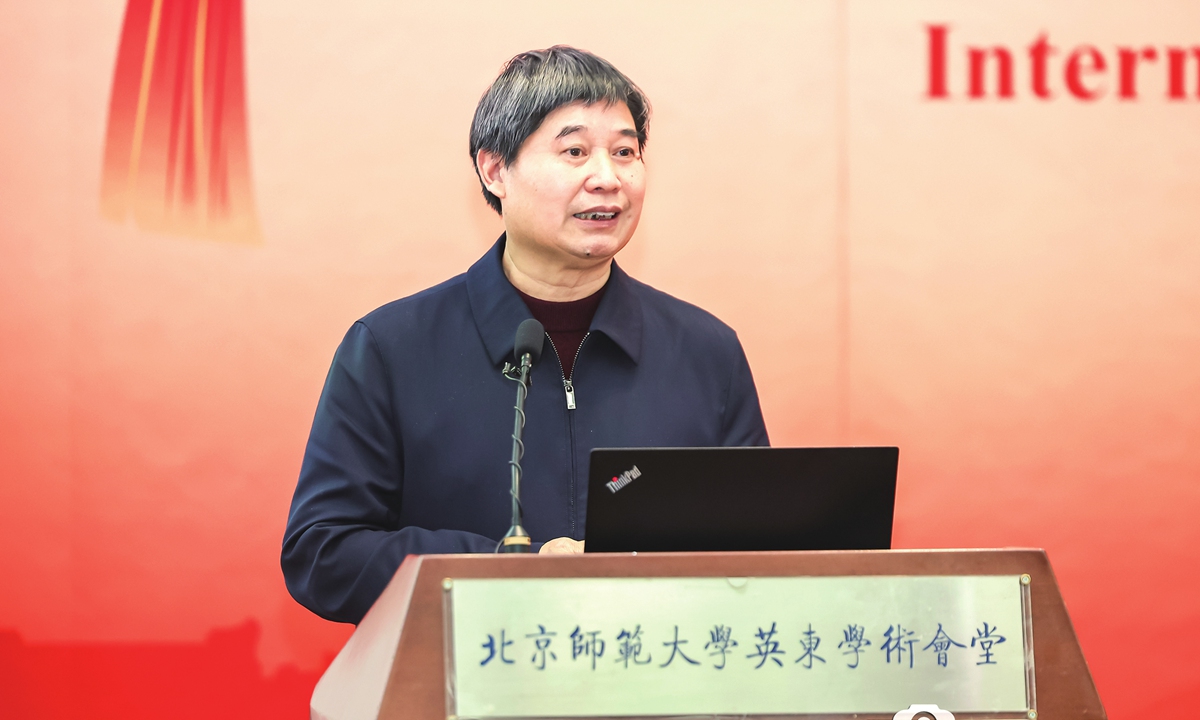
Chinese folklorist Xiao Fang Photos: Courtesy of Xiao
As red lanterns light up the streets of Beijing and overseas Chinese communities gear up for festive gatherings, Xiao Fang, a renowned Chinese folklorist and professor at the School of Sociology, Beijing Normal University, sits at his desk, flipping through manuscripts recording the new changes in Spring Festival customs for the Year of the Horse.For him, the night of December 4, 2024, remains etched in his memory. That evening, in Asunción, Republic of Paraguay, the 19th session of the Intergovernmental Committee for the Safeguarding of Intangible Cultural Heritage of UNESCO officially inscribed "the Spring Festival, social practices of the Chinese people in celebration of the traditional new year" on the Representative List of the Intangible Cultural Heritage of Humanity.
One year after this milestone, Xiao launched his new book Spring Festival, a comprehensive exploration of the festival's millennia-old history, traditional rituals, cultural connotations and contemporary value.
In an exclusive interview with the Global Times, Xiao shared his insights into the book, the essence of the Spring Festival and its universal significance as a shared human heritage.
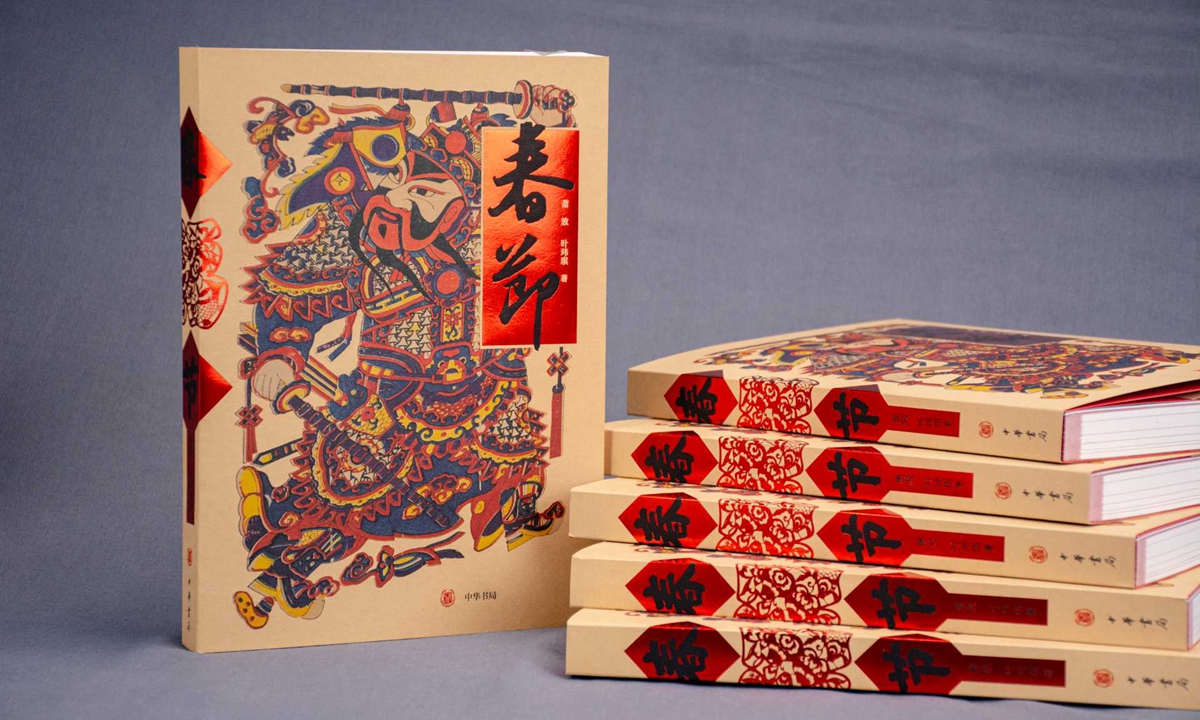
Xiao Fang's new book Spring Festival
A national heritageWhen it comes to his original motivation for writing the book, Xiao noted that the Spring Festival is the most important festival for the Chinese nation.
After its successful inscription, there was a surge in public attention toward this intangible cultural heritage, and readers were eager for a systematic and in-depth understanding of Spring Festival culture.
"My core intention was to help Chinese people gain a deeper comprehension of traditions, better understand the connotations and values of the Spring Festival, and more consciously experience and identify with this cherished festival."
What makes the book Spring Festival stand out is its inclusion of the Spring Festival customs of ethnic minority groups.
To present a holistic picture of the Spring Festival as a symbol of the Chinese nation, Xiao and his team conducted extensive fieldwork in ethnic areas, documenting a lot of unique festival practices.
"One unforgettable experience was learning about the 'early New Year' of the Tujia ethnic group," Xiao recalled with a smile.
Unlike Han people who celebrate on Chinese New Year's Eve, the Tujia people hold their New Year celebrations one or two days earlier.
Legend has it that during the Ming Dynasty (1368-1644), Tujia men were mobilized to resist Japanese pirates along the coast during the 12th lunar month of the Chinese calendar and had to depart before New Year's Eve. To gather with their families before leaving, they chose to celebrate the New Year in advance, a tradition that has been passed down to this day.
Through these diverse practices, Xiao found that while specific customs vary by region, the core patterns remain consistent.
"Worshiping the ancestors, family reunion and bidding farewell to the old and welcoming the new are common threads across all ethnic groups. The renewal of time in the annual cycle is the core concept of the Spring Festival, shared by the entire Chinese nation," he said.
Balancing academic rigor with readability, the book is accompanied by vivid woodblock New Year paintings, making the rich rituals accessible to both academic readers and the general public.
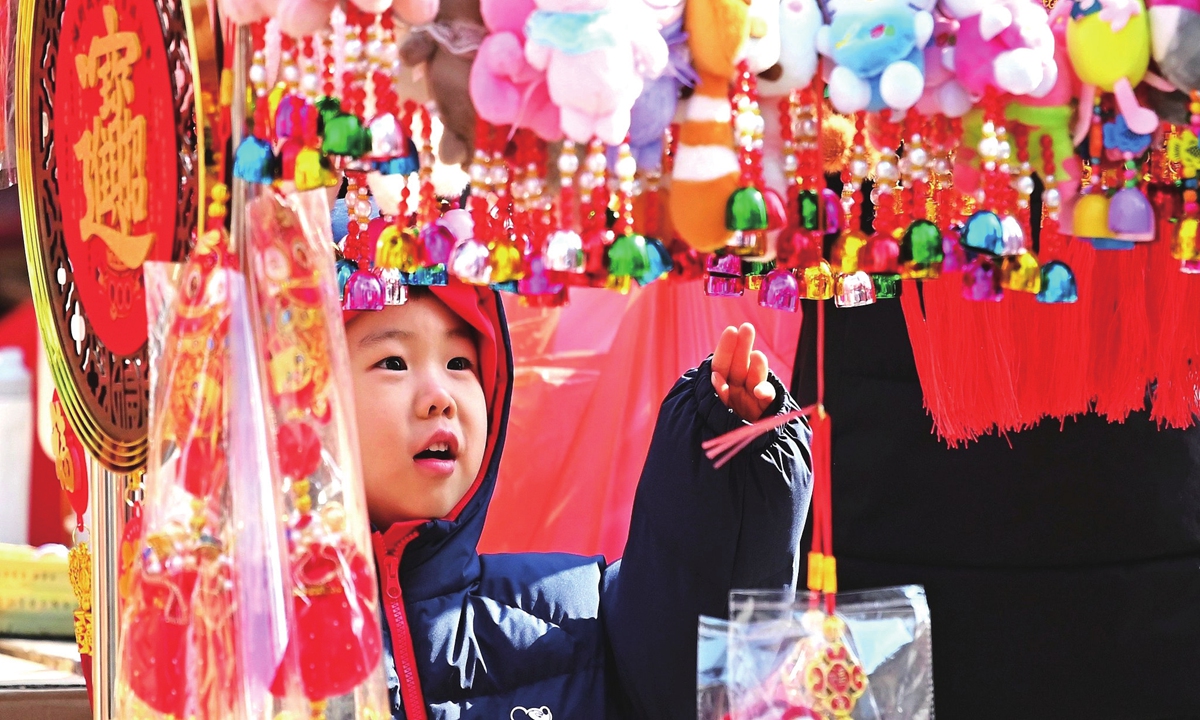
A boy selects his favorite Spring Festival decorations and ornaments at a market in Tengzhou, East China's Shandong Province, on February 7, 2026. Photo: VCG
Universal spiritXiao emphasized in his book that beyond its significance to the Chinese people, the Spring Festival carries profound universal value that resonates across cultures.
At the heart of this value lies the word "he," which means "harmony."
"More than 30 out of China's 56 ethnic groups celebrate the Spring Festival. It is no longer a festival of a single ethnic group, but a cultural bond that unites the entire Chinese nation," he said.
This spirit of harmony is reflected in every aspect of the Spring Festival: the warmth of family gatherings, the friendliness among neighbors, the harmony of society and the longing for world peace.
Rooted in agricultural civilization, this peaceful essence has evolved over thousands of years, absorbing cultural elements from various ethnic groups and becoming a profound cultural feast.
"The core of the Spring Festival, peace and harmony, is a universal language that transcends cultural barriers. It embodies the values of building a community with a shared future, pursuing harmony and prosperity for all," Xiao stressed.
The global influence of the Spring Festival is also a testament to its universal appeal. "Approximately one-fifth of the world's population celebrates the Spring Festival in various forms, and nearly 20 countries have designated it as a public holiday," Xiao said with pride.
He cited the Zigong Lantern Show from Southwest China's Sichuan Province, a folk cultural project that has expanded to more than 100 countries and regions, as a perfect example of cross-cultural communication.
"Cultural communication is never a one-way output, but a two-way interaction. We should use tangible carriers like lanterns, lion dances and intangible cultural heritage food as bridges, allowing people overseas to intuitively feel the joy and warmth of the Spring Festival," he explained.
For Xiao, the successful inscription of the Spring Festival is not an end, but a new starting point for cultural inheritance.
His academic research has shifted from focusing on the details of folklore to exploring the festival's contemporary value, sustainable development and global expansion.
In classrooms, lecture halls and academic forums, he has been working tirelessly to pass on the cultural code of the Spring Festival to young people and the public.
"The protection and inheritance of the Spring Festival lies in 'landing' it in real life," Xiao said.
More places are transforming Spring Festival culture into tangible cultural productivity, including Langzhong ancient city's various Spring Festival activities to Zigong's lantern-themed cultural tourism brand.
Meanwhile, Xiao continues to share his knowledge through lectures, helping more people at home and abroad understand the charm of this traditional holiday.
"The Spring Festival is not only an annual event for the Chinese people, but also a 'festival' for the world. As a cultural heritage imbued with peace and hope, it will continue to nourish the vision of 'building a community with a shared future' with its enduring warmth," he noted.
RELATED ARTICLES