Song Dynasty reunification drama stirs interest in Taiwan, viewed as metaphor for peaceful cross-Straits future
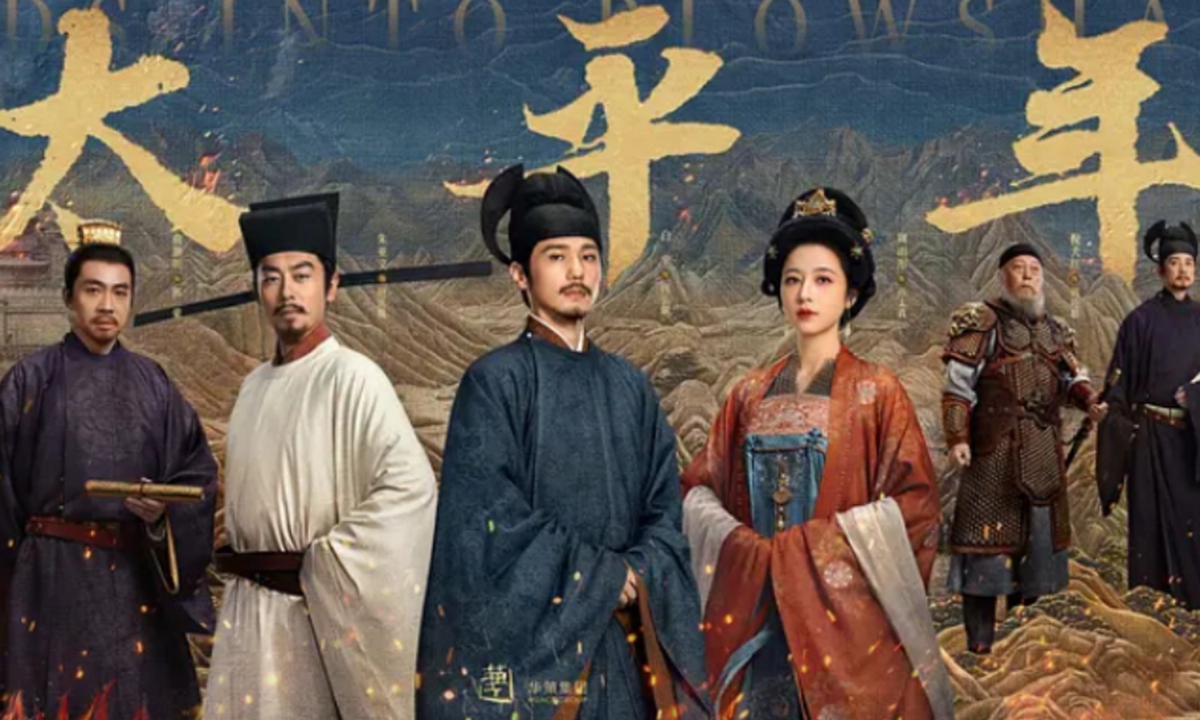
The poster of TV series Swords into Plowshares, or Taipng nian. Photo: Courtesy of Douban
Premiered on China Central Television (CCTV) at the start of 2026, the historical drama Swords into Plowshares (Taipingnian), which centers on the turbulent Five Dynasties and Ten States (907-979), captures audiences in the Chinese mainland and across the Taiwan Straits.The Storm Media Group, among other Taiwan island media outlets, has reported on the drama. According to a commentator for the group, the series' release timing underscores that "peaceful reunification" remains the mainland's mainstream narrative for cross-Straits relations. The commentator described the drama as using the historical tale of "peaceful submission to the Song Dynasty" to convey a cultural and historical appeal for peaceful reunification today.
According to a report by CCTV-6, the drama is set against the backdrop of the late Five Dynasties period and the early Northern Song Dynasty (960-1127), a time marked by fragmentation and social turmoil. It follows Qian Hongchu, ruler of the Wuyue Kingdom, as he matures into a leader who shoulders responsibility for the greater good and ultimately chooses to cede his territory to the Song Dynasty, contributing to the realization of peace.
Historically regarded as an era of division, the period is nonetheless portrayed in the series under the title Taipingnian, which means year of peace. In an interview with the People's Daily, the show's screenwriter Dong Zhe explained that whether emperors and generals or ordinary people, everyone living through chaotic times longs for peaceful years, adding that peace "is the greatest common denominator of the human heart."
The series premiered on January 23 and was simultaneously released on multiple major streaming platforms. Since its debut, it has generated widespread discussion on the Chinese mainland, with related topics garnering more than 1.8 billion views across platforms.
Although the drama has not been officially broadcast in Taiwan, it has attracted sustained attention from Taiwan media and netizens, according to multiple media outlets. As of now, they can watch the series through China Huace TV Official Channel from Youtube.
Taiwan media the United Daily News said in a report citing views from the Chinese mainland that the series should be viewed not as a prophecy, but as a form of summons. It referred to some comments that the message conveyed to society in Taiwan is "clear and gentle": "Returning territory for unification" is not an act of submission, but one of wisdom; not a loss, but a return; and not an endpoint, but the starting point of a new era of peace.
The report also noted that in recent years, the mainland film and television industry has produced a number of works carrying strong symbolic references to national reunification. These include Peng Hu, released in 2025 to mark the 80th anniversary of Taiwan's restoration, and Silent Honor, aired the same year and focusing on Wu Shi, an underground operative active in Taiwan after 1949.
The TV drama also prompted different perspectives in coverage from other media outlets on the island, with SET News offering an analysis of Zhao Kuangyin's historical role by drawing on the TV series, and Meihua Media citing CCTV as saying this marks the first time that the historical milestone of the Wuyue Kingdom's ''peaceful submission to the Song Dynasty'' has been presented in a comprehensive, panoramic manner through a television drama.
Taiwan media figure Zhang Junkai wrote on the Storm Media Group that the climax of Swords into Plowshares lies in Qian's decision during the early Northern Song period to "submit territory to the Song," creating one of the rare examples of peaceful reunification in Chinese history. This, he argued, lends the drama's metaphorical reference to the ultimate outcome of cross-Straits relations a heightened sense of contemporary political relevance.
Zhang noted that the Five Dynasties and Ten Kingdoms period is often glossed over in Taiwan's school curricula, yet its more than 70 years of upheaval played a significant role in the broader currents of dynastic transition in Chinese history. While the mainland's capacity to produce historical and costume dramas has long been recognized by audiences at home and abroad, Zhang said it remains rare for a production team to delve deeply into this particular era.
Global Times
RELATED ARTICLES