J-10 fighter jets’ overseas airshow and joint drills showcase PLA Air Force’s progress toward strategic force: Chinese expert
By and Liang Rui Published: Feb 10, 2026 06:43 PM

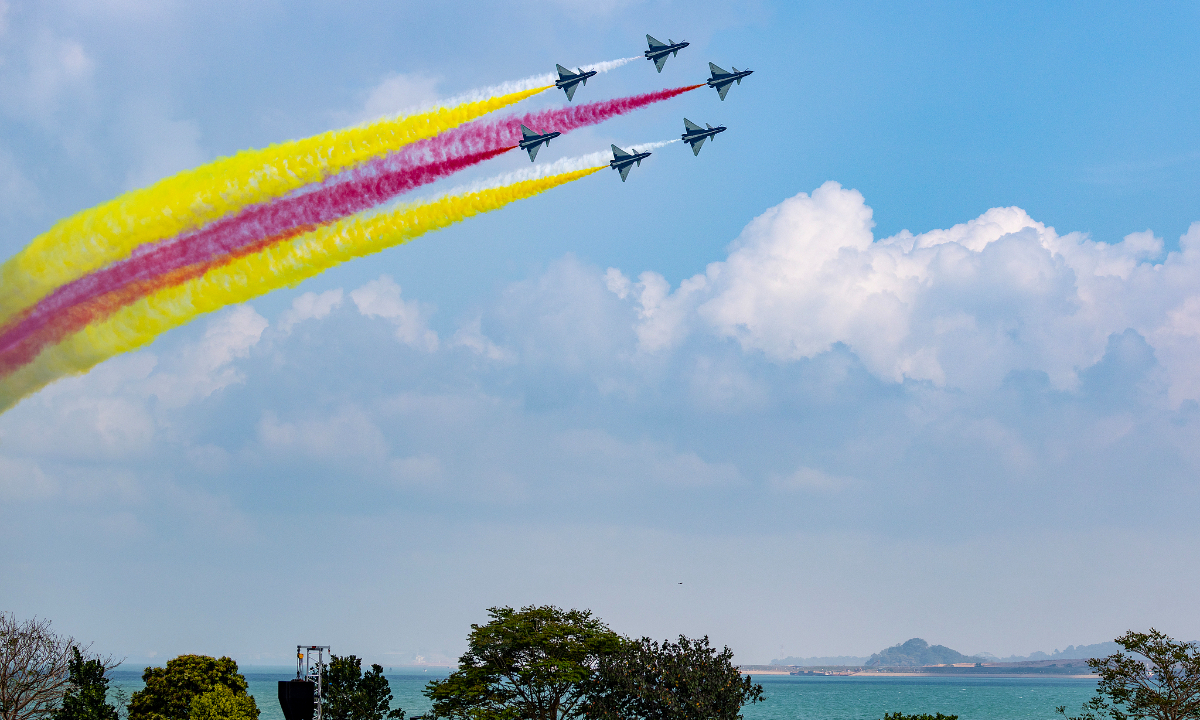
J-10 series fighter jets of the Chinese People's Liberation Army (PLA) Air Force's Bayi Aerobatic Team conduct an inspection flight training at Singapore Changi Airport on February 1, 2026, in preparation for the 10th Singapore Airshow. Photo: VCG
With the Chinese People's Liberation Army (PLA) Air Force's J-10 fighter jets recently completing their flight performances at the Singapore Airshow, a Chinese military affairs expert highlighted a hidden significance behind the aircraft's airshow and joint drills in the past year, saying that the long-distance overseas flights of the Chinese aircraft mark the PLA Air Force's strides toward strategic force.After successfully completing its mission at the 10th Singapore Airshow, the PLA Air Force's Bayi Aerobatic Team left Singapore's Changi Airport for China on Tuesday morning. It is a non-stop flight under the support of the YU-20 tanker aircraft, the military channel of China Central Television (CCTV) reported on Tuesday.
This participation marks a second time that the Bayi Aerobatic Team has performed in Singapore. After arriving in Singapore, the team completed five flight displays. With exquisite flying skills, an open and confident demeanor, and sincere and friendly interactions, it has won wide acclaim from both at home and abroad, CCTV said.
Reuters reported last week that the PLA Air Force's aerobatic team made a headline-grabbing show debut of its Chengdu J-10C fighter jets. Citing Chinese media reports, the report noted that the team had used mid-air refueling to fly directly to Singapore for the high-profile deployment.
Reuters quoted Tim Robinson, editor-in-chief of the Royal Aeronautical Society's Aerospace magazine, as claiming that, "That's a bit of a message to say: Our power projection is growing," "It's one of the key enablers a modern air force should have. Previously people said this is one of their weaknesses."
According to an earlier report by CCTV, when the Bayi Aerobatic Team flew to Singapore from an airfield in Southwest China on January 27, seven J-10 series fighter jets of the team also had a non-stop flight under the support of the YU-20 tanker aircraft.
The fact that the J-10 fighter jets of the Bayi Aerobatic Team can conduct long-distance non-stop flights and refuel in coordinating with tanker aircraft, even in their role as an aerobatic team, epitomizes the combat-oriented training level of the PLA Air Force, Wang Yunfei, a Chinese military affairs expert, told the Global Times on Tuesday.
Long-distance flights in unfamiliar environments and aerial refueling over the high seas beyong national borders can only be accomplished with a systematic support system. This clearly demonstrates that the PLA Air Force is enhancing its strategic capability, Wang said, adding that the service's operational reach is no longer confined to Chinese territory airspace.
Besides of overseas airshows, the combination of the J-10 fighter jet and YU-20 tanker aircraft was also observed in joint drills with foreign militaries over the past year.
From December 9 to 22, 2025, China and the UAE conducted the Falcon Shield 2025 joint air force training, marking the first time that the PLA Air Force has deployed its J-10 fighter jets, KJ-500 airborne early warning aircraft and YU-20 tanker aircraft to the UAE for such training, Zhang Xiaogang, a spokesperson at China's Ministry of National Defense, said at a regular press conference in December 2025.
The Chinese and UAE participating forces carried out mixed formation operations, conducted exercises on command-and-control wargaming and air superiority operations, and engaged in in-depth exchanges on night vision and night combat, unmanned combat, and battlefield search and rescue, Zhang said.
Another joint exercise took place between China and Egypt on April 17 to May 4, 2025, with the two countries' air forces holding the first Eagles of Civilization 2025 joint training at an Egyptian air force base, Zhang said at a regular press briefing in May 2025.
Zhang noted that the PLA Air Force dispatched J-10C, KJ-500 and YY-20 aircraft to participate. This was the first time that China sent force packages to Africa for joint training, during which the two sides conducted drills on such subjects as air superiority operations, suppression of enemy air defenses, battlefield search and rescue, and mixed grouping. Discussions and exchanges on training models, air combat tactics and aerial refueling were also held.
Highlighting the distances between China and the UAE as well as China and Egypt, Wang said that a strategic air force is defined by its capability for intercontinental flight and support operations. The J-10 fighter jet is a type of tactical aircraft with a combat radius of just over 1,000 kilometers, so to make intercontinental flight a reality, the aerial support from tanker aircraft and long-range command-and-control capabilities must be achieved.
The PLA Air Force's participation in joint exercises over long distances proves that it already possesses this capability of strategic projection, strategic support and long-range strike, Wang said.
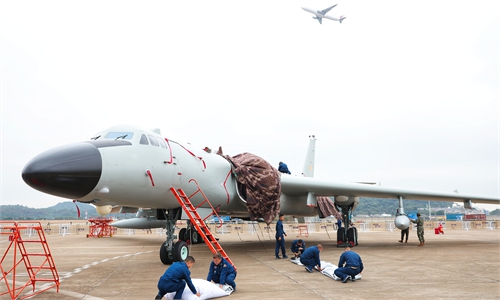
Wang further noted that the J-10 is not the most advanced aircraft in the PLA Air Force. The fact that the J-10 can successfully carry out missions during long-range operations means that China's J-20 and J-35 stealth fighter jets all possess such capabilities. Even its H-6N strategic bomber benefits from the extended range thanks to aerial refueling.
Chinese military affairs expert Zhang Junshe told the Global Times on Tuesday that in-flight refueling not only enables the warplanes to reach farther distances, but also boosts its combat capabilities in special conditions.
For example, in combat, airfields could be damaged beyond use. With in-flight refueling, warplanes can continue its missions without landing, Zhang said.
In November 2018, the PLA Air Force released a roadmap for building a strong and modernized air force, aiming to basically cross the threshold of being a strategic air force by 2020, to initially establish a modern strategic air force by 2035, and to fully build a world-class strategic air force by the middle of this century, the Xinhua News Agency reported at the time.
Against the backdrop of the Airshow China 2024, where J-20 and J-35A stealth fighter jets made flight performances, the PLA Daily said in a report that new-type domestically developed weapons and equipment have injected new momentum into the strategic transformation of the PLA Air Force.
Wang said that he expects more advanced weapons and equipment to enter services with the PLA Air Force, including strategic bombers and even larger transport aircraft, early warning aircraft and tanker aircraft, as the PLA Air Force continues to make progress for its strategic transformation.
RELATED ARTICLES