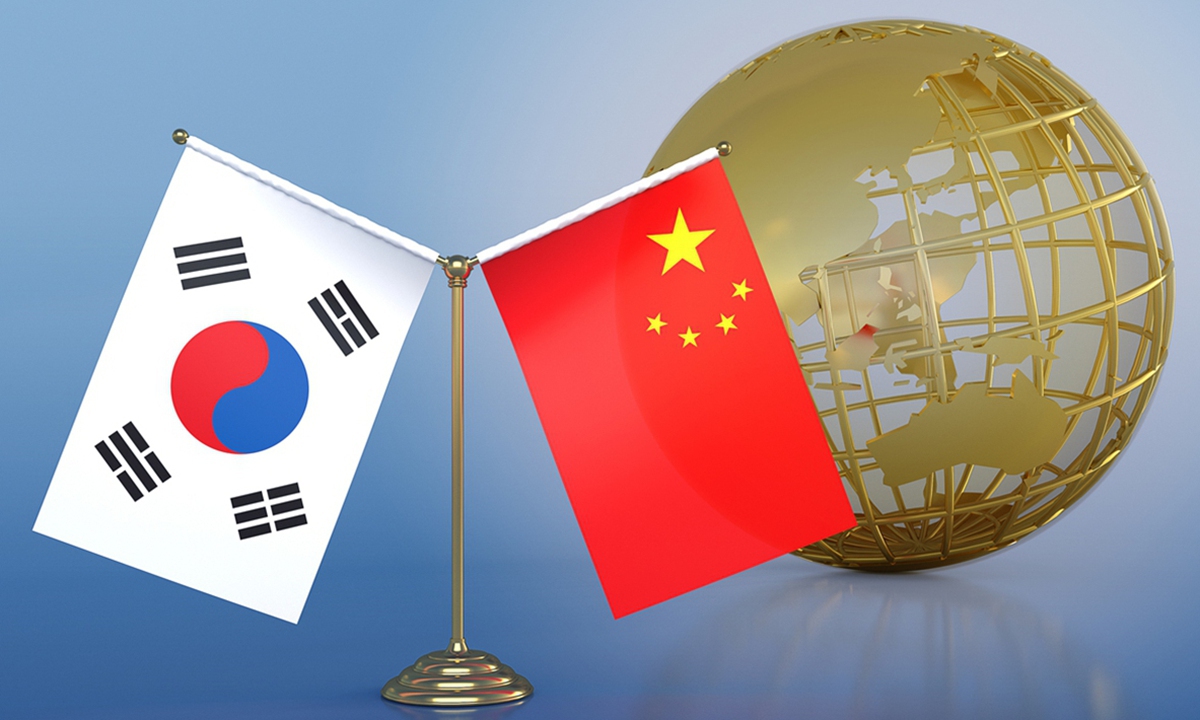
China South Korea Photo:VCG
South Korean enterprises have ramped up efforts to further explore the Chinese market in the new year, marking closer bilateral trade and economic cooperation after South Korean President Lee Jae-myung paid a visit to China in January.
The latest example was that Du Xiaogang, secretary of the Municipal Party Committee of Wuxi, East China's Jiangsu Province, held talks on Monday with a delegation led by Park Sung-taek, president of SK China. The two sides engaged in in-depth discussions on further elevating the level of cooperation and expanding areas of collaboration, the Wuxi Daily reported on Tuesday.
According to the report, the two sides will earnestly implement the strategic cooperation consensus reached by the leaders of China and South Korea, positioning Wuxi as a core node in SK Group's global strategic layout, and collaborate on building a resilient local ecosystem and other areas to pursue win-win development at deeper levels and in broader fields.
Since SK Group's entry into Wuxi in 2005, the two sides have consistently pursued mutual benefit and shared win-win outcomes. For instance, SK Hynix Semiconductor (China) Co has undergone seven phases of investment, with the total exceeding $23 billion, making it the largest single foreign-invested project in the province and SK Group's largest investment project in China.
The SK medical complex project has a total investment of approximately 3 billion yuan ($420 million), including the construction of SK Wuxi Hospital with a planned capacity of 500 beds, which is expected to be completed and commence operations this year, according to the report.
Guangzhou, South China's Guangdong Province, welcomed its first 10 billion yuan-level foreign-invested manufacturing project of the new year from leading South Korean semiconductor equipment company STI Co, the Guangzhou government said in a social media post on Tuesday.
According to the post, the government of Baiyun district in Guangzhou and STI on February 5 officially signed an investment agreement under which the South Korean company will invest in constructing a power semiconductor intelligent manufacturing base in the district with a total investment of approximately 12.4 billion yuan.
The Phase I investment is about 1.6 billion yuan, with the facility primarily focused on producing AMB ceramic substrates, a key foundational material for power semiconductor modules that is widely applied in strategic emerging industries such as new-energy vehicles.
Construction of the project is scheduled to officially commence after the Spring Festival, with completion and production expected by the end of the year. Once fully operational, it is projected to generate an annual output value of about 3 billion yuan, said the post.
"Following Lee's visit to China, South Korean companies have accelerated their expansion into the Chinese market and pursuit of cooperation opportunities. This has ushered in a phase of closer and more intensive collaboration between China and South Korea in high-tech sectors," Lü Chao, a professor at the Liaoning Academy of Social Sciences, told the Global Times on Tuesday.
Lü said that China and South Korea have great potential for cooperation in high-tech sectors. "Many South Korean companies established a presence in China in previous years, and China's rapid development of new quality productive forces - coupled with continuous improvements in its business environment - has provided these enterprises with multifaceted support in areas such as talent, market access, and favorable policies," the expert noted.
As of the end of November last year, South Korea's cumulative actual investment in China stood at $104.65 billion. The role of China-South Korea economic and trade cooperation as a "ballast stone" and "propeller" in bilateral relations continues to become increasingly prominent, according to China's Ministry of Commerce.
"Facts have proven that mutual benefit and win-win outcomes constitute the essence of China-South Korea economic and trade cooperation," Lü said, noting that the South Korean side is expected to maintain a pragmatic attitude toward China, free from interference by external factors, and create a friendly, sustained, and healthy environment for exchanges and communication between the business communities of the two countries.
RELATED ARTICLES