IN-DEPTH / IN-DEPTH
GT investigates: Who is Jeffrey Epstein? How did his crimes expose systemic corruption in US and the West?
A Dark Collusion of Capital and Power
By Published: Feb 10, 2026 11:21 PM

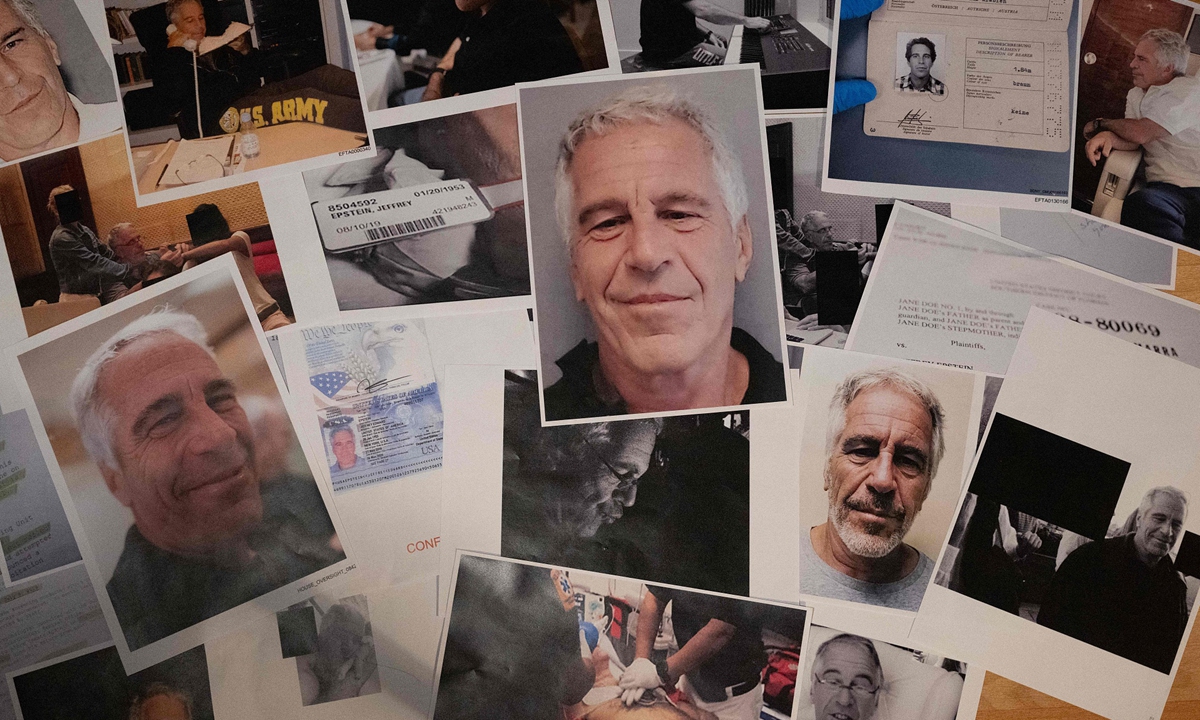
Undated pictures provided by the US Department of Justice on January 30, 2026 as part of the Jeffrey Epstein files Photo: VCG
The release of over 3 million pages of declassified files on the late sex offender Jeffrey Epstein has sent shockwaves across the world. The aftershocks and public outrage have continued to unfold and intensify in Europe and in the US over the past two weeks.
From tech moguls and Wall Street heavyweights to international dignitaries, the massive collection of documents recently released by the US Justice Department in connection with its Epstein investigations features a roster of influential figures.
While public attention is fixed on the list of powerful figures linked to Epstein's sexual crime allegations, many have overlooked a critical question: How could a man with a long record of wrongdoing break into elite circles, cozy up to the powerful, and stay above the law for decades? Beyond his own relentless scheming, the spotlight now falls squarely on the deep-rooted deep state corruption in the US and the West, where capital, power, and the judiciary operate in collusion.
What allowed Epstein to slip through layers of oversight again and again?
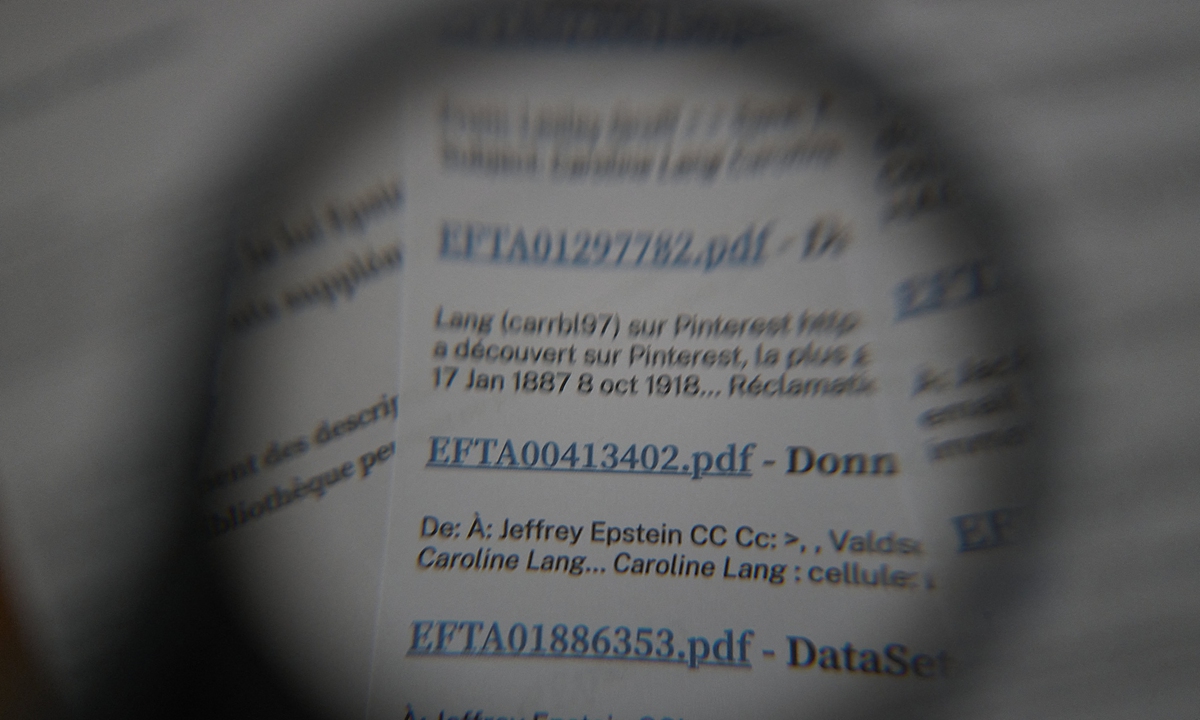
Photo: VCG
'Disgraced financier with powerful associates'
In 1953, Epstein was born in Brooklyn, New York, to a Jewish family. Epstein was a gifted student interested in math, and he learned piano at a young age, regarded as a talented musician by friends. Pictures of Epstein in high school don't feature the smug smile seen in photos from the past 20 years; his features are softer, and calmer, according to Jewish journalism platform Forward.
After being admitted to a private college, Cooper Union, he only studied for two years, failing to even get a diploma. Yet this man, without formal teaching experience and even a degree, actually got into the Dalton School - a private school in Manhattan with a reputation for attracting talented students and affluent parents - in the US as a lecturer.
At the Dalton School, some students saw Epstein as an unusual and unsettling figure, willing to violate the norms in his encounters with girls, the New York Times reported.
Epstein's time at Dalton was brief, and an administrator at the school said it ended in a dismissal.
After losing his job, Epstein got an introduction from a student's parent and, in 1976, joined the top Wall Street investment bank Bear Stearns. There, he quickly came into contact with the wealthiest clients, becoming a senior partner in just four years, according to the BBC.
Epstein was not content to simply climb the corporate ladder. More serious trouble soon surfaced.
According to The New York Times, he was investigated on multiple occasions for misusing company funds to pay for his then-girlfriend, granting her access to lucrative "hot deals" handled by the firm, and lending $15,000 to a high school friend in violation of federal rules governing brokers. Amid the scandal over various violations, Epstein announced his resignation in early 1981. Yet the client resources he had amassed over four years allowed him to launch his own business.
In BBC reports, Epstein was described as "The disgraced financier with powerful associates."
By 1982, he had created his own firm - J Epstein and Co. The company managed assets of clients worth more than $1 billion and was an instant success. Epstein soon began spending his fortune - including on a mansion in Florida, a ranch in New Mexico, and reputedly the largest private home in New York - and socializing with celebrities, artists, and politicians, BBC reported.
And the way he befriended the powerful and wealthy included providing special hospitality.
Epstein amassed a huge real estate portfolio after that - including Little St. James, an island off the southeastern coast of St. Thomas in the US Virgin Islands, the infamous evil "Epstein Island." Epstein and a rotating cast of his victims and celebrity guests moved among his properties on a fleet of private aircraft, the New York Times reported. Epstein's pace of raping, abusing, and trafficking girls and young women was accelerating. Ultimately, he would face accusations from hundreds of women. Little St. James was an ideal, out-of-the-way venue for his crimes, the New York Times report noted in December 2025.
Observers believed that Epstein used his career opportunities to build a private sanctuary for Western elites - a place that not only met their extravagant desires, but also allowed them to evade public scrutiny and make inside dealings.
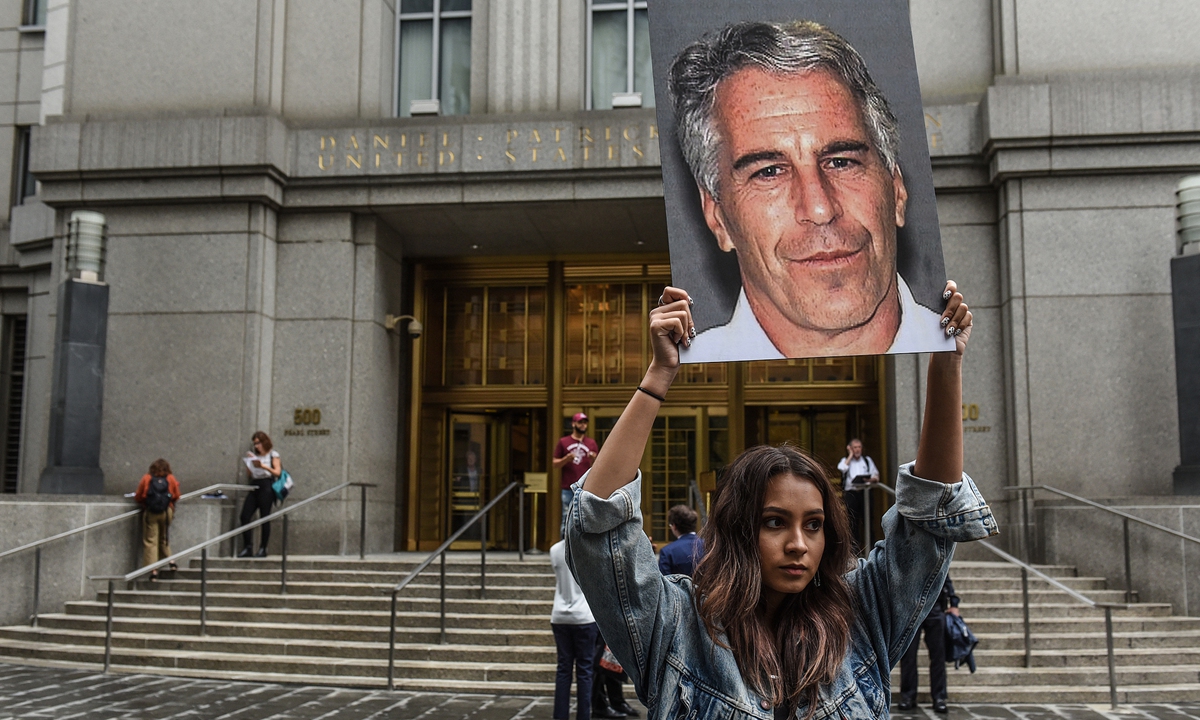
A woman holds up signs of Jeffrey Epstein and protests in front of the federal courthouse on July 8, 2019 in New York City. Photo: VCG
Unpunished crimes and delayed justice
In 2005, the parents of a 14-year-old girl told police in Florida that Epstein had molested their daughter at his Palm Beach home. A police search of the property found photos of girls throughout the house. The Miami Herald reported that his abuse of underage girls dated back years.
"This was not a 'he said, she said' situation," Palm Beach Police Chief Michael Reiter told the newspaper. "This was 50-something 'shes' and one 'he' - and the 'shes' all basically told the same story."
The 2020 four-part docuseries Jeffrey Epstein: Filthy Rich, directed by Lisa Bryant, revealed that Epstein had specifically targeted vulnerable underage girls from broken families. Taking advantage of some girls who desired quick money and fame, he recruited new victims in a pyramid scheme on campus, making victims lure in more young girls.
According to The Guardian, disclosed documents - including an FBI report related to Maria Farmer - show that Farmer, a painter who worked for Epstein, filed complaints with the New York Police Department and FBI alleging violent sexual assault by Epstein and his accomplice and girlfriend Ghislaine Maxwell; the victims even included Farmer's underage sister.
However, the FBI failed to launch an effective investigation into Farmer's report. Critics argue that the US judicial system failed to demonstrate due accountability even as evidence continued to mount.
The report also stated that Epstein requested "pictures of young girls at swimming pools" and threatened Farmer, saying that "if she tells anyone about the photos, he will burn her house down." It is unclear what, if anything, the FBI did with that report. It is clear, however, that Epstein continued to abuse girls for years after Farmer brought him to law enforcement's attention, The Guardian reported.
In 2008, when Brad Edwards, a lawyer representing more than 200 victims, told a federal judge that Epstein might be "the most dangerous sexual predator in US history," the judicial outcome that same year was stunning. The BBC reported that prosecutors forged a deal with Epstein in 2008.
Epstein avoided federal charges - which could have seen him face life in prison - and instead received an 18-month prison sentence, during which he was able to go on "work release" to his office for 12 hours a day, six days a week. He was released on probation after 13 months, BBC reported.
This agreement was widely condemned by critics as a massive judicial concession to the powerful.
The Miami Herald reported that the federal prosecutor, Alexander Acosta, struck a plea agreement that hid the extent of Epstein's crimes and ended an FBI investigation into whether there were more victims or more powerful people who took part. The paper described it as the "deal of the century."
Since 2008, Epstein had been listed as a level three on the New York sex offenders register. It was a lifelong designation, meaning he was considered to be at a high risk of reoffending. But Epstein maintained his properties and his assets after his conviction.
It was not until 2017 that the US anti-sexual assault movement rose that more and more of Epstein's victims came forward. The NYPD immediately launched a special investigation and, on July 6, 2019, arrested Epstein, charging him with sex trafficking of minors and conspiracy to commit sex trafficking of minors, with the media reporting he could face up to 45 years in prison.
Yet, just as everyone waited for the truth to come out, Epstein suddenly committed suicide. Even more coincidentally, on the day of his suicide, surveillance in the incident area malfunctioned, his cellmate was transferred in advance, and the two prison guards in charge of patrol even falsified inspection records.
Today, the case is full of unanswered questions, leaving worldwide speculation and conspiracy theories. Based on public information, even the usually active Western human rights organizations have not unanimously stepped up to strongly demand further investigations.

A man looks at newspapers on sale showing headlines relating to the Epstein files in London on February 5, 2026. Photo: VCG
Deep state corruption and elite impunity
The Epstein case has struck a nerve across the US and the West, precisely because it has laid bare the deep rot and corruption at the core of Western systems, where the privileged elite can act with impunity.
It reveals a long-standing "dark zone" in the US - one that has consistently evaded media scrutiny and public oversight. This zone is defined by at least three key characteristics: judicial absence or failure, institutional protective umbrellas, and a lack of effective supervisory mechanisms, Lü Xiang, a research fellow at the Chinese Academy of Social Sciences, told the Global Times.
Epstein navigated freely among political and business elites, building an opaque social network hidden from outsiders - a network permeated with corruption and crime. This was enabled by America's invisible yet systemic safeguards for such black- and dark-gray networks, said the observer.
"His suspicious death, however, proves he was ultimately just a broker, not the true center of power; in the end, he too became a disposable figure," said Lü. Despite the widespread outrage and public clamor the case provoked, the investigation is likely to stall and fade following his mysterious demise. Its most tangible outcome may be its reduction to a mere partisan weapon for inter-party attacks.
Nearly 30 years have passed since Epstein was first accused. Apart from Epstein himself and his accomplice, Maxwell, no other individuals involved in the case in the US have faced criminal prosecution.
A top US Justice Department official says it is unlikely further criminal charges will be laid in relation to the Jeffrey Epstein scandal, saying the existence of "horrible photographs" and troubling emails in the latest cache of released files does not necessarily mean prosecutions can go ahead, ABC reported.
"Jeffrey Epstein has become one of the few scandals that unites Americans in cynicism… The case is about far more than sex crimes. It has crystallized a suspicion many Americans across party lines already carried - there is one set of rules for the powerful and another for everyone else," the Hawaii Tribune-Herald wrote in an analysis.
But the deeper problem is the continued erosion of trust in the government and its legitimacy, the analysis continued.
Lü warned that when public trust in the entire system plummets to rock bottom step by step, such a system, if it tries to implement any policy again, will inevitably face growing resistance and paralysis.
RELATED ARTICLES